
As companies approach 2026, executives face a rapidly evolving business environment: market volatility, technological disruption, and increased stakeholder expectations. Traditional, one-day workshops and short-term initiatives are insufficient.
CEOs are focused on predictable revenue, scalable systems, and leadership capability that ensures consistent sales performance across teams. This report outlines the key priorities B2B leaders are emphasizing and highlights where conventional training programs often fall short.
1. Growth with Discipline
Revenue growth remains a top priority for B2B leaders, but growth strategies now require operational rigor:
Budget discipline and ROI-driven investments
Scalable sales processes that reduce reliance on individual contributors
Accurate forecasting to mitigate business risk
CEOs are increasingly concerned about uneven sales performance and the potential impact on annual revenue. Growth must be predictable, repeatable, and resilient to market fluctuations.
2. Operational Efficiency and Scalable Systems
CEOs are seeking systems that enable consistent team execution across departments and geographies:
Standardized, repeatable workflows for sales and operations
Integrated technology, including CRM and revenue management tools
Processes that scale with business growth
Efficient systems reduce variability and improve pipeline performance, giving leadership confidence in predictable outcomes.
3. Talent Readiness and Leadership Development
Workforce capability is a strategic differentiator. CEOs are focusing on preparing their sales teams and leadership to handle evolving client demands:
Developing managers who coach and hold teams accountable
Upskilling employees for digital tools and market adaptability
Embedding performance management into day-to-day operations
Many leaders feel anxious about skill gaps and underprepared managers, as these directly influence sales execution and long-term revenue stability.
4. Predictable Performance and Measurable Outcomes
Traditional one-day training programs often fail to impact real-world results. CEOs require interventions that deliver measurable improvements:
Reliable forecasting and pipeline visibility
Quantifiable gains in conversion rates, deal velocity, and quota attainment
Alignment of learning initiatives with broader business objectives
By focusing on measurable outcomes, executives ensure training investments contribute to both revenue growth and operational efficiency.
5. Strategic Implications for End-of-Year Planning
As 2025 concludes, leaders are reviewing organizational readiness for 2026:
Are sales teams executing consistently and meeting performance expectations?
Are processes repeatable and scalable across the organization?
Are leaders equipped to drive execution while maintaining accountability?
Subtle concern is natural: CEOs are worried about pipeline unpredictability, uneven team performance, and potential gaps in capability. Those who address these now position their organizations for sustainable growth in 2026.
Conclusion
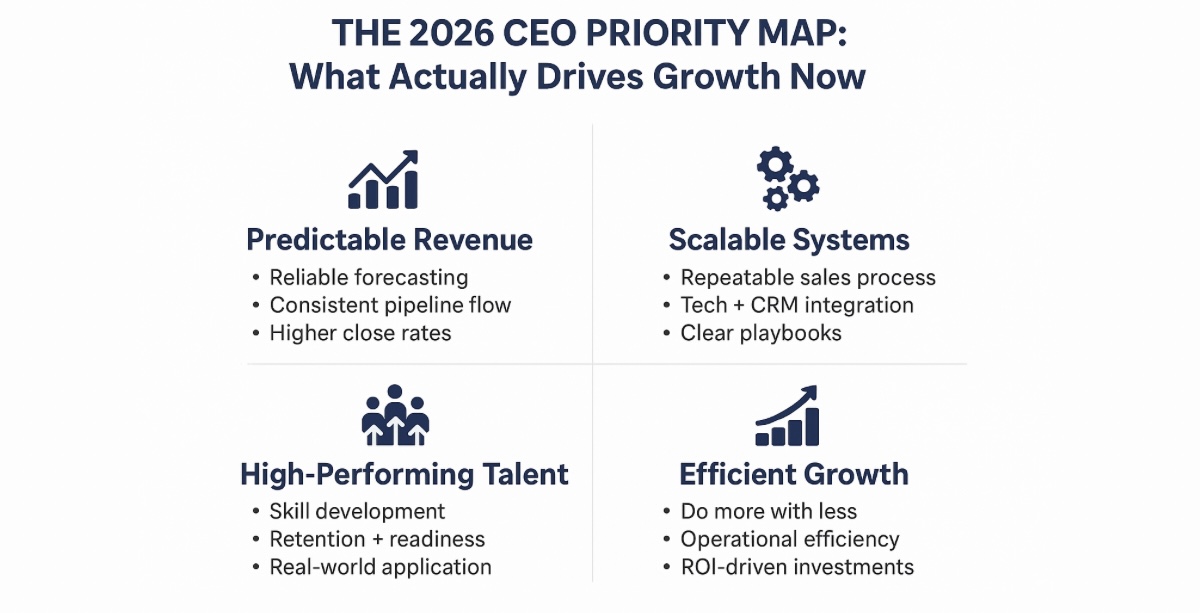
B2B CEOs entering 2026 are focused on:
Predictable revenue generation
Scalable systems and repeatable processes
Sales performance and pipeline execution
Leadership development and talent readiness
Measurable business outcomes and ROI
One-off seminars or workshops do not meet these requirements. Strategic, integrated initiatives that align people, process, and technology are essential for sustained success.
At The Ruby Group, we partner with executives to build high-performing sales organizations that deliver consistent results. Our approach ensures leaders and teams are equipped for the challenges of 2026, with measurable impact across revenue, pipeline, and team execution.
Contact us today to discuss how your organization can strengthen leadership capability, optimize sales performance, and achieve predictable, sustainable growth in the coming year.