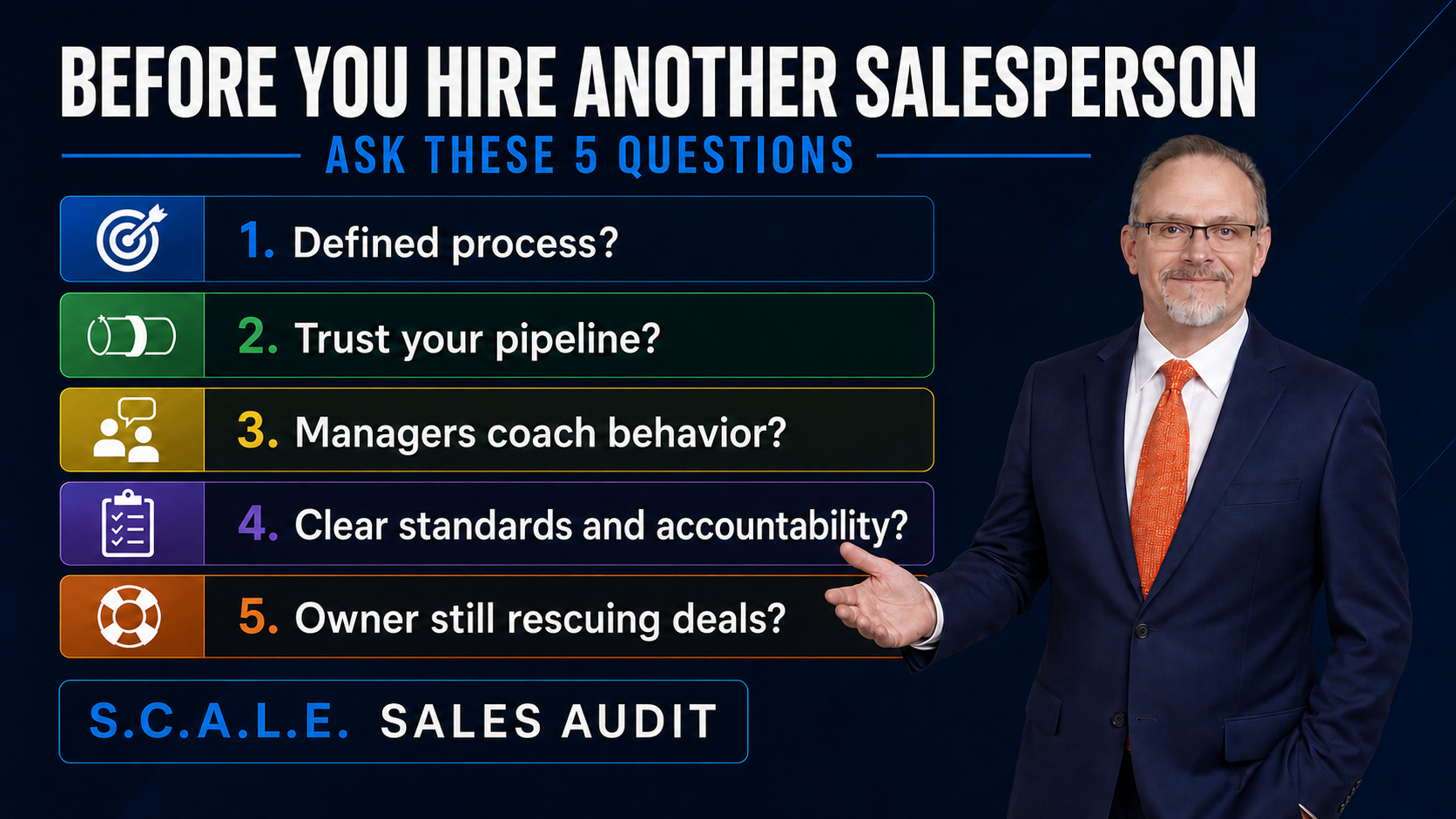
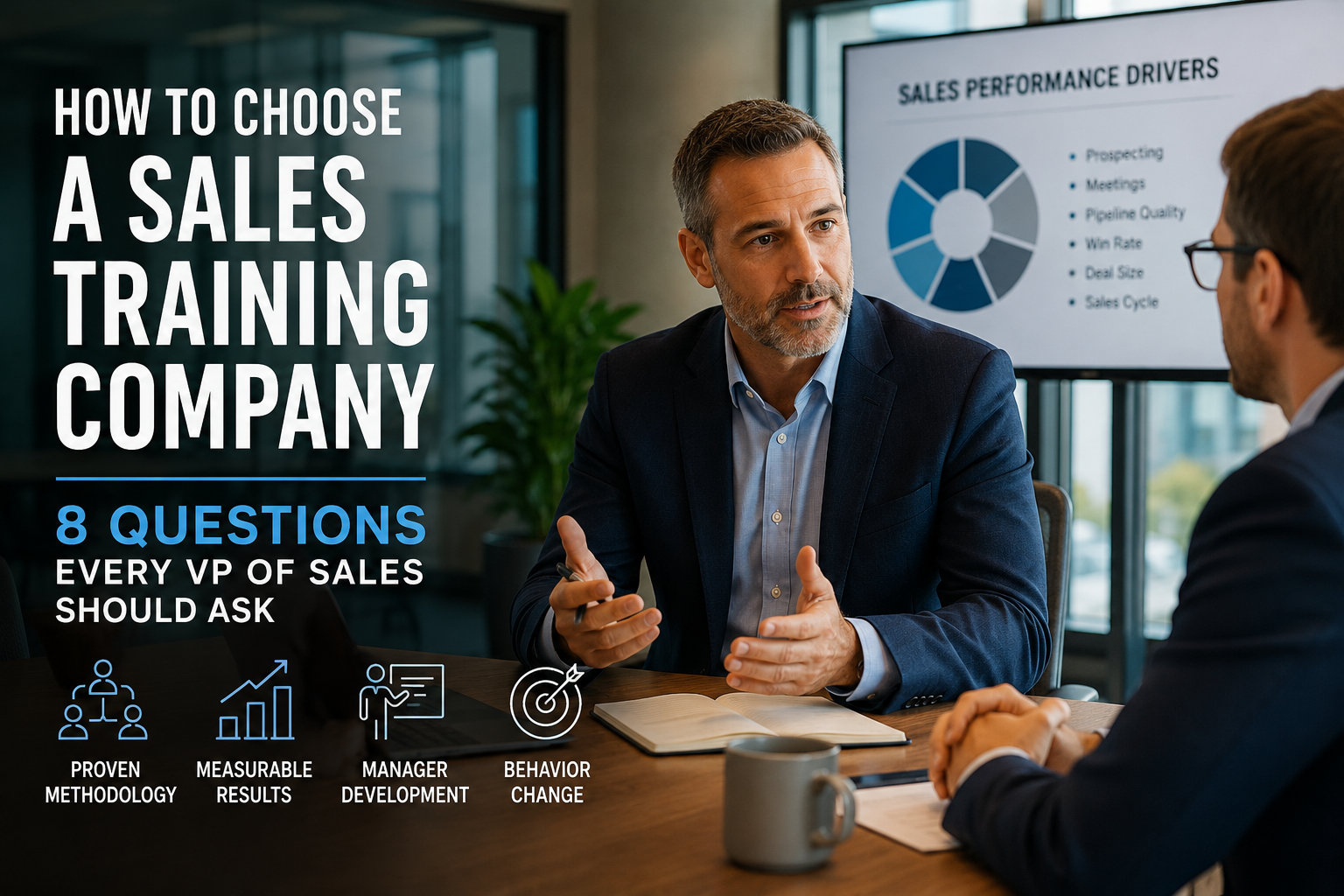
How to Choose a Sales Training Company: 8 Questions Every VP of Sales Should Ask
Choosing a sales training company can be harder than it looks.
Most firms can show you a polished curriculum. Many can teach prospecting, discovery, objection handling, negotiation, and closing. Some have well known methodologies. Others rely heavily on the individual trainer.
But if you are a VP of Sales, CRO, business owner, or sales leader, the real question is not whether the training sounds good.
The real question is:
Will this actually change the way our salespeople sell and the way our managers manage?
Because if your team attends training and goes back to doing the same things a few days later, very little has changed.
Before choosing a sales training company, here are eight questions worth asking.
1. What Business Problem Are We Actually Trying to Solve?
Start with the problem, not the training.
Instead of asking:
“What sales training programs do you offer?”
Start by asking:
“What needs to be different in our sales organization six or twelve months from now?”
Maybe your salespeople are not prospecting consistently.
Perhaps your pipeline looks healthy, but opportunities keep moving from one month to the next.
Maybe your team is giving proposals before prospects are properly qualified.
You may be seeing too much discounting.
Your sales managers may be spending most of their time solving problems instead of coaching.
Or perhaps every salesperson seems to have their own version of the sales process.
Those are different problems, and they may require different solutions.
A credible sales training company should spend time understanding what is happening before recommending a program.
If the solution appears before the diagnosis, that is worth questioning.
2. Does the Company Teach a Repeatable Sales Process?
Talented salespeople often develop their own way of selling.
That may work when you have a small team with a few strong producers.
It becomes more difficult when you are trying to build a scalable, predictable sales organization.
A strong sales methodology should give your team a common framework for moving an opportunity from the first conversation through qualification, decision, and close.
That process should address areas such as:
Prospecting
Building rapport and trust
Setting expectations for the sales conversation
Discovery
Identifying business problems
Understanding the impact of those problems
Discussing budget and resources
Understanding the decision process
Presenting solutions
Handling objections
Negotiating
Closing
Developing existing accounts
The methodology should also give sales managers a common language for coaching.
When everyone is working from the same process, it becomes easier to identify where deals are getting stuck and why.
3. How Will the Training Change Behavior?
This may be the most important question.
Most experienced salespeople already know they should prospect consistently.
They know they should ask better questions.
They know they should qualify opportunities.
They know they should listen more and talk less.
Knowing is usually not the biggest issue.
Doing it consistently is.
Ask the training company:
“What happens after the training session?”
Look for a development process that includes reinforcement, coaching, practice, role playing, accountability, application, and repetition.
One training session may introduce a new concept.
Changing a selling habit usually requires reinforcement over time.
The objective should not simply be to transfer information.
It should be to change behavior.
4. Who Is Actually Training Your Salespeople?
Before hiring a sales training company, find out who will actually be working with your team.
Ask about their real world experience.
Have they carried a quota?
Have they managed salespeople?
Have they been responsible for a sales forecast?
Have they hired and developed sales professionals?
Have they dealt with underperforming representatives?
Have they sold to senior executives?
Have they experienced the pressure of being responsible for revenue?
There is value in understanding sales theory.
There is also value in learning from someone who has experienced the situations your team deals with every day.
Salespeople usually recognize that difference quickly.
5. Will Your Sales Managers Be Part of the Process?
One of the biggest reasons sales training fails has very little to do with the salespeople.
It has to do with management.
Imagine sending your sales team through a new development program.
They learn a new methodology.
They begin using new terminology.
They are encouraged to change the way they qualify opportunities.
Then they return to managers who continue managing exactly as they did before.
How long will the new behavior last?
Probably not long.
If you want sales training to become part of the culture, managers need to know how to reinforce it.
That may include improving their ability to:
Coach salespeople
Conduct effective one on one meetings
Hold people accountable
Inspect pipeline quality
Identify skill gaps
Set clear expectations
Manage behavior and activity
Recruit effectively
Develop individual salespeople
Sales management development should not be an afterthought.
It should be part of the performance improvement strategy.
6. How Will We Measure Whether the Training Worked?
Before the program begins, decide how success will be measured.
Attendance should not be the primary measurement.
Neither should whether everyone enjoyed the class.
The more important question is whether sales performance improves.
Depending on your objectives, you might measure:
New opportunities created
Qualified pipeline
Prospecting activity
Meetings with decision makers
Conversion rates
Average deal size
Sales cycle length
Discounting
Closing ratios
Forecast accuracy
Revenue per salesperson
New account acquisition
Not every metric will improve immediately.
But the organization should agree on what progress looks like before the initiative starts.
Otherwise, months later, someone may ask:
“Did the sales training actually work?”
And nobody will have a clear answer.
7. Can the Training Be Applied to Our Real Sales Environment?
Your sales team does not operate inside a training manual.
They have real prospects, real competitors, real pricing pressure, real objections, and real deals sitting in the pipeline.
The training should connect the methodology to those situations.
Ask prospective providers:
Can our salespeople work through actual prospecting conversations?
Can they practice difficult discovery meetings?
Can managers discuss real opportunities from the pipeline?
Can the team work through the objections they hear every week?
Can the methodology adapt to our sales cycle, buyer, and market?
The objective is not to create an entirely different sales methodology for every organization.
The objective is to make the methodology relevant to the environment in which your people actually sell.
8. How Does the Sales Training Company Sell to You?
This may be one of the simplest ways to evaluate a sales training provider.
Pay attention to how they sell their own services.
Do they immediately begin explaining their programs?
Do they spend most of the conversation talking about their company?
Do they rush to send you a proposal?
Or do they slow the conversation down?
Do they ask thoughtful questions?
Do they try to understand what is happening inside your sales organization?
Do they explore why you are considering training now?
Do they ask what the current situation may be costing the business?
Do they understand what you have already tried?
Do they discuss what success would need to look like?
Do they explore how the decision will be made?
And perhaps most importantly, are they willing to determine that there may not be a fit?
If a company teaches consultative selling, you should experience consultative selling when they sell to you.
Does Your Sales Training Company Need to Be Local?
Not necessarily.
There can be advantages to working with a local provider, especially if you want in person coaching, onsite training, or someone who understands your regional business environment.
But location should not be the primary decision.
A better training partner who happens to be farther away may deliver significantly more value than a weaker provider located nearby.
The more important questions are:
Does the trainer understand your business?
Can they work effectively with your team?
Do they have a repeatable methodology?
Can they provide ongoing reinforcement?
Will they develop your managers as well as your salespeople?
Can they measure progress?
Can they challenge your organization when necessary?
The right fit matters more than the ZIP code.
One Question Every VP of Sales Should Ask
If you are interviewing several sales training companies, ask each one this question:
“If we work together for the next twelve months, what specifically should be different about the way my salespeople sell and the way my managers manage?”
Then listen carefully.
You are looking for more than a description of classes, curriculum, training hours, or online content.
You want to understand the transformation.
How will prospecting change?
How will discovery improve?
How will opportunities be qualified differently?
How will managers coach differently?
How will accountability change?
How will you know whether the organization is improving?
A strong answer should describe what will change inside your sales organization, not simply what training will be delivered.
Choosing the Right Sales Training Partner
The best sales training company for your organization may not be the one with the most entertaining trainer, the largest content library, or the most impressive presentation.
Look for a partner that can help create sustainable improvement in behavior, process, management, and results.
That means evaluating the methodology, reinforcement process, management development, coaching approach, measurement strategy, and the real world experience of the people who will be working with your team.
At Tridenza Authorized Sandler Training Center, we believe the process should begin with understanding the problem before discussing the solution.
Sales development should do more than teach techniques.
It should help create stronger sales conversations, better qualification, greater accountability, more effective sales management, and a repeatable process your team can actually use.
We work with sales leaders and organizations in Fort Lauderdale, South Florida, and beyond.
If you are considering sales training, the first conversation does not necessarily have to be about buying a training program.
It may simply begin with a better question:
What is preventing your sales organization from performing at the level you believe it should?
That is usually the better place to start.
Ready to Take a Closer Look at Your Sales Organization?
If you are wondering whether sales training is really the issue, it may make sense to start with a conversation.
We can look at what is happening in your sales organization, where opportunities may be getting lost, what your managers are seeing, and whether training, coaching, process improvement, or something else is the real priority.
There is no need to assume there is a fit.
The purpose of the conversation is simply to determine whether there is a problem worth solving and whether it makes sense to continue the discussion.
Schedule a Prospect Discovery Call with Tridenza Authorized Sandler Training Center.
https://info.tridenza.sandler.com/meetings/trabosh/prospect-discovery-call