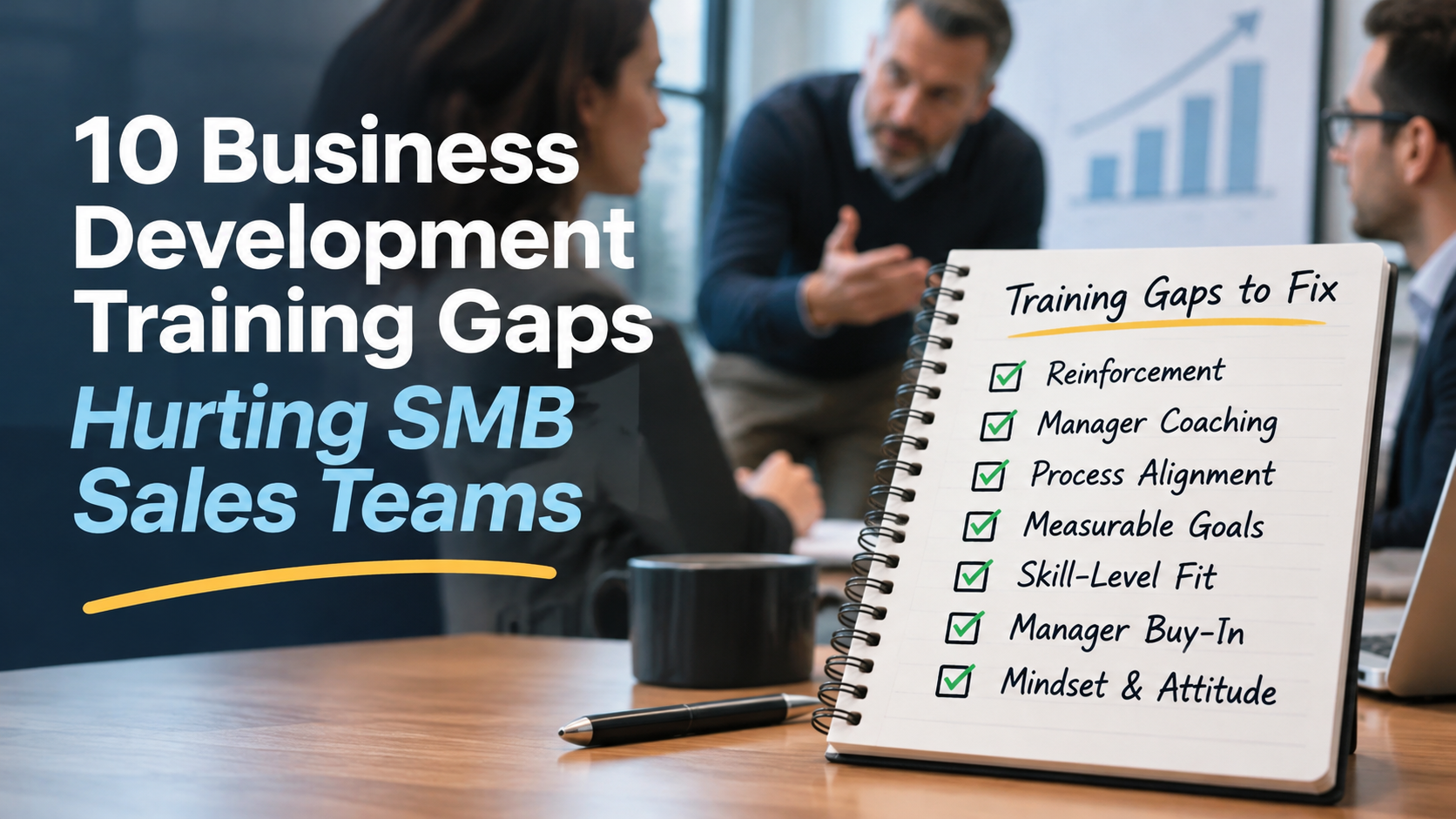
Your sales team completed training last quarter. They were engaged, took notes, and left motivated. But three months later, the same pipeline problems persist. PEAK Sales Performance helps SMB sales leaders diagnose exactly where business development training breaks down after the sessions end.
The gap between learning and execution is where most SMB training investments lose their impact. The list below identifies the most common implementation failures and walks you through practical fixes you can put in place this month.
Key Takeaways: Business Development Training Gaps for SMB Sales Teams
- Training that lacks ongoing reinforcement fades within weeks, wasting budget and momentum.
- Sales managers who cannot coach the methodology become the biggest bottleneck to adoption.
- Misalignment between training content and your actual sales process creates confusion on calls.
- PEAK Sales Performance addresses implementation gaps through structured coaching and accountability systems.
- Measuring behavior changes rather than attendance reveals the true return on your training investment.
Common Business Development Training Gaps in SMB Sales Teams
1. No Reinforcement Plan After Initial Training
A single workshop or seminar rarely produces lasting behavior change. Research from SBI's 2025 Modern Enablement Benchmarks Report found that most enablement teams still struggle with training sellers and sales managers effectively. Without a structured reinforcement cadence, reps revert to old habits within weeks.
Build a reinforcement rhythm into your calendar. Schedule weekly micro-sessions where reps practice one specific skill, then debrief real calls against that skill in your next coaching session. Short, consistent practice beats a single intensive event every time.
2. Sales Managers Who Cannot Coach the Methodology
Your managers may be exceptional closers, but closing skill does not automatically translate into coaching skill. Industry research shows that only about 39% of organizations have dedicated enablement programs for frontline managers. When managers lack coaching ability, training concepts die before they reach daily pipeline reviews.
Invest in sales leader development before rolling out rep-level training. Managers who can model, observe, and correct methodology in real-time conversations become the single most powerful reinforcement mechanism on your team.
3. Training Content Disconnected from Your Sales Process
If the language used in training does not match what reps see in your CRM stages, call frameworks, or team meetings, confusion follows quickly. Reps hear one set of terminology in the classroom and encounter a different set on the sales floor.
Align every training module directly to your documented sales process. Map each concept to the specific stage, activity, or metric it supports. When reps see the same vocabulary everywhere, from the training room to their pipeline dashboard, adoption accelerates.
4. Vague Training Objectives with No Measurable Outcomes
Goals like "improve selling skills" or "close more deals" are too broad to drive focused behavior change. Without specific, measurable targets, there is no way to determine whether training actually moved the needle on performance.
Define precise metrics before training begins. Targets such as reducing average discount percentage by five points, shortening sales cycle duration by a week, or increasing discovery-to-proposal conversion rates give you a clear benchmark for evaluating results.
5. Uniform Programs That Ignore Skill Levels
Grouping a ten-year veteran and a first-month hire into the same session dilutes the value for both. Veterans disengage because the content feels basic, and new reps feel overwhelmed by advanced concepts that require foundational context they have not yet built.
Use assessments to segment your team by skill level before assigning training paths. Tailor content depth and pacing to each group. Experienced reps benefit most from advanced scenario work, while newer team members need structured fundamentals first.
6. No Manager Buy-In from the Start
When sales leaders treat training as something the team "has to sit through," reps pick up on that signal immediately. An Inc. 2025 survey found that over 50% of fast-growing small businesses do not offer formal sales training at all.
Involve managers in selecting the curriculum, reviewing session agendas, and defining success criteria. When managers co-own the training initiative from day one, they are far more likely to reinforce it actively in their one-on-one meetings and deal reviews.
7. Failing to Address Attitude and Mindset Alongside Technique
Technique-only training misses two-thirds of the equation. Sales professionals also need to address the attitudes and behaviors that either support or sabotage their execution. A rep who has mastered a discovery framework but avoids prospecting calls due to call reluctance will still underperform.
PEAK Sales Performance builds training around the Sandler BAT framework, connecting behavior, attitude, and technique into one integrated system. This approach ensures that mindset barriers receive the same attention as tactical skill gaps, producing more durable results.
8. Lack of Structured Onboarding for New Hires
When every new rep receives a different version of "how we sell here," inconsistency becomes baked into your team. Ad-hoc onboarding creates knowledge gaps that compound over time, and each generation of hires drifts further from your intended sales process.
Build a standardized onboarding path that every new hire follows during their first 90 days. Include milestone checkpoints, skill-specific assessments, and paired coaching sessions so new reps ramp to productivity on a predictable timeline.
9. Ignoring the Connection Between Training and Hiring
Training cannot fix a hiring problem. If you are consistently bringing in reps who lack foundational sales instincts or coachability, no curriculum will close that gap. The right hiring decisions reduce the burden on your training program and accelerate results.
Integrate behavioral and skills-based assessments into your hiring process. Candidates who demonstrate coachability, resilience, and a structured approach to problem-solving are the ones who will benefit most from your development investment.
10. Measuring Attendance Instead of Behavior Change
Tracking who showed up tells you nothing about whether the training changed how your team sells. Many SMBs stop at completion metrics and never connect training activity to the revenue outcomes that matter to the leadership team.
Create a dashboard that tracks specific post-training behaviors. Monitor changes in discovery call quality, proposal-to-close ratios, and average deal size. When you tie training investment to observable results, you can refine your program based on what actually works.
How to Close Business Development Training Gaps at Your SMB
Every gap on this list shares a common root cause: treating training as an event rather than a system. Sustainable improvement requires ongoing reinforcement, capable coaching, clear metrics, and alignment between what reps learn and what they do every day.
PEAK Sales Performance partners with SMB sales leaders to build that system from the ground up. Through the Sandler Methodology, structured coaching, and continuous reinforcement, your team can turn training into repeatable sales behaviors.
Connect with us to see how a structured approach can address the specific training gaps holding your team back.
FAQs about SMB Business Development Training Gaps
What is the most common reason business development training fails at SMBs?
Lack of ongoing reinforcement after the initial training event causes most failures. Without regular practice, coaching, and accountability, reps lose new skills quickly and revert to previous habits.
How can sales managers improve training adoption on their teams?
Managers should participate in the training themselves, then reinforce specific concepts during weekly one-on-ones and deal reviews. When managers actively model and inspect new behaviors, reps adopt them faster.
Why do SMBs struggle more with training implementation than larger companies?
SMBs typically have smaller budgets, no dedicated learning and development staff, and reps who wear multiple hats. These constraints make it harder to dedicate time and resources to structured, ongoing training programs.
How does PEAK Sales Performance help SMBs address training gaps?
PEAK Sales Performance uses the Sandler Methodology to connect attitude, behavior, and technique into one system. Continuous reinforcement and coaching ensure that what your team learns in training becomes part of how they sell every day.
What metrics should I track to measure training effectiveness?
Focus on behavior-based metrics like discovery call completion rates, proposal-to-close ratios, average deal size changes, and sales cycle length. These indicators reveal whether training actually changed how your team operates.
How long does it take for sales training to produce measurable results?
With consistent reinforcement and coaching, most SMB teams start seeing measurable changes within 90 days. Durable, long-term behavior change typically requires six to twelve months of structured support and accountability.