
Athletes or politicians?
Some sellers win on skill. Others work the system, lobbying for better territories and grabbing accounts when a rep leaves. Their numbers can look fine for years while their skills stay weak.
Are your top performers winning on skill, or on territory and timing?
Athletes start with talent. They train and are coached until their skills hold up under pressure. At the elite level, skill development separates the podium from the pack. AI and call data make athletes easier to build than ever, as long as the people using the tools know what to look for.
🔷 What two Olympic swimmers teach sales leaders
Mark Spitz won seven gold medals at the 1972 Munich Olympics.
Canadian teenager Summer McIntosh won three golds and a silver at Paris 2024. Her times in shared events land within a few seconds of the world records Spitz set at a similar age.
Most of the difference comes down to how she trains.
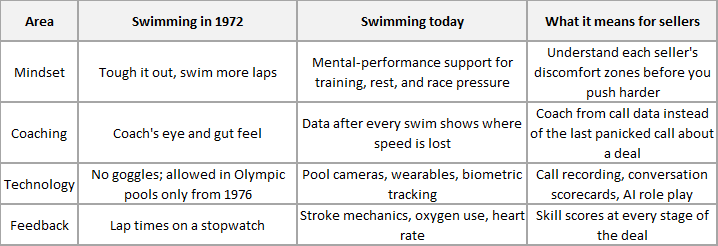
Is your sales team still training for a 1972 swim meet?
I learned sales the 1972 way.
My sales career started at AT&T. I'll never forget when my first sales boss dropped me at a Framingham office park with 100 business cards and told me to call from a pay phone when they were gone.
I made that call from the Framingham police station, picked up for unlawful solicitation with about 50 cards left.
That was training back then: take your lumps. Many teams still run a playbook of more calls and more grind. Effort counts, but it can't tell you which skill is breaking down.
🔷 Call data finds the gap your eyes miss
When a deal stalls late in the cycle, can you name the skill that broke down?
A client's mid-level seller had a pipeline full of deals that cleared discovery and then stalled. He scored high in both role play and early calls on setting an Upfront Contract, Sandler's technique for agreeing on time, purpose, agendas, and outcome.
In late-stage calls, his Upfront Contract average dropped to 1.93. The skill he knew best disappeared when he asked buyers to commit.
His DISC profile explained why. He leaned hard toward keeping people comfortable, and conflict topped his discomfort list. A late-stage Upfront Contract can surface a "no," so he skipped it, and his call prep left it out too. The data found the gap. Closing it took a coach.
🔷 Technology finds the problem, and a leader fixes it
Scorecarding tools grade recorded calls against your methodology, whether that's Sandler or another process. AI role-play agents let sellers practice against an AI buyer and are scored. Compare role-play scores with real call scores, and see whether a skill survives contact with a buyer.
Your team records every call. Who reviews them, and what changes as a result?
The data flags where a seller struggles. A leader still has to figure out why and coach the seller through the discomfort. Few sales leaders signed up to play part-time psychologist. The best ones do it anyway.
🔷 How to start building sales athletes
How much of your coaching comes from data, and how much from the last deal that went sideways? Shift the balance with these steps.
- Audit your tech. Make sure call recording and scoring tools reflect your process and methodology.
- Commit to one methodology. Build it into coaching, pipeline reviews, and leadership meetings.
- Define the skills you want. Spell out how sellers open calls, diagnose problems, and ask for commitment.
- Learn what drives each seller. Know their natural tendencies and discomfort zones.
- Benchmark on day one. Score skills with role plays or call recordings when someone starts.
- Tie skills to outcomes. Connect skill scores to stage conversion and win rates.
🔷 Frequently asked questions
What is sales skills development? The ongoing training, coaching, and measurement of how well sellers execute specific behaviors in real customer conversations, tracked over time.
How can AI help with sales coaching? AI scores recorded calls against your methodology, spots patterns across many conversations, and lets sellers practice with AI role-play agents. Managers get specific coaching targets instead of guesses.
Can AI replace a sales manager or coach? No. AI shows where skills break down. A manager or coach still has to understand why and help the seller practice until the behavior holds up with real buyers.
Why do sellers skip techniques they already know? Usually because the technique feels uncomfortable in the moment. Behavioral assessments such as DISC help leaders spot those patterns.
Where can Boston companies get data-driven sales coaching? Sandler by Praxis Growth Advisors, led by Eric Warner, works with Massachusetts sales teams by combining the Sandler methodology, behavioral assessments, and call-based skill measurement.
Build a team of sales athletes
Eric Warner and Sandler by Praxis Growth Advisors help Boston-area CEOs and sales leaders benchmark their sellers, coach to real skill gaps, and measure what changes in customer conversations.
See what working with Praxis looks like