We sat down with advisors and practice principals for the Financial Advisors Growth Playbook, and the words kept changing but the story didn't. "We build the whole plan, present it, and never hear back." "I know I should be asking for introductions. I've known that for fifteen years." "The paperwork always seems to win the morning, and the calls I need to make are the ones that get pushed."
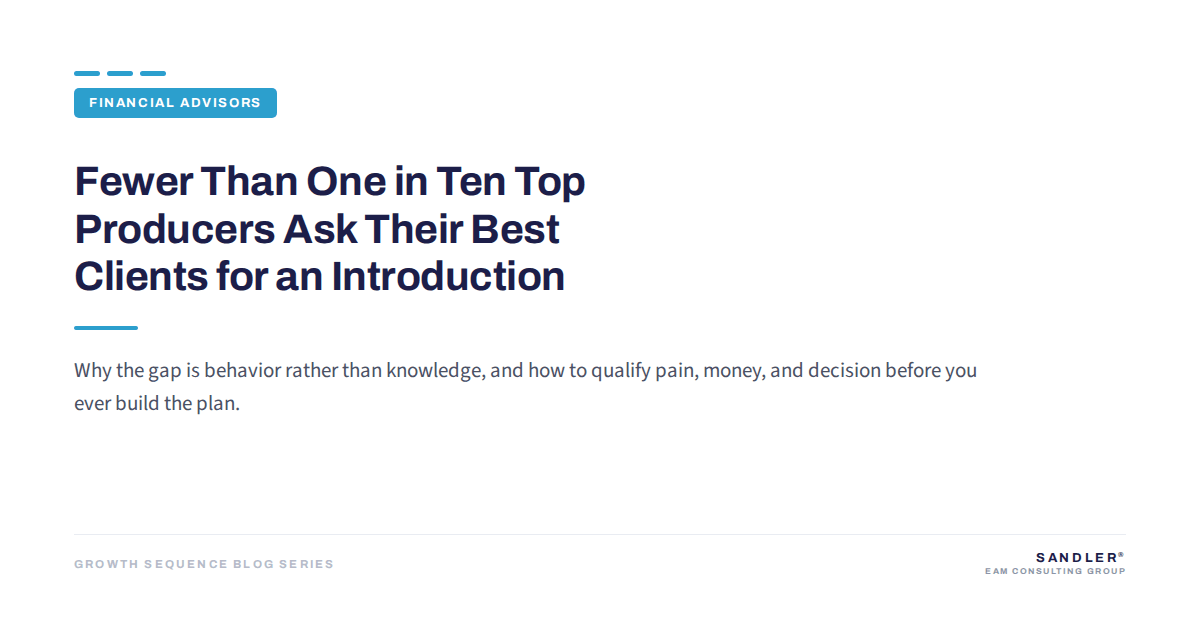
The numbers are blunt about this. Fewer than 10% of top producers actually receive referrals from their best clients. Under 30% have a referral process at all, and under 18% follow it most of the time. Almost every advisor already knows they should ask. The gap isn't knowledge, it's behavior, and it usually traces back to a fear of hearing no that is stronger than the habit of asking.
The damage from standing still isn't one lost case. It's spread across the whole practice, hidden behind a calendar that looks productive. Full case designs get built and presented for prospects who were never going to fund, which is unpaid work you'll never recover. Introductions never get asked for, from clients who would almost always have said yes. The old employer plan, the outside brokerage account, and the coverage nobody has reviewed since the kids were born all sit somewhere else, held away from a household that already trusts you. And roughly 30% of the average day disappears into activity that will never produce income.
The fix isn't a better illustration. It's three shifts. First, qualify before you build the plan. Three things have to be clear: the pain, meaning the gap between where they are and where they need to be and whether they actually feel it; the money, meaning what they're willing and able to invest and what's genuinely available to move; and the decision, meaning who's in the room, by when, against what criteria. A spouse you've never met is a decision maker you haven't qualified. No green light on all three means no plan.
Second, ask on a schedule, and structure the ask. Most advisors ask badly and then conclude that asking doesn't work. Stop requesting referrals and start a conversation with an up-front contract instead: "If you'd be open to it, I'd like to spend a couple of minutes brainstorming about people in your circle who could benefit from talking with me. If you'd rather not, I completely understand." That framing removes the pressure that makes both people uncomfortable, and it turns a vague request into a working session.
Third, protect pay time. Every activity either contributes directly to income or it doesn't. Paperwork, case design, meeting prep, and administrative work are all essential, and none of them are pay time. When they crowd out prospecting, asking for introductions, and meeting new households, they stop being work and start being a comfortable place to hide. Schedule the no pay time activities around pay time, never through it. Sandler frames lasting success as a triangle of behavior, attitude, and technique: do the activity, believe you belong in the room, and use a proven approach when you get there.
None of this asks a thoughtful, client-focused advisor to become a closer. It asks for one habit at a time. The advisor who keeps building plans on spec and hoping introductions arrive on their own is running a practice on hope. The advisor who qualifies first, asks with structure, and defends the calendar stops needing a good quarter to make the year.
Every plan your practice built for free last quarter didn't just cost a case design. It came out of the same hours you needed for the households that would have funded, and those hours don't come back.