
Every year, sales leaders sit down to establish new revenue targets.
Maybe the business needs 10% growth. Maybe investors expect 15%. Maybe the number is based on last year's performance plus an ambitious increase.
Leadership announces the target. The sales team acknowledges it. Everyone returns to their territory, pipeline, and prospecting activities.
But there's a question that often goes unasked.
What does that number mean to the person responsible for achieving it?
A Company Goal Isn't Automatically a Personal Goal
Your business might need another $2 million in revenue. Your salesperson might be thinking about buying a home, paying down debt, or advancing into management.
Those priorities aren't necessarily in conflict. But the connection between them isn't always obvious.
When leaders assume that compensation or quota attainment motivates everyone equally, they miss an opportunity to understand what actually drives individual performance.
One salesperson may be motivated by financial independence. Another may value professional development. Someone else may be working toward greater flexibility for their family.
The number matters to the business. The reason behind the number matters to the individual.
Where Sandler's Success Triangle Comes In
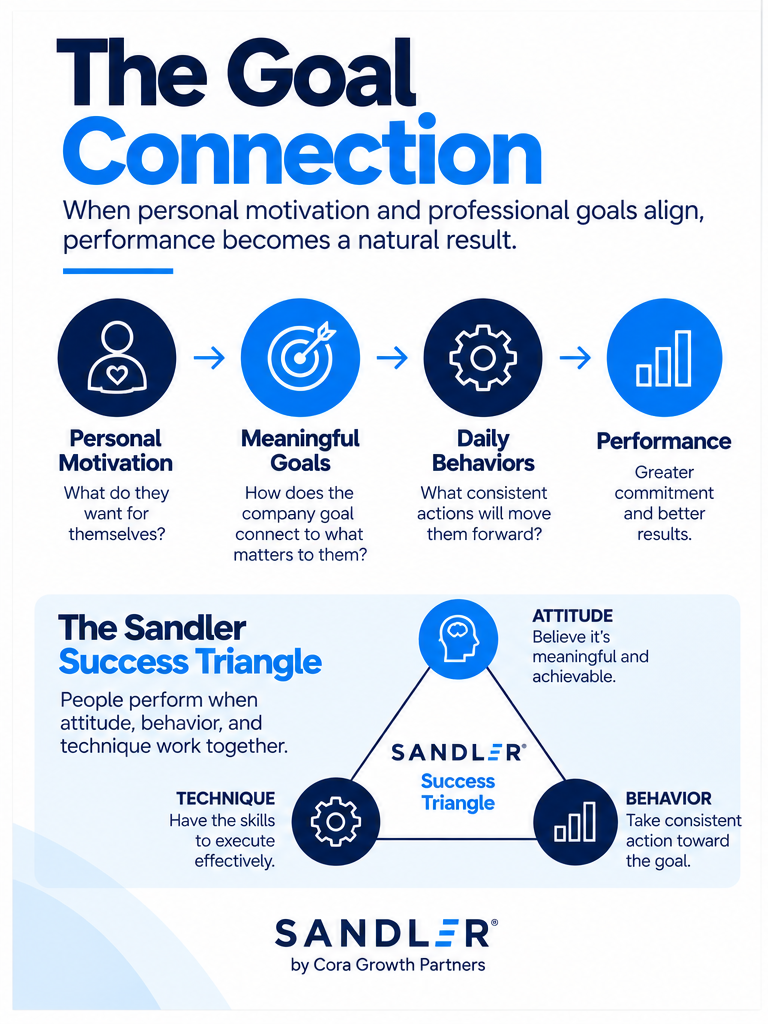
In Sandler, we teach that success depends on three interconnected elements: Attitude, Behavior, and Technique.
Attitude: Does the salesperson believe their goals are meaningful and achievable?
Behavior: Are they consistently performing the activities required to make progress?
Technique: Do they have the skills to execute those activities effectively?
Personal motivation can influence attitude, but motivation alone doesn't produce revenue.
A salesperson who wants to buy a home still needs to prospect, conduct meaningful discovery conversations, qualify opportunities, and advance business.
That's where coaching becomes critical.
Start With a Different Conversation
Rather than beginning every goal-setting discussion with quota attainment, try asking:
What would you like to accomplish personally over the next year?
What would achieving your professional goals make possible?
What might get in the way?
Which behaviors are within your control?
How can I support you in making progress?
These questions invite employees to connect their work with their own priorities. They also give managers a foundation for more relevant coaching conversations.
Of course, employees should be free to decide how much personal information they share.
Give the Number Meaning
Revenue targets provide direction. Personal goals can provide motivation. Consistent behaviors, supported by effective coaching, create the path forward.
As I often say:
“A percentage isn't a reason to get out of bed in the morning.”
The next time you review your team's sales goals, ask yourself whether you're discussing numbers people are accountable for or goals they genuinely want to pursue.
The best coaching conversations make room for both.
Book a conversation with Heather.
Related reading: Coaching vs. Managing: What Do Your Sales Reps Really Need? and The #1 Reason Most Pipeline Meetings Fail