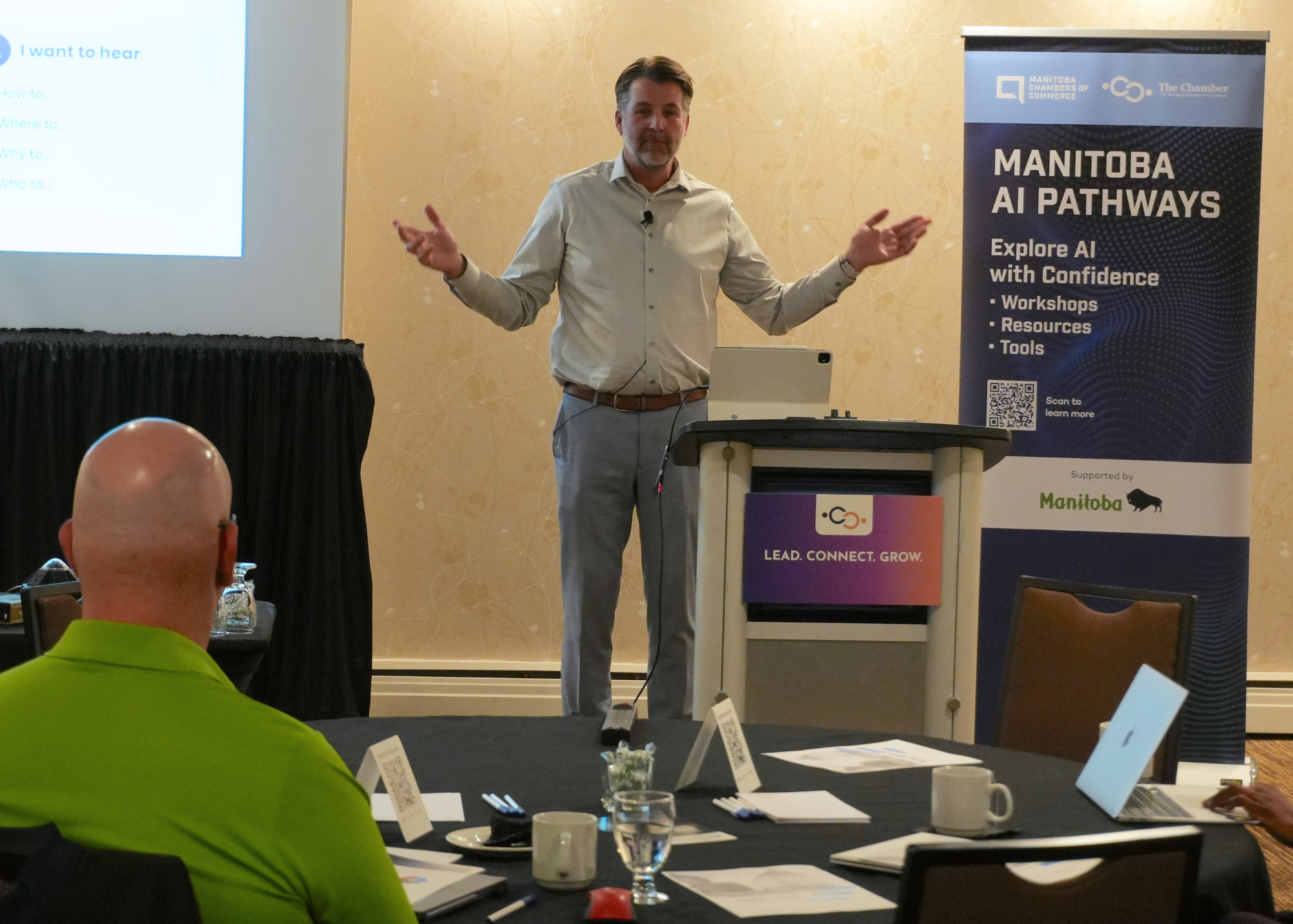
Most sales leaders I talk to aren't asking whether to use AI anymore. They're using it in a variety of ways. They know it can produce content at an incredible pace and they're aware that not everything it produces is golden. Many questions remain about how it should be used and how it will affect the sales profession.
I'll take a hard stance on this one, and I'm going to deliver the bad news: AI can't do your sales job.
It can help you be better at sales, but it can't replace you, and it is here to challenge you to be even better than you are today. Only people understand trust, and people will continue to buy from people they trust. Therefore, salespeople need to keep getting better at delivering trust and at demonstrating that sales is an honourable profession, one with skills, one with ethics, one with drive and one with people.
Start with the Success Triangle
At Sandler, every lasting improvement in sales comes back to three things: Behaviour, Attitude and Technique. AI doesn't change that recipe. It just gives you new ingredients.
Behaviour. Most salespeople know what they should be doing. The gap is doing it consistently. AI is excellent at crunching data and measuring the activities in your cookbook. You can even set it up to keep you on track and give you reminders, week after week, month after month.
Attitude. Curiosity beats fear when you’re starting with AI tools, and only people can help you build a mindset of possibility. Your attitude is uniquely human, and AI isn’t a coach or a mentor.
Technique. Sales training gives people the techniques to be successful, and AI can play a role in helping you master the right ones. Feed the tool the definition of a strong Up-Front Contract, and it can evaluate you, help you rehearse for real conversations, review your performance, identify where you need to ask better questions, and much more.
Five places AI pulls its weight in sales
We spent most of the morning defining the problem, so some of the tools I shared deserve a bit more airtime here.
- Research. Walk into every first meeting knowing the company, the industry, the likely pain and the people who make and influence decisions, and find all of it in minutes instead of hours. I use the AI tools inside ZoomInfo and HubSpot, where my data lives. I ask HubSpot's Breeze Assistant what I've done with a client in the past, what I know about them and what I still need to learn. I use ZoomInfo's AI to watch for buyer signals and to give me insights on recent activity within the account. That research lets me target specific people for a conversation, which I open using the third-party story format of the 30-Second Commercial. Claude, ZoomInfo and other tools can then summarize the challenges a particular company may be facing and prime me to deliver that 30-Second Commercial.
- Copywriting. Obviously, it can draft emails, follow-ups and LinkedIn posts that you then make sound like you. I find the real value comes when I feed Claude a strong 30-Second Commercial and let it suggest improvements or variations for different clients and industries. I take what I like and deliver it in person to a prospect. It gives me ideas and reminds me to use past pains as insights with new clients.
- Recording what you learn about your client. Capture what was said in a sales conversation so nothing important lives only in someone's memory. Our tool is Fathom. It's linked to my HubSpot CRM, and it records and transcribes my calls so that specific qualification fields are populated. For instance, when we have the budget discussion and I share an "Investment Range," that data is stored in the appropriate budget field. This tells me how far my client and I have gone in our budget discussion and shows me what I still need to learn.
- Assessment. Review calls and pipeline against your process, and spot where deals really stall. Whether you're doing a cold assessment to evaluate the skills of a salesperson you're hiring, or recording calls for a coaching session to help a team member grow, comparing the potential conversation with the actual one shows which skills your team member is truly great at and which ones they still need to develop.
- Role-play. Rehearse the tough conversation before it happens. Practise the Up-Front Contract, the pain questions and the budget talk as often as you like. If your brain never hears you say something, you're not likely to say it when the pressure is on in the real world. AI bots like our Sandler AI Roleplay coach help you practise your sales process and skills so you can build on what you do in real life.
None of these replace the salesperson. They give the salesperson more time and better preparation for the part that matters most, which is the conversation.
What are your principles?
I also proposed that AI is likely to create some chaos in our world, and that every leader and professional should identify their own guidelines for where it belongs and where it’s likely to damage their business. I encouraged each person to build their own principles, and I shared mine:
- Always represent your brand to your absolute best ability.
- Always improve the experience for people.
- Never take a shortcut that has long-term costs.
- Challenge yourself, and challenge your people.
If an AI tool passes those four tests, use it. If it doesn't, the time it saves isn't worth it.
Your next step
Pick one of the five uses above and try it with your team this month. Just one. Measure it, talk about what worked, then add the next.
If you'd like help building AI into your sales process the Sandler way, or want to bring this workshop to your team, reach out at go.sandler.com/ask. The wind is in our favour. Let's raise some sales.
Clint Unrau, Anchor Sales Knowledge, Sandler Training, Winnipeg
Photo credit: The Winnipeg Chamber of Commerce