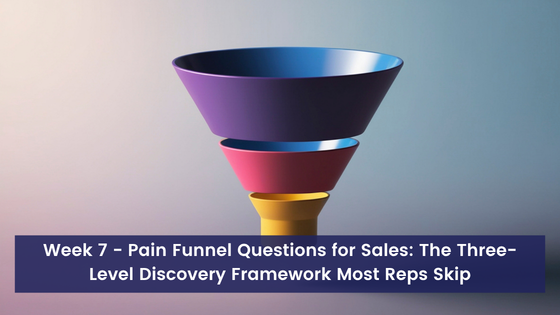
The best B2B sales reps ask pain funnel questions the average rep never thinks to ask. When a prospect mentions a problem, they don't pivot to their solution. They slow down, get curious, and go three levels deep before they move the conversation anywhere else. That single discipline, more than talent or personality, is what separates top performers from everyone else.
Four words do most of the work: “Tell me more about that.”
The willingness to ask them, and to actually listen to the answer, separates good salespeople from great ones more than almost anything else.
I've listened to a lot of sales calls over the years. Across different industries, different company sizes, and reps at every experience level, the pattern holds. The best ones aren't better closers. They're not more charming. They're not smoother. They're just willing to go deeper when the prospect hands them an opening.
Why Most B2B Sales Reps Skip the Pain Funnel Questions
Here's the moment I'm talking about. A VP of Sales at a Fort Worth packaging company tells you: “We've had a hard time keeping our sales team accountable.”
A typical rep hears that as an open door and walks right through it. They share a case study. They ask a product question. They start solving a problem they haven't actually understood yet.
What they almost never do is stay in the problem.
What does that look like for you specifically? How long has that been going on? What have you tried to fix it? What happens if it doesn't change?
Those questions aren't complicated. But most reps don't ask them. And there are real reasons why.
Some reps are afraid of silence. Sitting in a hard moment with a prospect feels uncomfortable, so they fill the space with words and energy.
Some reps listen to respond instead of listening to understand. While the prospect is still talking, they're already preparing their next point.
Some reps think they already know the answer. After selling the same thing for a few years, pattern recognition kicks in. They hear a familiar problem and assume they understand it. But understanding the category of a problem and understanding this person's specific version of it are two completely different things.
And some reps are afraid of being too direct. They confuse persistent curiosity with pressure, so they soften every question until the conversation stays comfortable and shallow.
None of those instincts are malicious. But all of them produce the same result: a conversation that stays on the surface, where the real pain never gets uncovered and the real opportunity never gets found.
Objective Management Group has assessed more than two million salespeople, and the pattern is consistent: “Qualifying” ranks near the bottom of the 21 core sales competencies OMG measures across the population. This isn't a talent problem. It's a discipline problem.
The Three-Level Pain Funnel Framework for B2B Sales Discovery
Here's the framework I teach. It's a practitioner's version of what Sandler calls the Pain Funnel, the discovery discipline that anchors our methodology and has held up for four decades because human buying behavior hasn't changed. When a prospect mentions a problem, a frustration, or a challenge, don't move on until you've gone three levels deep.
Level One: What is it?
Get specific. “Tell me more about that.” or “What does that look like in practice?” You're moving from the general to the particular. From the category to the actual experience.
Level Two: What does it cost?
Now you're getting to impact. “What happens when that goes wrong?” or “Is there a financial impact to that?” or “How does that affect the rest of the team?” This is where the problem gets weight. Where it stops being an issue and starts being a real business pain.
Level Three: What's at stake?
This is the deepest level and the one most reps never reach. “How long has this been a problem?” or “What have you tried already?” or “If this isn't solved in the next year, what does that mean for you?” This is where urgency lives. Where you understand whether solving this problem actually matters to this person.
Most salespeople operate at level one. Some get to level two. Very few make it to level three consistently. But that's exactly where the deals are.
What Changes When You Go Deeper
When you actually reach the third level of a prospect's problem, a few things shift.
The prospect starts trusting you more. Not because you said something impressive, but because you cared enough to understand. Most vendors they talk to are already thinking about their solution before they've heard the actual problem. When you do something different, they notice.
You start qualifying more accurately. Surface-level problems are easy to dress up as urgent. When you understand the real impact and the real timeline, you know whether this is a deal worth pursuing.
Your proposals get more specific. When you truly understand what someone is dealing with, your solution sounds different. Instead of presenting what you offer, you're connecting it to what they've already told you they need. That's a completely different conversation.
And your close rates go up. Not because you got better at closing, but because you got better at discovery. The close is just the natural conclusion of a well-run conversation.
Where This Gets Complicated
Here's what this advice oversimplifies, and what a CRO with fifteen years in the seat will push back on.
Not every buyer will play. Procurement-trained buyers in financial services and large professional services firms are specifically coached to deflect pain funnel questions. They give short, surface-level answers and route the conversation back to specs and price. Going three levels deep with them requires different tradecraft than it does with an owner-operator at a DFW manufacturing shop. With the sophisticated buyer, you earn permission before you probe. You share a relevant observation, wait for them to validate or correct you, and only then ask a deeper question. Same framework, completely different cadence.
Your comp plan may be working against you. If your reps are measured primarily on activity metrics like calls made, demos booked, or pipeline volume, you're paying them to move fast, not deep. The sales manager who tells reps to “slow down and get curious” is fighting the incentive structure every Monday morning. Real change on discovery discipline requires looking at the comp plan honestly, not just the coaching.
Three levels isn't a script. Some reps read advice like this and turn the Pain Funnel into an interrogation. The skill isn't in the questions. It's in the pacing, the room-reading, and the willingness to share something of your own between questions so the conversation feels like a dialogue rather than a deposition. That's why coaching beats training on this particular competency. You can teach a framework in a day. Building the instinct to use it well takes roughly 90 days of real-time coaching on live calls.
None of this means the three-level approach doesn't work. It means it's a discipline, not a trick. And disciplines take infrastructure to build.
One Thing to Try This Week
Before your next discovery call, write down three things you genuinely need to learn about this prospect's situation. Not things you want to tell them. Things you don't know yet and need to understand before you can help them.
Then go into the call committed to not moving forward until you've gone at least two levels deep on anything significant they share.
You'll feel uncomfortable at first. That's how you know you're doing it right.
The reps who ask the questions others are afraid to ask close more deals, at higher values, in shorter cycles. Not because they're more aggressive. Because they know more. And when you know more than your competition about what a buyer is actually dealing with, you become very difficult to lose to.
FAQs
What are the best pain funnel questions for B2B sales discovery calls?
The strongest pain funnel questions move from the surface problem to business impact to personal stake. Start with “Tell me more about that” or “What does that look like in practice?” Then move to impact: “What happens when that goes wrong?” Then to stakes: “If this isn't solved in the next year, what does that mean for you?” The sequence matters more than the exact wording.
How do I train my sales reps to use pain funnel questions in B2B sales without sounding like an interrogation?
The skill is pacing, not scripting. Train reps to earn permission before going deeper (“Can I ask you a harder question about that?”) and to share their own reactions between questions so the conversation feels like a dialogue, not a deposition. Most sales teams in DFW we work with need about 90 days of real-time coaching before this feels natural on live calls.
How is the Sandler Pain Funnel different from other B2B sales discovery frameworks?
Most discovery frameworks focus on information gathering. The Sandler Pain Funnel is designed to uncover business pain, financial impact, and personal stake, in that order. That sequence is what separates it from frameworks like SPIN or MEDDIC, which are structured for different outcomes. The Pain Funnel is specifically designed to find out whether the prospect has real, fundable pain before you invest time building a proposal.