
Is Your Sales Comp Plan Driving the Wrong Behavior?
If your sales team keeps discounting, chasing small deals, or ignoring expansion revenue, the problem probably is not motivation. It is your comp plan. Most sales compensation structures reward behaviors the business has outgrown, and until you fix the system, no amount of coaching or kickoff speeches will change what your reps actually do. The question every B2B business owner and VP of Sales in Dallas-Fort Worth should be asking right now is whether your sales comp plan is driving the wrong behavior.
Why Your Comp Plan Stops Working (Even When Nothing Looks Broken)
Here is how it usually plays out. A comp plan gets built at a specific moment in time, for a specific version of the business. It makes sense when it is designed. Then the business evolves. New priorities emerge. A different segment becomes more important. Profitability starts mattering more than volume. The company tries to move upmarket.
But nobody touches the comp plan.
So now you have a leadership team talking about moving upmarket while the comp plan pays the same on a $15K deal as it does on a $150K deal. You have leaders preaching margin discipline while reps get paid on revenue regardless of what they discounted to get it. You have a CEO asking why the team keeps hunting small, discounting heavily, and chasing the wrong customers.
The reps are not confused. They are doing exactly what you are rewarding them for. That is the core of the problem when a sales comp plan is driving the wrong behavior: the plan itself has become the obstacle.
Five Signs Your Sales Comp Plan Is Driving the Wrong Behavior
In Sandler, we teach that people make decisions based on their own self-interest, and that is not a flaw. It is human nature. Your comp plan is the single clearest signal your reps receive about what you actually value. Not what you say in meetings. What you pay for.
This is not just a Sandler principle. According to the Alexander Group, only 21% of companies report satisfaction with their current sales compensation plans. And Forrester research shows that just 47% of B2B sales reps hit quota on average, a number that points directly to systemic misalignment between how reps are paid and what the business needs them to do.
Here are the five areas where comp plans most commonly break down.
One: It rewards the wrong revenue.
Not just any closed deal. The right deals, from the right segments, at the right margins. If you want your team focused on enterprise accounts or a specific vertical like manufacturing or packaging, your plan needs to make those deals more attractive than small, easy ones. Money talks louder than any kickoff presentation ever will.
Two: It requires constant management to drive the right activity.
The best comp plan naturally pulls reps toward the behaviors you want, so you are not reminding them every Monday. If you are constantly pushing a priority that the comp plan does not reward, that is a design flaw, not a motivation problem. In Sandler, we call this the difference between managing behavior and managing the system that produces the behavior.
Three: It creates incentives to hold or time deals.
Reps are smart. If your plan creates any incentive to hold a deal, slow-walk a Q4 opportunity into Q1, or stack closings around an accelerator period, they will figure it out. A well-designed plan makes closing early always better than waiting. No ambiguity.
Four: It ignores expansion revenue.
New logos get all the attention. But expansion revenue is often your highest-margin revenue, sitting inside accounts you have already won. If your reps have no financial reason to grow existing customers or support renewals, you have designed that indifference into your business. This is especially common in professional services and tech-enabled services companies across DFW where the real profit sits in account growth, not acquisition.
Five: It does not account for profitability.
If a rep can discount down to the floor and still earn a full commission, you have created a margin problem by accident. Comp plans that do not factor in deal profitability produce a lot of revenue and not enough profit. Eventually, that catches up with you.
Where This Gets Complicated
If the fix were as simple as rewriting the comp plan over a weekend, every company would have one that works. The reality is harder. Here is what makes this genuinely difficult to solve in practice.
Mid-cycle changes destabilize teams. Any VP of Sales or CRO with experience knows that changing comp mid-year can erode trust fast. Reps plan their lives around their expected earnings. If you shift the structure without enough lead time or a clear transition mechanism, you risk losing your best people, exactly the ones with options.
Comp design is rarely a solo decision. In most organizations, finance, HR, and the executive team all have input. In PE-backed companies, the board may dictate comp structure entirely. The sales leader who sees the misalignment may not have the authority to fix it without building internal consensus, and that takes time and political capital.
Legacy structures create entitlement expectations. If reps have been earning under a certain model for years, any change feels like a takeaway, even if the new plan is objectively better for high performers. This is the part that most compensation articles skip: the behavioral and emotional friction of changing what people are used to.
None of this means you should avoid fixing the problem. It means you should plan the transition as carefully as you plan the new structure. The comp plan redesign is a change management project, not just a spreadsheet exercise.
Comp Plan Alignment Scorecard
Use this diagnostic to pressure-test whether your current comp plan is aligned with your business strategy. If you mark three or more as "No" or "Not Sure," your comp plan is likely driving the wrong behavior.
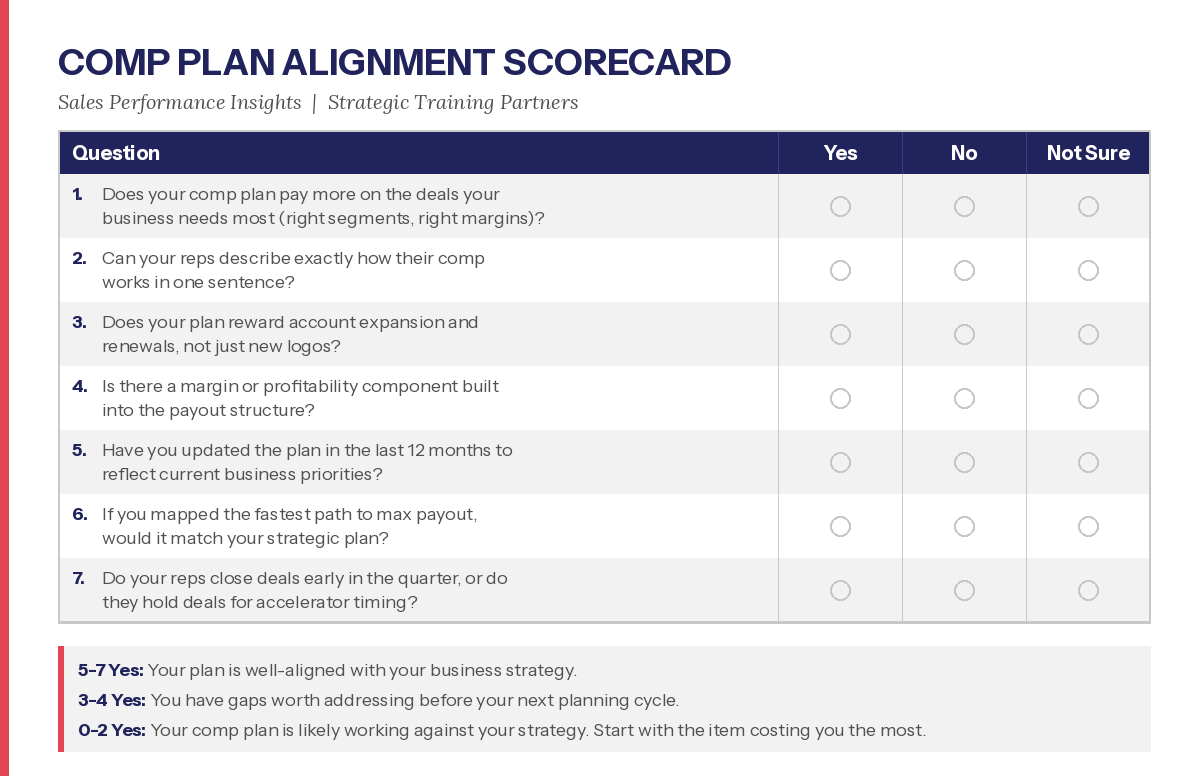
Score your comp plan in 2 minutes. If three or more answers land on "No" or "Not Sure," your plan is likely rewarding behaviors your business has outgrown. Start with the gap that is costing you the most.
Frequently Asked Questions About Sales Comp Plan Alignment
How do I know if my sales comp plan is driving the wrong behavior?
The clearest sign is when your reps are doing rational things that conflict with your business priorities. If your team discounts heavily, avoids larger deals, or ignores renewals, look at the comp plan first. The behavior your plan rewards is the behavior you will get.
How often should a B2B company review its sales compensation plan?
At minimum, annually. But any time your business strategy shifts, whether you are moving upmarket, entering a new vertical, or changing your margin targets, the comp plan should be reviewed alongside it. The Alexander Group recommends annual reviews, and companies that do them consistently report stronger alignment between sales activity and business outcomes.
Can a sales comp plan actually improve close rates and pipeline quality?
Yes, if it is designed to reward the right behaviors. A Sandler-aligned approach ties comp to the full sales process, not just the close. When reps are incentivized to qualify properly, uncover real pain using tools like the Pain Funnel, and pursue deals that fit your ICP, your close rate and deal quality both improve. Compensation is the system that reinforces the process.
If your comp plan and your strategy are pointing in different directions, that is a conversation worth having before your next planning cycle. Frank Gustafson works with B2B sales leaders across Dallas-Fort Worth who want their compensation structures to reinforce the right behaviors, not reward the wrong ones. Book a conversation: meetwithfrank.com | 817-771-1313 | frank.gustafson@sandler.com |
#SandlerDFW #StrategicTrainingPartners #SalesPerformanceInsights #SalesCompensation #SalesLeadership #B2BSales #SalesManagement #CompPlan