
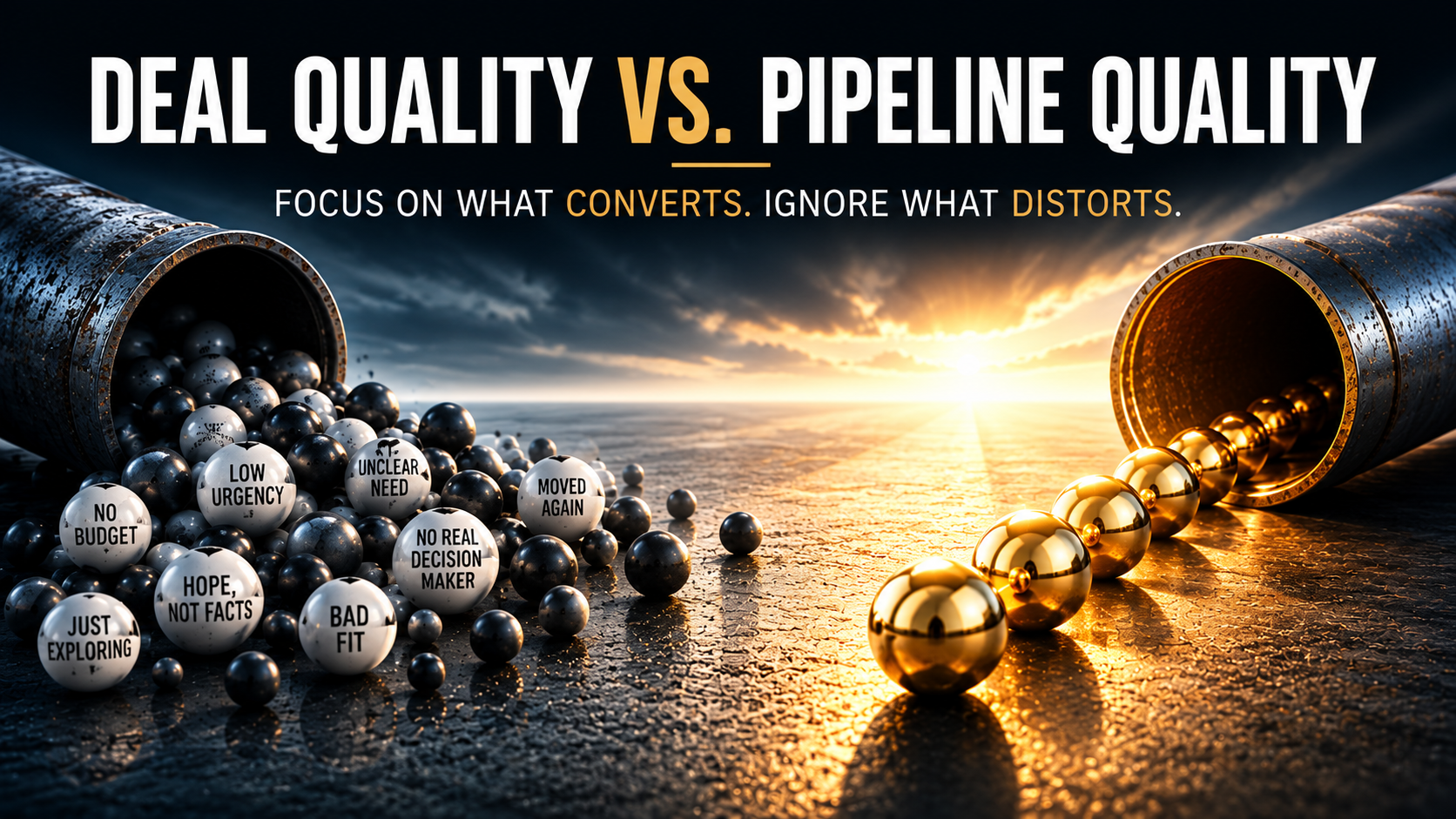
For decades, sales leaders have been taught a simple formula:
If you want more revenue, build more pipeline.
Need to hit next quarter's target? Generate more pipeline.
Conversion rates falling? Add more pipeline.
Forecast looking weak? Increase pipeline coverage.
It's become one of the most accepted truths in sales leadership.
And that's exactly the problem.
Because while pipeline remains a critical measure of future revenue potential, many organisations have become obsessed with pipeline quantity at the expense of pipeline quality.
The result?
Bloated CRMs. Inflated forecasts. Endless activity. And disappointing outcomes.
In boardrooms across technology, professional services, manufacturing and logistics businesses, I continue to hear the same concerns:
"We've got plenty of pipeline."
"We've invested heavily in lead generation."
"Our coverage ratio looks healthy."
Yet revenue growth remains stubbornly inconsistent.
The uncomfortable truth is that most sales organisations don't have a pipeline problem.
They have a deal quality problem.
And no amount of additional opportunities will fix it.
The Dangerous Obsession with Coverage Ratios
Ask most sales leaders how they assess pipeline health and you'll often hear references to coverage ratios.
Three times coverage.
Four times coverage.
Five times coverage in more complex environments.
These benchmarks can be useful indicators. The issue arises when they become the primary measure of success.
A healthy pipeline is not determined by its size.
It is determined by its ability to convert.
Yet many organisations continue to celebrate pipeline growth without asking the more important question:
How much of this pipeline is actually winnable?
I've seen businesses proudly report record pipeline levels while simultaneously missing revenue targets quarter after quarter.
Why?
Because the pipeline contained opportunities that should never have been there in the first place.
Prospects without urgency.
Projects without budget.
Stakeholders without authority.
Conversations mistaken for opportunities.
Hope masquerading as forecast.
When these opportunities accumulate, leaders gain a false sense of security.
The dashboard looks healthy.
The CRM appears full.
The forecast feels achievable.
Until reality arrives.
Why Weak Deals Stay Alive
One of the biggest challenges facing sales leaders today is that poor-quality opportunities rarely announce themselves.
Instead, they linger.
They drift through stages.
Close dates move quietly from month to month.
New stakeholders appear.
Decision processes become unclear.
Yet the opportunity remains in the forecast.
Why?
Because human behaviour often works against objective decision-making.
Salespeople naturally want to believe their opportunities will progress.
Managers want confidence in their team's pipeline.
Leaders want visibility against ambitious growth targets.
As a result, organisations develop a tendency to protect opportunities rather than challenge them.
The question becomes:
"How do we move this deal forward?"
Instead of:
"Should this deal still exist at all?"
That subtle difference changes everything.
The highest-performing organisations don't just qualify opportunities well.
They disqualify relentlessly.
The Cost of Poor Deal Quality
Poor-quality opportunities create far more damage than simply reducing win rates.
They distort almost every commercial decision a business makes.
Forecast accuracy suffers because weak deals create artificial confidence.
Resource allocation becomes ineffective because teams invest time in opportunities that never materialise.
Sales cycles extend because opportunities without genuine urgency continue consuming attention.
Management focus shifts towards volume rather than conversion.
Coaching conversations become less impactful because managers are discussing deals that should have been removed months earlier.
Most importantly, poor-quality pipeline creates a dangerous illusion of progress.
Teams stay busy.
Activity levels remain high.
Meetings continue.
Reports look positive.
Yet genuine momentum is absent.
This is why many organisations experience what I call "busy failure."
Everyone is working hard.
Nobody is moving forward.
The Difference Between Activity and Progress
One of the greatest misconceptions in sales leadership is the belief that activity automatically creates outcomes.
Activity certainly matters.
Prospecting matters.
Meetings matter.
Discovery conversations matter.
Pipeline generation matters.
But activity without qualification simply produces more opportunities to manage.
Not more revenue.
The most effective sales organisations understand that progress is measured by customer commitment, not salesperson activity.
Every opportunity should demonstrate evidence of forward movement.
Has the customer confirmed a business problem?
Have decision makers been identified?
Has a compelling reason to act been established?
Is there a clear buying process?
Has commercial value been quantified?
Without evidence, progression becomes assumption.
And assumptions are where forecasts go to die.
What Great Sales Leaders Do Differently
The best revenue leaders approach pipeline management differently.
They focus less on quantity and more on integrity.
Rather than asking:
"How much pipeline do we have?"
They ask:
"How much of this pipeline deserves to exist?"
This shift changes the nature of pipeline reviews entirely.
Conversations become more rigorous.
Assumptions are challenged.
Evidence becomes essential.
Opportunities are scrutinised.
Risk is surfaced earlier.
Most importantly, sellers learn that removing weak opportunities is a sign of strength, not failure.
The objective is not to maintain a large pipeline.
The objective is to maintain a credible pipeline.
There is a significant difference.
The Power of Ruthless Qualification
The phrase "qualification" is often misunderstood.
Many organisations treat qualification as a stage in the sales process.
A box to tick.
A checklist to complete.
The strongest sales organisations view qualification differently.
For them, qualification is continuous.
Every interaction either strengthens the opportunity or weakens it.
Every conversation provides new evidence.
Every stakeholder engagement reveals additional risk.
Qualification is not something completed at the beginning of the sales cycle.
It is an ongoing assessment of deal viability.
This requires discipline.
It requires courage.
And occasionally, it requires walking away.
The irony is that organisations that disqualify aggressively often achieve higher win rates, shorter sales cycles and more accurate forecasts.
Not because they generate less pipeline.
But because they focus their resources on opportunities that matter.
Building a Pipeline Quality Culture
Improving deal quality is not simply a sales process issue.
It is a leadership issue.
Culture determines what remains in the pipeline.
If leaders reward volume, teams will create volume.
If leaders reward activity, teams will generate activity.
If leaders reward optimism, teams will become optimistic.
However, if leaders reward accuracy, discipline and evidence, behaviours begin to change.
The organisations that consistently outperform their competitors have built cultures where truth is valued more than hope.
Reps are encouraged to raise risks.
Managers challenge assumptions.
Forecast reviews focus on reality rather than aspiration.
Weak opportunities are removed quickly.
Strong opportunities receive disproportionate attention.
Over time, the entire revenue engine becomes more predictable.
Not because there are more opportunities.
But because there are better opportunities.
The Leadership Question
Every sales leader eventually faces a choice.
Do you want a pipeline that looks impressive?
Or a pipeline that delivers results?
Because those are not always the same thing.
A large pipeline can create confidence.
A high-quality pipeline creates revenue.
One impresses people in meetings.
The other satisfies investors, boards and shareholders.
In uncertain economic conditions, this distinction becomes even more important.
When budgets tighten and buying decisions slow down, weak opportunities become increasingly exposed.
Organisations that rely on volume struggle.
Organisations that prioritise quality adapt.
The gap between the two widens significantly.
Final Thoughts
The next time someone says, "We need more pipeline," it may be worth asking a different question.
Do we really need more pipeline?
Or do we need better deals?
Because pipeline quantity has never been the ultimate predictor of success.
Deal quality has.
The organisations that consistently achieve predictable growth are not necessarily the ones generating the most opportunities.
They are the ones making better decisions about which opportunities deserve their attention.
In a world increasingly obsessed with volume, that may be the most important competitive advantage of all.
More pipeline won't save you.
Better pipeline just might.