For years, commercial alignment has largely been framed as a Sales and Marketing issue.
Marketing generates demand. Sales converts it. Operations fulfil the promise. Customer Success protects retention. Leadership manages the strategy.
At least, that is how the org chart tends to read.
But in practice, customers do not experience organisations in departmental silos.
They experience one company.
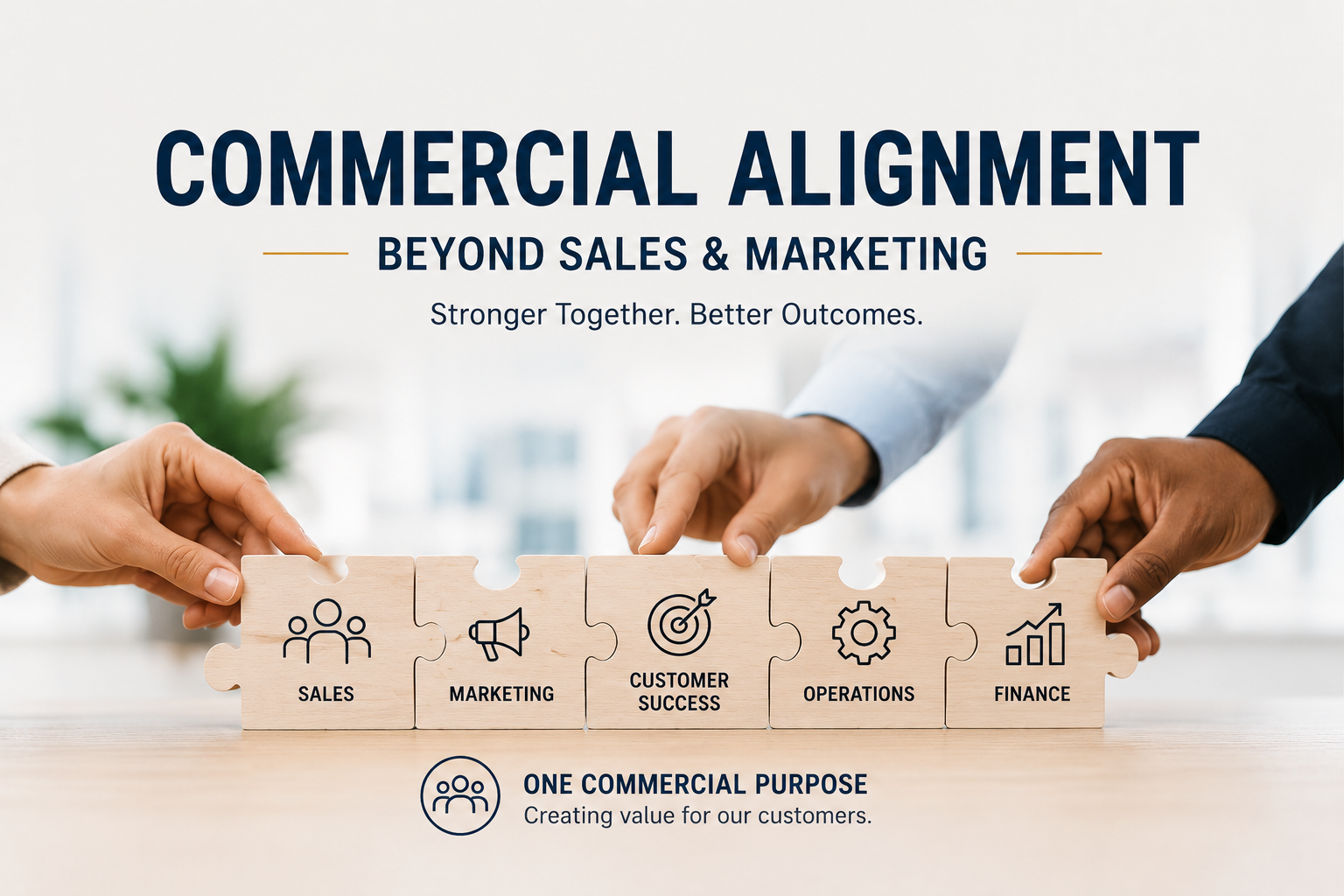
And increasingly, the organisations outperforming their markets are the ones recognising that commercial alignment is no longer a Sales and Marketing initiative. It is an enterprise-wide discipline.
The companies creating sustainable growth today are aligning not just messaging and pipeline activity, but decision-making, customer conversations, accountability, and execution across the entire commercial ecosystem.
That shift matters because the modern buying environment has changed dramatically.
Buyers are more informed, more sceptical, and more resistant to traditional selling approaches than ever before. They can research competitors independently, gather peer recommendations instantly, and delay decisions indefinitely.
At the same time, organisations are dealing with longer buying cycles, increasing internal complexity, margin pressure, and rising customer expectations.
In that environment, growth is rarely limited by effort.
It is usually limited by friction.
And friction inside organisations often looks deceptively normal.
Marketing optimises for lead volume while Sales prioritises deal quality.
Sales promises speed while Operations is measured on efficiency.
Customer Success focuses on retention while Finance pressures renewals and pricing.
Product teams build based on roadmap priorities that may or may not reflect the conversations happening in the field.
None of these groups are intentionally misaligned.
But when teams are incentivised differently, communicate inconsistently, or define success independently, the customer feels the disconnect immediately.
The result is slower decisions, inconsistent experiences, lost trust, internal frustration, and ultimately stalled growth.
That is why commercial alignment today requires a broader lens.
It is not simply about improving handoffs between Marketing and Sales.
It is about creating organisational consistency around how value is defined, communicated, delivered, and expanded.
Alignment Begins with a Shared Customer Reality
One of the most common problems inside growth organisations is that teams often operate from different assumptions about the customer.
Marketing may focus on personas.
Sales may focus on pain points.
Customer Success may focus on adoption metrics.
Operations may focus on implementation timelines.
Leadership may focus on revenue targets.
Each perspective is valid. But if those perspectives are disconnected, the organisation ends up solving internal priorities instead of customer problems.
The strongest commercial organisations create alignment around a shared customer reality.
That means teams understand not only what the customer is buying, but why they are buying, what risks they are trying to avoid, what pressures they are under internally, and what business outcomes matter most.
This is where one of the most valuable Sandler concepts becomes highly relevant: uncovering the true pain behind the problem.
Too often, organisations respond to surface-level requests instead of diagnosing deeper business challenges.
A prospect asks for a faster implementation.
What they may actually need is reduced operational disruption.
A customer asks for pricing flexibility.
What may really be happening is internal uncertainty around ROI.
A buyer requests more information.
What may exist underneath is fear of making the wrong decision.
High-performing commercial teams learn to align around those deeper realities instead of reacting transactionally.
And that alignment cannot live solely within Sales.
Marketing content should reflect those deeper business concerns.
Customer Success conversations should reinforce them.
Leadership communication should prioritise them.
Product positioning should support them.
When every customer-facing function speaks to the same business issues with consistency and clarity, trust accelerates.
Alignment Requires a Common Language
Another challenge many organisations face is that departments often use different language to describe the same objective.
Marketing talks about engagement.
Sales talks about pipeline.
Finance talks about forecasting.
Operations talk about delivery.
Customer Success talks about retention.
Individually, these metrics matter.
But without a shared commercial language, teams begin optimising locally rather than collectively.
That fragmentation creates inefficiency.
For example, a Sales team may push aggressively to close business at quarter end, while Operations struggles to onboard clients effectively because implementation capacity was never considered.
Or Marketing may celebrate campaign performance while Sales questions lead quality.
Or Customer Success identifies recurring customer concerns that never make their way back into positioning, messaging, or product strategy.
Organisations that break through this cycle create alignment around shared outcomes rather than departmental activities.
Instead of asking:
“How many leads did Marketing generate?”
They ask:
“How effectively are we helping the right customers make confident buying decisions?”
Instead of asking:
“How quickly can Sales close?”
They ask:
“How sustainably are we creating long-term customer value?”
That subtle shift changes behaviour significantly.
It encourages collaboration instead of territorial thinking.
It creates accountability beyond functional boundaries.
And it improves organisational decision-making because teams begin operating from the same commercial priorities.
The Hidden Cost of Misalignment
Many organisations underestimate the true cost of commercial misalignment because the symptoms appear gradually.
Pipeline conversion slows.
Forecast accuracy declines.
Customer churn increases.
Internal meetings multiply.
Decision cycles lengthen.
Employees become reactive.
Customers receive inconsistent information.
Eventually, growth becomes harder to sustain even though activity levels remain high.
What makes this especially dangerous is that organisations often respond by increasing pressure rather than improving alignment.
More meetings.
More dashboards.
More reporting.
More outreach.
More urgency.
But pressure rarely solves structural inconsistency.
In fact, it often amplifies it.
One of the core principles within Sandler methodology is that effective selling depends on upfront clarity and mutual understanding.
The same principle applies organisationally.
When teams fail to establish clear expectations internally, friction compounds downstream.
Misalignment at the leadership level eventually becomes confusion at the customer level.
And customers always feel organisational inconsistency faster than organisations recognise it themselves.
Commercial Alignment Is a Leadership Discipline
One of the biggest misconceptions about alignment is that it is primarily an operational issue.
It is not.
It is fundamentally a leadership responsibility.
Leaders shape how organisations communicate, prioritise, collaborate, and make decisions.
If executive teams operate with conflicting priorities, siloed communication, or inconsistent messaging, those behaviours cascade throughout the company.
Conversely, when leadership teams model alignment, organisations tend to follow.
That includes:
Creating shared commercial priorities across functions.
Defining success beyond departmental KPIs.
Encouraging transparency around customer feedback.
Aligning incentives to long-term outcomes.
Building cross-functional accountability.
Reinforcing consistent customer messaging.
Creating space for healthy internal challenge and collaboration.
Strong alignment also requires leaders to confront an uncomfortable reality:
Growth problems are not always market problems.
Sometimes they are internal consistency problems.
The organisations that address this early create enormous competitive advantage because they reduce friction while competitors continue managing around it.
Alignment Creates Better Buying Experiences
Ultimately, commercial alignment is not an internal initiative.
It is a customer experience strategy.
Modern buyers are evaluating more than products and services.
They are evaluating confidence.
Confidence that your organisation understands their business.
Confidence that your teams communicate effectively.
Confidence that commitments made during the sales process will be delivered operationally.
Confidence that long-term partnership will create measurable value.
When organisations are aligned, customers feel that confidence.
Conversations become more consultative.
Decision-making becomes easier.
Implementation becomes smoother.
Renewals become more natural.
Expansion opportunities become more visible.
Trust compounds.
And in today’s environment, trust is one of the few remaining competitive advantages that cannot be easily replicated.
The Future of Commercial Growth
The future of commercial growth will belong to organisations that stop viewing alignment as a departmental initiative and start treating it as an organisational capability.
Because growth today is not simply about generating more activity.
It is about reducing friction.
It is about creating consistency.
It is about ensuring every customer interaction reinforces the same value story.
And it is about helping buyers make confident decisions in increasingly uncertain environments.
Sales and Marketing alignment still matters.
But it is no longer enough.
The organisations creating durable growth are aligning leadership, operations, customer experience, messaging, delivery, and strategy around a unified commercial reality.
That is where modern competitive advantage is being built.
Not in isolated functions.
But in organisational coherence.
And the companies that master it will not simply sell more effectively.
They will operate more effectively, retain more consistently, and grow more sustainably over time.