
Your forecast assumes Sales will deliver.
So what evidence says it will?
Companies spend enormous amounts of time developing revenue targets, budgets and growth forecasts. Yet the number itself doesn't tell leadership whether the sales organization is capable of producing it.
A forecast is a financial expectation.
Your sales process is the evidence behind it.
Look Beyond Pipeline Value
One of the first places leaders look for reassurance is pipeline coverage.
If the target is $2 million and Sales has $8 million in pipeline, everything looks great.
Unless much of that pipeline isn't real.
A large pipeline filled with poorly qualified, stalled or unlikely opportunities doesn't create predictability. It creates false confidence.
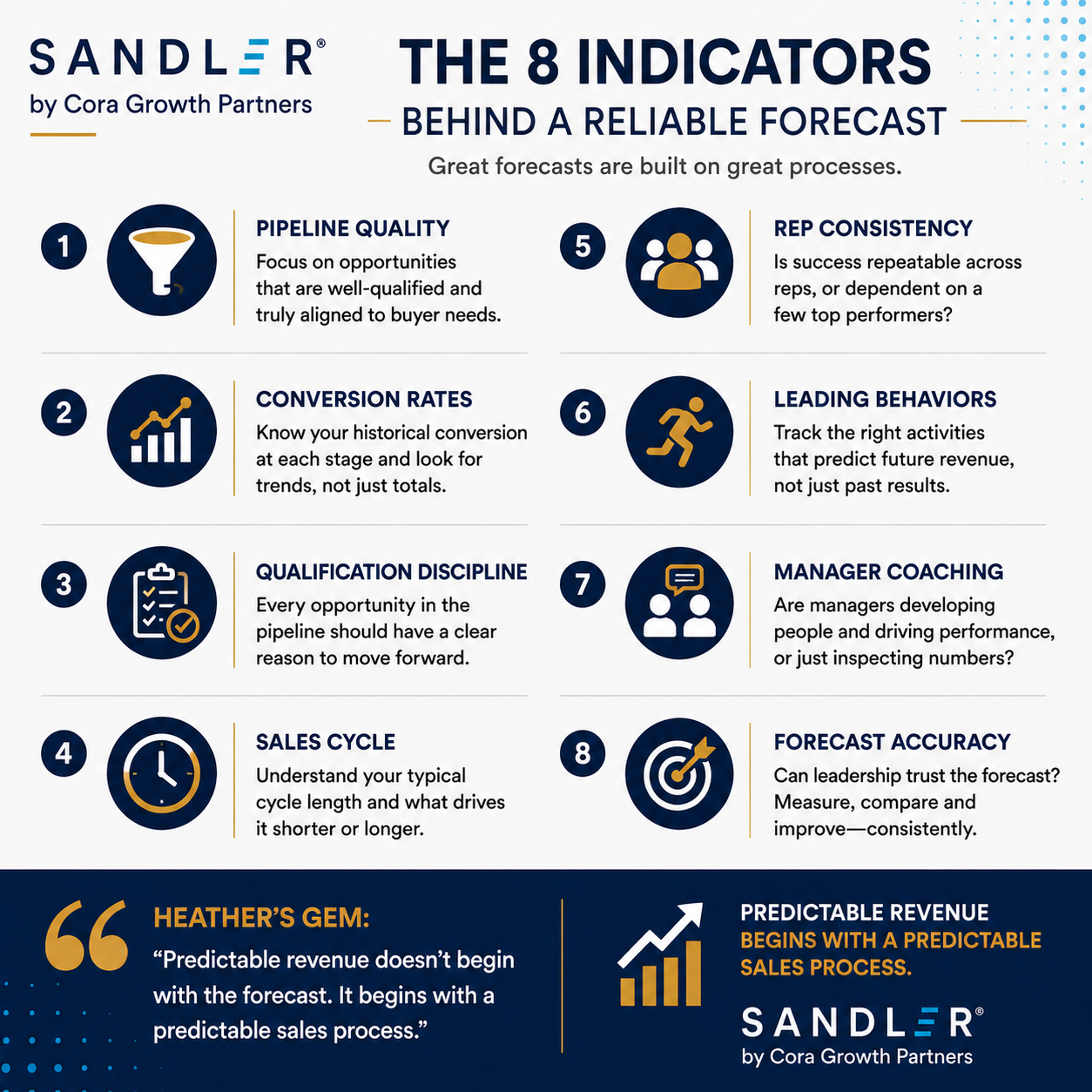
Instead of asking only how much pipeline exists, leaders should understand pipeline quality and qualification discipline.
Why is each opportunity there? What problem is the buyer trying to solve? Is there a compelling reason to act? Do we understand how the decision will be made?
Understand How Revenue Actually Moves
Predictability also requires understanding your conversion rates and sales cycle.
How often do opportunities move from one stage to another?
Where do deals typically stall?
How long does it realistically take an opportunity to become revenue?
Historical patterns don't guarantee future results, but they give leadership evidence to evaluate whether today's forecast is reasonable.
Is Success Repeatable?
Next, look across the sales team.
If one or two top performers generate most of the revenue, you may have strong salespeople—but not necessarily a scalable sales process.
Rep consistency matters because predictable growth requires a process other people can learn and execute.
That also means tracking leading behaviors.
Revenue tells you what already happened. Conversations, prospecting activity, qualified opportunities and pipeline movement provide clues about what may happen next.
Managers Matter
Sales managers are another critical part of predictability.
Are they coaching people to improve—or simply inspecting the pipeline?
Effective coaching helps salespeople execute the process consistently and gives leadership greater confidence in future performance.
Finally, look at forecast accuracy.
When Sales says revenue is coming, how often does it arrive when expected?
If leadership routinely discounts the sales forecast because nobody trusts it, the problem isn’t forecasting.
It’s the process underneath it.
Heather’s Gem: “Predictable revenue doesn't begin with the forecast. It begins with a predictable sales process.”
The goal isn't simply to become better at predicting revenue.
It's to build a sales organization capable of producing it.