

I spent two days this month earning my PeopleBest certification. Most of it confirmed things I already believed about human behaviour. Then one number stopped me cold.
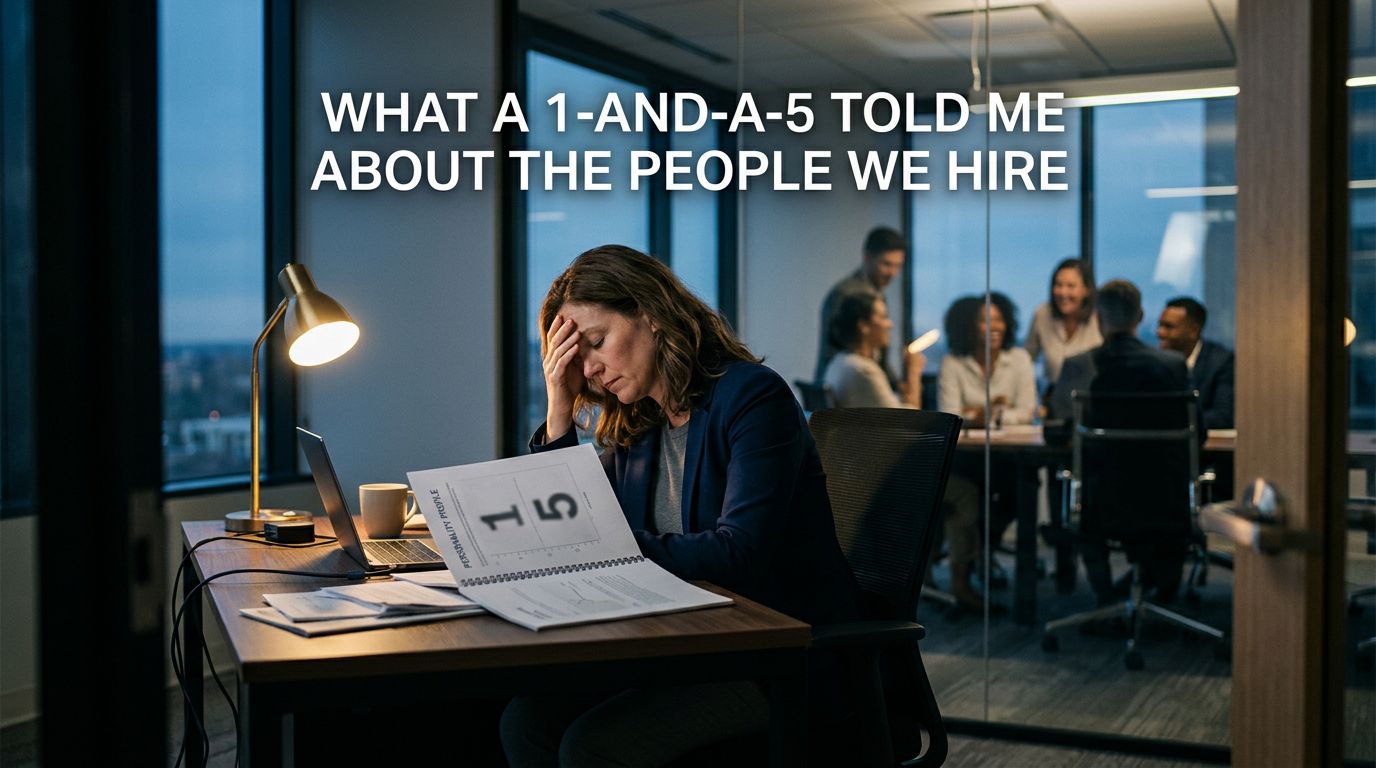
A leadership profile we reviewed showed a split score on Agreement: a 1 on the natural side, a 5 on the situational side. In plain English: this person’s hard-wired instinct is to push back, plant a flag, and not yield. But in their current role, they’re showing up as fair-minded and diplomatic.
Four points of daily energy spent being someone they aren’t.
The room got quiet. Because every one of us recognized the pattern.
We’ve all hired this person. We’ve all coached this person. Sometimes we’ve been this person. And we almost always misread what’s happening.
The polished surface isn’t the real wiring
Here’s the problem. We see someone operating well, composed in meetings, measured in conflict, effective in their role and we assume that’s who they are. We use that observation to set our expectations. We build their accountability structure around it.
What we’re often missing is the cost of that performance.
People can absolutely operate outside their natural wiring. They do it every day. They do it in interviews, in boardrooms, in their first year at a new company. Behavioural adaptation is real, and it’s not fake; it’s actually a skill. But that gap between who someone naturally is and how they’re required to show up costs energy. And energy is finite.
The leader who’s been “diplomatic for the board” for three years is running on fumes. Nobody’s measuring it. Nobody’s managing it. And then a missed quarter hits, or a tough client pushes back hard, or a boardroom challenge lands and the natural setting comes roaring back. That’s not a character flaw. That’s the cost of adaptation finally exceeding the person’s bandwidth to keep paying it.
Three things this reinforced about how I work with sales teams and leaders
Behavioural change is real, but it has a price
When we coach salespeople or leaders to operate differently, we’re asking them to spend energy. That’s not a reason to stop; growth requires that investment. But it is a reason to be precise. What are we asking them to change, and why? How much of the gap between their natural style and the required behaviour is necessary for performance, and how much is just organizational habit?
The leaders and salespeople I work with don’t need to become different people. They need to understand where the gap is, decide if the investment is worth it for this role and this environment, and build the self-awareness to know when the cost is exceeding what they can sustain.Accountability without self-awareness is just pressure
Most accountability conversations fail for one reason: the person on the receiving end doesn’t understand what’s driving the behaviour being addressed. Telling someone to “be more accountable” when they don’t see their own wiring is like telling someone to drive faster without showing them the road.
Behavioural data doesn’t replace the hard conversation. It gives the conversation somewhere to land. When a leader can see their own pattern — not as a judgment, but as a map — the coaching sticks differently. They’re not defending against feedback; they’re working with information.The patterns show up under pressure, not in interviews
Anyone can be fair-minded in a 45-minute interview. Anyone can be a collaborative team player when the pipeline’s full and the calendar’s light. The question that matters in a hiring conversation — the one I’m now better equipped to ask is: What does this person revert to when the deal is slipping, the calendar is full, and nobody’s watching?
That’s the hire you’re making. Not the version that shows up rested and prepared for a structured conversation. The version that shows up at 4 PM on a Thursday when the quarter is three weeks out and a key deal just stalled.
What this means for owner-operated businesses
Most of the businesses I work with in the GTA — manufacturers, construction firms, technology companies, professional services — don’t have an HR department running sophisticated pre-hire assessments. They hire on gut feel, referrals, and the interview. And then they spend the next 12 months trying to full clarity on who they hired.
Here’s what I see consistently in that population:
- Top performers whose output depends almost entirely on conditions being right and who collapse in disruption
- Revenue concentrated in one or two people, with no clear read on whether that’s talent or just fit
- Leaders who are brilliant operators but exhausted by the people side of their role
- Salespeople who perform in the easy market and quietly disappear when buyers get cautious
Most of these aren’t motivation problems or skill gaps. They’re wiring mismatches where people find themselves operating in roles or conditions that cost them more than the role is designed to give back.
The salespeople and leaders I work with don’t need another personality quiz. They need a clearer read on what their team is paying to perform and what they themselves are paying. They want to know what it takes to support their people to perform at their best. That data makes every coaching conversation, every hire, and every accountability structure sharper.
The story most teams are already telling you
The 1 and the 5 in that profile weren’t a problem to solve. They were a story to listen to.
The person wasn’t broken. They were adapting. And they’d been adapting, at cost, for longer than anyone around them knew. The only reason it was visible in that room was because someone had thought to measure it.
Most people on your team are telling you a version of that story right now.
We’re just not reading it.
Want to understand what your team is paying to perform?
I work with owner-operated businesses in Markham and the GTA to build sales teams that perform consistently, not just when conditions are easy. If you’re hiring, building a team, or trying to figure out why strong people aren’t converting, let’s have a direct conversation.
Reach out at Francesco.ientile@sandler.com