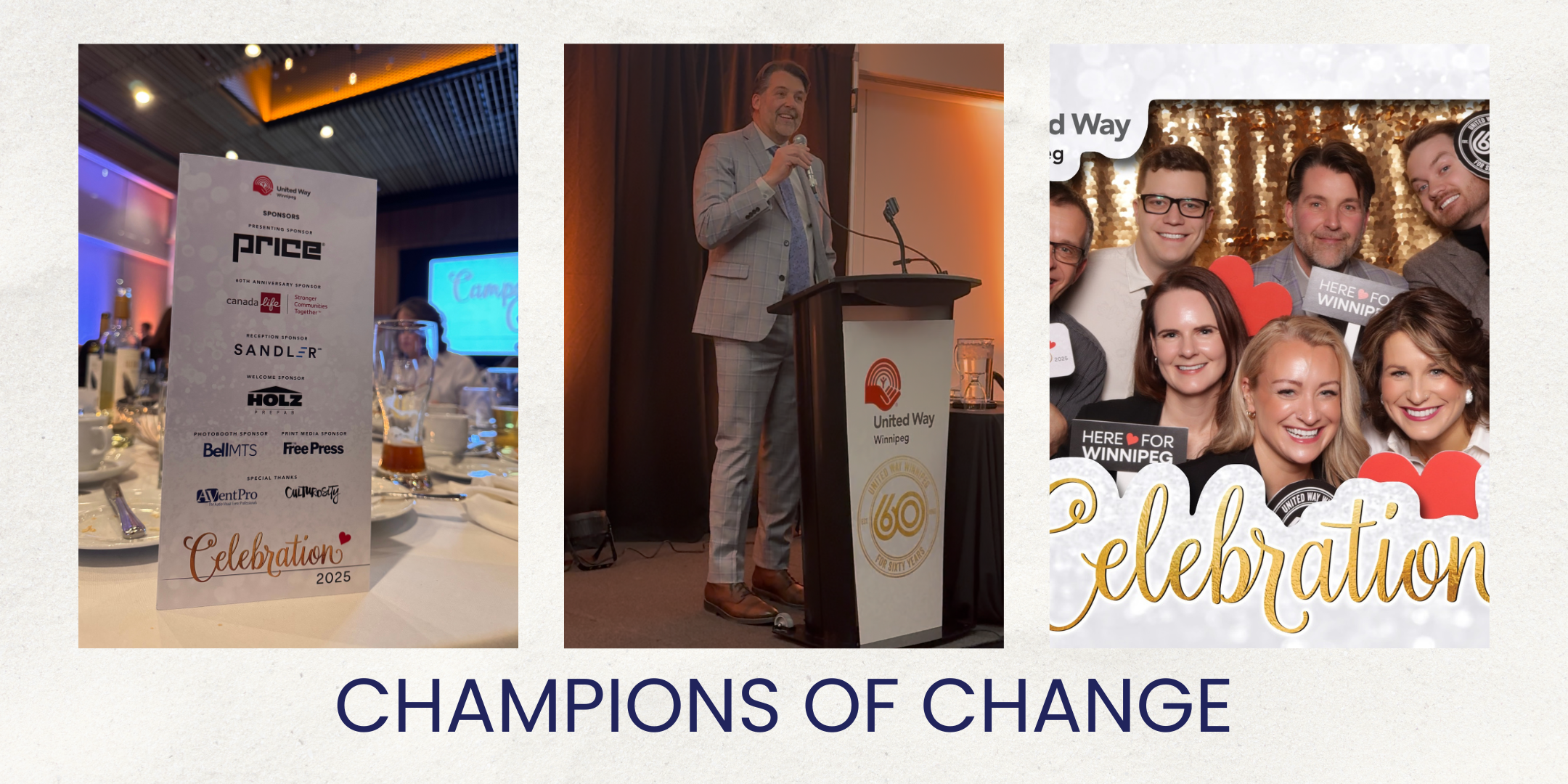
Last week, the United Way of Winnipeg hosted its annual Champions of Change celebration and announced something worth pausing for: a record-breaking $23.3M raised from Winnipeg supporters. That funding goes directly into a network of nonprofits doing real work across our city.
For the fourth year in a row, ASK Sandler was proud to support the cause by sponsoring the reception ahead of the dinner. And beyond the sponsorship, I left the evening reminded of something I teach often:
High performance always comes down to Behaviours, Attitudes, and Techniques.
In Sandler, we call this the BATing triangle—a simple model for diagnosing what’s working, what’s missing, and what needs to improve.
Champions of Change: High Performance in the Real World
United Way’s Champions of Change are true leaders in Winnipeg. Each year, the campaign starts at the top with a respected local leader who chairs the effort. This year, that leader was JP Perron who prior to my Sandler days, I had the chance to work with JP at MTS. He was a great leader, mentor, and friend. It was genuinely meaningful to see him take the chair in a year where contributions grew by nearly a million dollars!
Extra congratulations are owed to the cornerstone accounts and the companies that engaged employees to raise these funds. Many Manitoba organizations have dedicated teams who run annual campaigns. It’s difficult work, and it deserves real appreciation. Because running a successful campaign is not accidental. It’s built.
Behaviours: The Work That Creates Results
I suspect the campaign was full of behaviours that can be counted, and that make a difference.
- Calls
- Conversations
- Emails
- Follow-ups
- Reminders
- Repeated efforts to engage every participant
This is the part that doesn’t get celebrated enough. Behaviors are measurable. They are visible. And they produce results.
If you want to evaluate performance—whether in fundraising, leadership, or sales—the first question is always:
Are we doing the right quantities of effort? The Champions of Change clearly were.
Techniques: The Creativity That Makes Effort More Effective
Techniques are the “what” and “how.” Maybe you had to survive a dunk tank or you’re still sore from pulling a plane.
Those creative fundraising techniques matter because they increase engagement and make participation easier. When teams discover a technique that works, it should be shared so others can repeat it.
Techniques also matter in conversation. We know that people decide emotionally and justify intellectually so we can use conversational techniques to understand someone’s emotional reason for contributing (or not), we can focus our efforts more effectively.
Techniques are trainable. Shareable. Repeatable. What did your team do that you could share with others?
Attitudes: The Real Source of Change
Attitude are what we believe. What we believe impacts our judgements, our judgements result in our actions, our actions results in our results. The people who commit to this cause succeed because they carry a mindset of possibility. They don’t allow limiting beliefs to dominate their thinking. They believe their actions matter, and that’s where the real challenge begins.
The Champions are already converted and we need more believers.
How can we use our own beliefs to create more believers?
The Power of Absolute Belief
Recently, I read a book called What to Say When You Talk to Yourself by Shad Helmstetter. He makes a powerful point. I took away some insights that the most powerful beliefs are absolute. Not “maybe.” Not “I’ll try.” Not “hopefully.”
Beliefs need to be strong statements without weak words. Even if reality hasn’t caught up yet, an absolute belief will become a visionary statement—one that reprograms the mind to pursue possibility instead of limitation.
In my programs with business owners, presidents, sales professionals and others that impact the revenue engine of your company, I often share: Our minds listen to what we tell them.
If we constantly repeat beliefs of limitation, we live by them. But if we choose beliefs of possibility, we begin to act enabled and with purpose so that our action changes outcomes.
A Practical Example: The Belief Wheel in Motion
Helmstetter gives an example of someone who smokes. Smokers often believe:
“I can’t quit because I’m addicted.” Or: “Tomorrow is a better day.”
But imagine writing and repeating a new belief:
“I don’t smoke. I love breathing clean air. I’m disgusted when I see a cigarette in my hand.” Journal it. Record it. Play it to yourself. Say it out loud.
What eventually happens? One day the person reaches for the next cigarette and their brain interrupts because the belief they programmed becomes the new reality.
That is the belief wheel in motion: Beliefs → Judgments → Actions → Results
What Winnipeg Believes Becomes Winnipeg’s Future
Here’s where this matters beyond sales and beyond fundraising. The United Way of Winnipeg campaign is not only about raising money. It’s about building a city where people believe the future can be better—and then doing the work to make it so.
Imagine beliefs like:
- “No child is ever hungry in Winnipeg.”
- “People always have emotional and mental support.”
- “Every young athlete gets the opportunity to play.”
Absolute beliefs become the first step in building an absolute future.
We write them.
We repeat them.
We share them.
Then we build the behaviours and techniques to make them real.
Because we can.
Because we create our future and our future looks amazing.
Thank you to everyone who makes Winnipeg a greater place.
If you want to build stronger beliefs and behaviours inside your sales team, come be our guest in a class or book a 15-minute chat .