
If revenue feels harder than it should in your business, there’s a reason.
It’s rarely effort or motivation. And it’s almost never solved by simply demanding more activity.
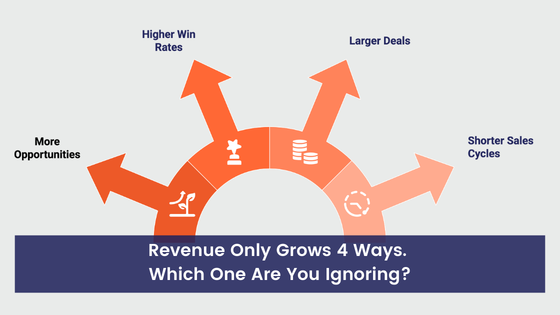
When you strip away the noise, revenue in a B2B organization grows four measurable ways:
- More opportunities
- Higher win rates
- Larger average deal size
- Shorter sales cycles
That’s it.
Everything else (marketing campaigns, training sessions, CRM updates, compensation tweaks) is a tactic designed to move one of those four levers.
The problem is not that leaders don’t know this, it’s that most try to improve all four at once.
More leads. Better closing. Higher pricing. Faster follow-up. More urgency. More reporting.
The team gets busy, and initiatives stack up. And focus disappears… and revenue barely moves.
If you lead a B2B company, especially in manufacturing, technology, or tech-enabled services, this is where growth gets constrained.
Let’s slow this down and look at each lever the right way.
Lever 1: More Opportunities
This is the most obvious lever. If you create more qualified opportunities, revenue can increase. But more opportunities only matter if they are qualified.
When opportunity volume is the constraint, we usually see thin pipeline coverage, over-dependence on a handful of accounts, and inconsistent prospecting discipline.
The fix is not ‘try harder.’ The fix is defined account focus, clear prospecting expectations, and weekly inspection of opportunity creation.
Lever 2: Higher Win Rates
When win rates are the constraint, deals advance without real qualification, discounting shows up late, aaaaand losses surprise the team.
Improving win rate is not about better closing lines, but stronger early-stage discipline and evidence-based deal advancement.
Lever 3: Larger Average Deal Size
This is probably the most underleveraged growth driver in many B2B companies.
When deal size is the constraint, reps stay too low in the organization and conversations center on features instead of outcomes.
Deal size grows when impact is quantified and aligned through executive conversations early in the process.
Lever 4: Shorter Sales Cycles
Long cycles create hidden risk. Cash flow becomes harder to forecast, and leadership starts reacting late. Been there, done that, read the book and saw the movie! And you probably have too!
Shortening the cycle is not about pressure. It’s about decision clarity and next-step discipline.
Here’s the part many busy leaders miss.
You don’t need 12 new initiatives. What you need clarity about the constraint.
Revenue doesn’t improve because the team is more motivated this month. It improves because leadership identifies the limiting factor and installs discipline around it.
- One lever.
- Ninety days.
- Clear standards.
- Weekly inspection.
That’s how predictability is built.
Over the next 10 weeks, I’m going to walk through what I call a Revenue Performance Reset.
We’ll break this down into:
- How to reverse-engineer revenue targets so they’re not just hopeful
- How to sharpen market focus so you stop spreading effort thin
- How to clean up pipeline integrity so forecasts stop swinging
- How to align talent, skill development, and incentives to the right growth lever
- And how to install a weekly leadership rhythm that makes improvement stick
Not theory or hype. Just structure.
If revenue feels heavier than it should right now, this series will help you identify the constraint and tighten it.
Revenue doesn’t drift up… It’s led up.
Stay tuned! - Frank
Frank Gustafson with Sandler in Dallas, Ft Worth, TX, helps B2B sales organizations build the discipline to forecast accurately, qualify rigorously, and grow predictably. If your pipeline feels more like hope than math, let's talk.
#RevenueGrowth #B2BSales #SalesLeadership #RevenueStrategy #PredictableRevenue #SalesManagement #BusinessGrowth #ManufacturingLeadership #TechEnabledServices #SandlerDFW #SalesPerformanceInsights