Why Your Sales Team Isn’t Hitting Quota (And It’s Not What You Think)
If your sales team is consistently missing quota, the default reaction is predictable.
You assume:
- The reps need more training.
- Marketing needs to generate better leads.
- The compensation plan isn’t motivating enough.
- The market is tighter this year.
- You need to hire “stronger closers.”
But after working with growth-focused organizations across industries, one pattern consistently shows up:
When a sales team isn’t hitting quota, the issue is rarely effort or talent.
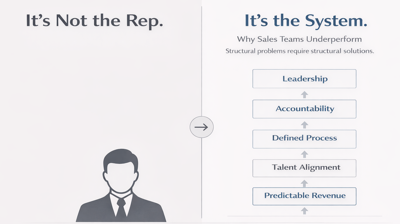
It’s usually structural.
And until you fix the structure, quota attainment will remain inconsistent — no matter how hard your team works.
What “Sales Team Not Hitting Quota” Really Means
Before diagnosing the problem, it’s important to clarify what’s actually happening.
Missing quota is a symptom.
It tells you:
- Revenue output is below expectation.
- Forecasting accuracy is weak.
- Pipeline conversion isn’t strong enough.
- Behavioral standards may not be enforced.
But quota misses do not tell you why.
Most organizations jump straight to tactics.
High-performing organizations diagnose first.
The 5 Real Reasons Sales Teams Miss Quota
Let’s break down the structural causes that most leaders overlook.
1. There Is No Enforced Sales Process
Ask your sales team to describe your sales process.
If you receive five different answers, you don’t have a sales process — you have preferences.
When process is undefined or unenforced:
- Reps qualify inconsistently.
- Deals move stages prematurely.
- Forecasting becomes emotional.
- Coaching becomes vague.
Quota misses often stem from inconsistent execution, not lack of skill.
Without defined stage exit criteria and qualification standards, pipeline health is an illusion.
Quota attainment improves when process clarity increases.
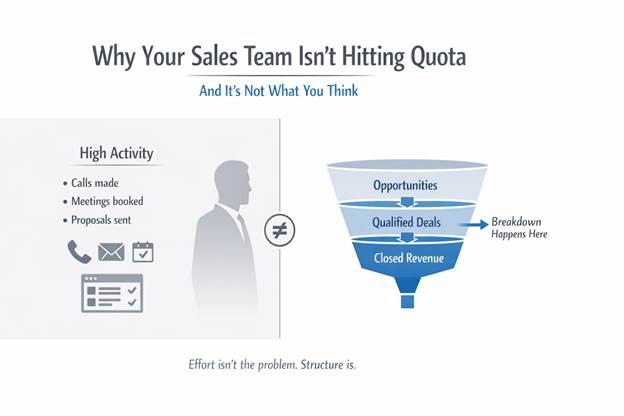
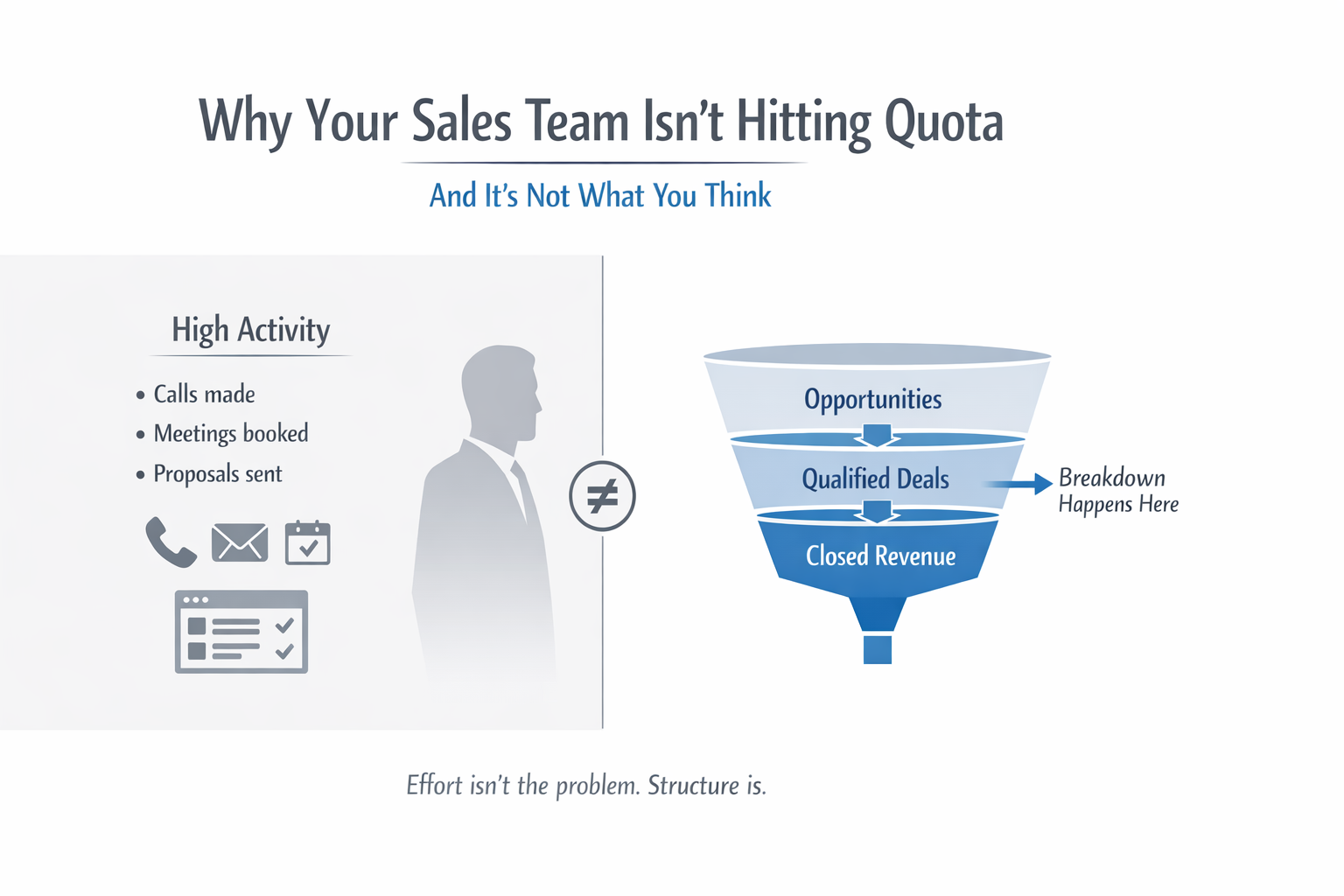
2. Activity Is High — But Discipline Is Low
Many sales teams are busy.
But busy does not equal productive.
High activity without qualification discipline produces:
- Inflated pipelines
- Long sales cycles
- Low close rates
- End-of-quarter surprises
The critical question isn’t:
“Are they working hard?”
It’s:
“Are they working inside a disciplined system?”
If leading indicators like:
- Prospecting conversations
- Qualified opportunities created
- Conversion ratios
- Time-in-stage
…are not inspected weekly, performance will drift.
Revenue follows discipline — not enthusiasm.
3. Sales Managers Are Managing Numbers, Not Behavior
When a sales team isn’t hitting quota, the issue often traces back to management.
Many sales managers:
- Review dashboards
- Ask for deal updates
- Step in to save late-stage deals
- Accept optimistic forecasts
What they don’t consistently do:
- Coach qualification
- Inspect prospecting discipline
- Reinforce stage criteria
- Hold performance standards
Without structured accountability, quota becomes aspirational.
Quota improves when management shifts from reporting to reinforcement.
4. Underperformance Is Tolerated Too Long
One weak performer can distort the entire team dynamic.
When underperformance continues without consequence:
- Standards decline.
- Top performers disengage.
- Culture softens.
- Leadership credibility erodes.
Quota misses are often cultural signals.
If 60–70% of your team is consistently below target, the problem isn’t individual effort.
It’s structural tolerance.
High-performance cultures address gaps early.
5. Hiring Mistakes Compound Over Time
Sometimes quota misses are the result of upstream hiring decisions.
Common hiring errors include:
- Overvaluing industry experience
- Hiring based on personality fit
- Relying solely on interviews
- Skipping behavioral assessments
When hiring precision is low:
- Ramp-up takes longer.
- Coaching burden increases.
- Performance variance widens.
- Turnover accelerates.
Quota reliability improves dramatically when hiring standards are clear and objective.
The Quota Illusion
Many companies believe quota misses mean “we need better closers.”
But here’s the uncomfortable truth:
If 70% of your sales team misses quota, the issue is not individual talent.
It’s system design.
Ask yourself:
- Are quotas aligned with realistic activity expectations?
- Are conversion ratios documented and tracked?
- Is management inspecting leading indicators weekly?
- Is forecast accuracy above 85%?
If not, you are managing outcomes — not drivers.
What Actually Improves Quota Attainment
High-performing organizations share common characteristics:
- Documented sales process with enforced stage criteria
- Weekly inspection of leading behaviors
- Structured coaching cadence
- Clear performance consequences
- Data-driven hiring practices
- Forecast validation discipline
Notice what’s not on that list?
Motivational speeches.
Quota attainment is engineered.
Not inspired.
A Simple Diagnostic for Leaders
If your sales team is not hitting quota, ask:
- Do we measure behavior weekly or just revenue monthly?
- Are stage exit criteria documented and enforced?
- How accurate have our forecasts been in the last two quarters?
- Do managers coach proactively or rescue reactively?
- How quickly do we address underperformance?
Your answers will reveal whether the issue is talent — or structure.
Why Most Leaders Misdiagnose Quota Problems
It’s easier to:
- Blame the market.
- Blame marketing.
- Replace reps.
- Add incentives.
It’s harder to:
- Tighten standards.
- Enforce qualification.
- Develop managers.
- Address cultural drift.
But structural clarity is what produces sustainable quota attainment.
Anything else is temporary.
The Bottom Line
If your sales team isn’t hitting quota, the solution is rarely more effort.
It’s better structure.
Quota misses are feedback.
They are signaling:
- Weak process discipline
- Inconsistent accountability
- Management capability gaps
- Hiring precision issues
Fix those, and quota attainment improves naturally.