
Years ago, a director at a global consulting firm told us what she found most valuable in all of our work together. She said she now has all her leaders asking one simple question in every internal 1-on-1: "How many greens do you have this week?"
A green meeting on the calendar is a money conversation.
I've been thinking about her a lot this month because so many leaders struggle with accountability these days, and we can help.
Money conversations need to happen every week.
Most calendars, CRMs, and other project management tools make it easier to track who looks busy. Somewhere along the way, though, many firms stopped looking at the one metric that matters: "How many money conversations are you having with clients and prospects each week?"
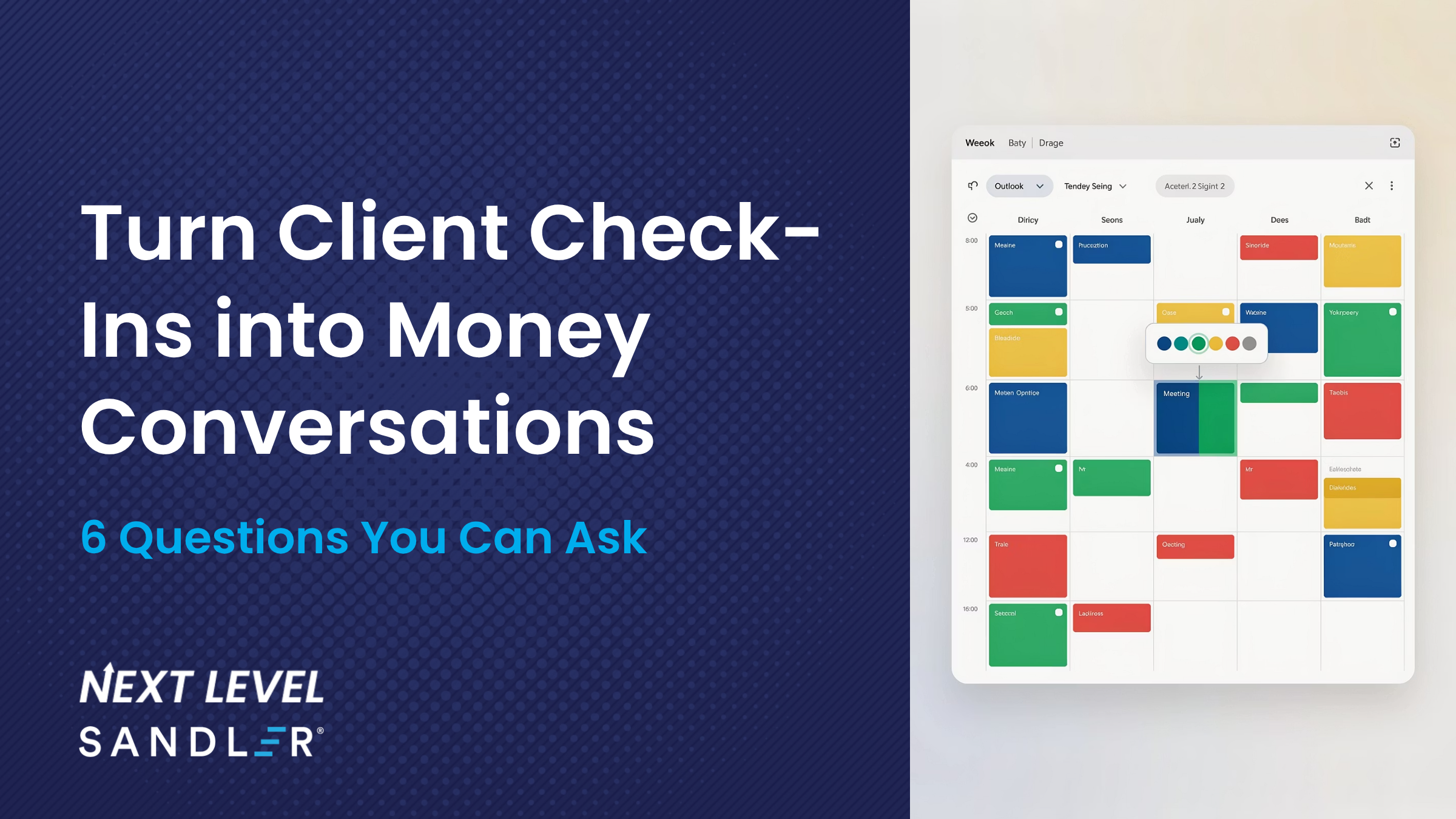
Four color codes for your calendar
The idea is simple, and every calendar system can do it, even paper. Every appointment gets a color. In Outlook and Google, right-click the meeting, choose Categorize, and pick a color. It takes two seconds.
- Blue is a meeting with a client or a potential client. Good. That's a check-in conversation, project update, or other business meeting.
- Green is a meeting with an opportunity attached: new work, a bigger scope, next year's budget, an introduction to another department.
- Yellow means caution. You're getting the runaround or someone in the building isn't a fan, and you need to find out what's going on.
- Red is a difficult conversation. A client relationship that needs a reset, a fee that needs to go up, or a hard talk with someone on your team.
Once a week, open the calendar and count the colors. Review them with your manager or your team.
A blue can become a green with one good question before you hang up. "Before we go, can I ask about something we've never talked about?" Megan recently wrote about this.
When the calendar is missing any green appointments
We're working again with a firm that has good people, good clients, and a strong reputation. Over the last few years, post-pandemic, how and where people work changed, and nobody adjusted their accountability to match. Nobody checks in on Monday. Nobody checks out on Friday. Productivity slid, including the work that brings in new clients.
When we looked at the calendars, there wasn't much on them. It was just billable work.
I suggested a basic check-in and check-out every Monday and Friday.
- What's on your calendar this week?
- What happened last week?
- How many greens do you have coming up?
Haley wrote about how to do these weekly accountability reviews, and we've written before about what real accountability sounds like in a one-on-one.
The leader loved the idea. Then he said, "I don't have time to do that." That's the gap. The people are capable. The tools are in place. Nobody is looking.
We can teach you, or we can do it for you until it becomes a habit, but you need to solve it if you want your firm to grow next year.
One green a day generates organic growth.
For the last several years, a lot of firms grew by acquisition. Buy a practice, add the revenue to the pile, and repeat. That's slowing down now, and even when it works, you still have to answer a hard question: how will you grow the business you already have?
That's organic growth. It's the work your own people create, without an acquisition and without waiting for something to fall out of the sky. It comes from networking, referrals, and having the money conversation in a meeting you're already in.
Here's a rule we've used for years...
Aim for at least one green every working day. String twenty of those together in a month and you'll be happy at the end of the quarter. Go weeks without one, and you'll feel it later, even if the week felt full with work.
Organic growth is purposeful, and you can see it in green on a calendar.
Open your calendar for next week and count the greens. The number of money conversations you have now determines your future paychecks.
Would you write yourself a check for that number?