
Here is an experiment you can run on Monday. Sit down with someone on your team and ask, "What appointments do you have this week?"
Then say nothing. Just wait.
I've watched that silence produce stammering, long explanations, and on at least one occasion something close to tears. These are capable, well-paid professionals. The question is as basic as it gets. The reaction tells you how long it's been since anyone asked.
How we got here
Most firms didn't decide to stop holding anyone accountable. The question got crowded out, probably around the pandemic. A CRM went in, then a dashboard, then call recordings that nobody has time to listen to. Each tool promised visibility. Somewhere in the middle, the leader stopped looking at the one report that never lies: the calendar.
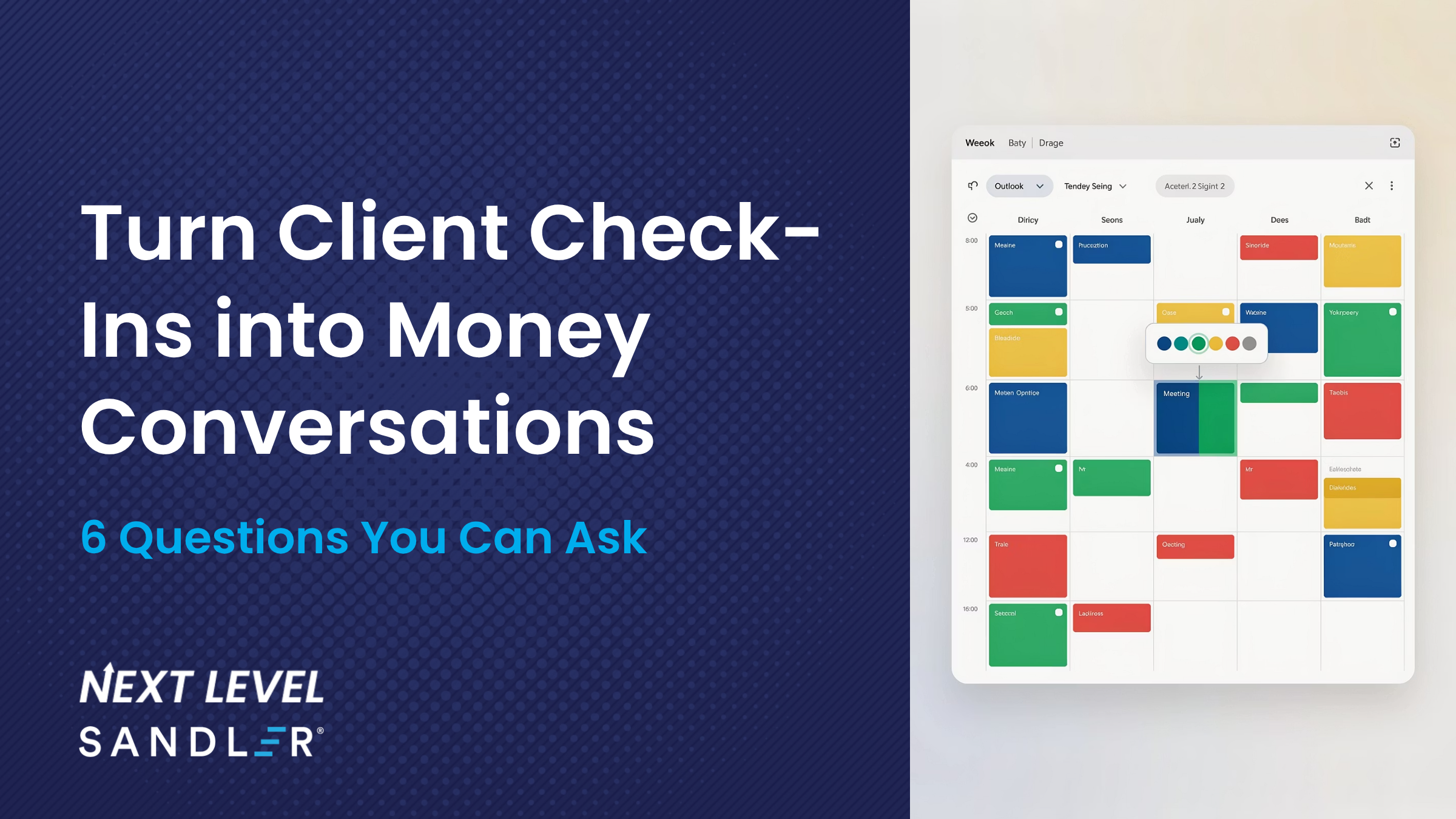
Jim Ayraud recently wrote about the color-coded calendar we've used for years to guide our sales accountability meetings: blue for a client meeting, green for a meeting with an attached opportunity, yellow for caution, and red for a difficult conversation. It is a brilliant system, but the colors only work if someone looks at them every week. That someone is you, the leader.
Check-in, check-out calls
The practice is old, and it works. Every week has two short conversations with the individuals on your team.
The check-in, early in the week. Fifteen minutes, with their calendar open on the screen.
- What's on your calendar this week?
- How many greens do you have?
- Which one meeting matters most, and how are you preparing for it?
- What's on next week so far?
- What do you need from me?
The check-out, at the end of the week. Ten minutes.
- What happened in your meetings?
- Did any blue turn green?
- Any yellows or reds we should talk about?
- What got moved or canceled, and why?
- What's going on the calendar for the next two weeks?
That's it. Nobody needs a new AI system to do this. You need a simple human conversation at the same time every week and the discipline to keep asking the questions.
How to ask accountability questions without making it an interrogation
A few things we've learned from running these with clients:
- Ask, then stop talking. The silence does more coaching than any comment you could add. People hear the gap on their own.
- Look ahead. Last week is already history. The question that changes behavior is "What's on next week?" because there's still time to fill it.
- Don't solve it in the meeting. If the calendar is empty, the check-in isn't the place to build a plan together. Ask what they'll have on it by Friday, and check out on Friday. Set a separate enablement session if they don't know how.
- Treat a red as a priority. If someone has a difficult conversation coming, that's the meeting to prepare for together. Don't let a red get pushed back because of fear. Deal with it now.
- Do the preparation. The best news I've heard from clients this fall is some version of "The client told me I was really prepared." That is a differentiator in today's frantic business world. Being prepped starts with knowing which meeting matters most on Monday.
Finally, be patient and repetitive if necessary. In one of these conversations, someone recently said to me, "Oh, I get it now." I had mentioned the same thing nine months ago, but people hear it when they're ready. Your job as a leader is to keep reinforcing the behavior you want until they are doing it.
You don't need direct reports to do this
In our leadership class this month, several people from engineering firms told us they don't have direct reports. However, they have project managers and engineers attached to their project who still need those conversations.
They still need to run a check-in, run a good debrief, give feedback, and have the occasional difficult conversation. If you were promoted because you're great at the technical work, we've written about what that promotion leaves out. The weekly calendar review is one of the easiest places to start.
When nobody will run it
Some of our other clients have told us plainly that they don't have time to run these conversations. I believe them. But your culture is defined by what you tolerate, and an empty calendar that nobody asks about becomes the accepted standard.
If no one inside the firm will own the accountability check-in, someone outside it can. More and more, we do that work alongside our clients, until the habit belongs to them. If you need help, let's chat.
When did someone last ask you what was on your calendar next week?
If it's been a while, let's chat.