
Stop Building a Better Prompt. Build a Better Record of Yourself.
The tool you make today is obsolete by December. The one thing that compounds is a record of how you think and how you work.
Obsolete by December
What you build today may be obsolete by December, and a year out it will need a rebuild. The tools you are using, and the ones you are making yourself, will be replaced by something better. That is not a reason to stop. It is a reason to watch where you put the effort, because most of us pour it into the product and the prompt, the two things guaranteed to get swapped out.
The highest-return thing you can build with AI is a better record of yourself: how you think, how you work, what you are trying to do. That record compounds while everything else gets replaced. If book learning were enough, we would all be wealthy and healthy. What changes you is a feedback loop over what you are already doing. The mirror tells you more than the driver's seat.
There is no expert to chase
Nobody is coming to hand you the right way to do any of this. We chase the people who claim they found it, and it is always a moving target, because nobody knows where AI goes from here.
Karen Gibson put it to me yesterday: stop trying to be the second-best version of someone else and be the best version of yourself. That is the whole game in technological adoption. You are not where someone else is to adopt what they are doing in a 1:1 way. The tool is not here to replace you. It amplifies what you already do well.
We see it in the room all the time. A seller comes in sure a process will cost him his instincts and resists it, but instead the system amplifies what he already brings. They're willing to learn that when enough is on the online. And this seller sees it the first time he uses it to walk a client through a six-figure correction and keep the deal. There is a truer name for what we call artificial intelligence. Call it fake intelligence, because everything it produces rides on your input. You are the intelligence in the loop. The way it thinks and the words it uses can make you feel great.
A prompt is not adoption
You can hand someone a precise, elaborate prompt, and without discovery and demonstration it will not get used for what it was built for. The instruction is not the adoption.
A learner we had, Annabelle spent four years in our training, roleplayed beautifully, and was the person everyone wanted in their breakout. She had the techniques down and gave great feedback. Then she announced she was closing her business, and the reason was because she could do it in class and not in front of a client. A wide gulf sits between knowing a move and running it live, and comfort holds the door shut. A perfect prompt lands a person right where she stood, full of the right words and unable to say them when it counts.
The team version is where it gets expensive. AI makes it easy to hold an opinion about someone's work without the context of what their work is, and the soundbites from a decent prompt will get you into a conversation you never earned a seat at. Drive change off a chat with AI instead of the person in front of you, and you are not only sabotaging yourself. You are sabotaging the person you overruled and the team that watched it happen. That is organizational sabotage wearing the costume of decisiveness.
It would be easier if AI arrived holding the context of your organization. It does not. You can farm for it, but the assumed context it holds is reactive. Most people use it to problem-solve issues. So, the context it has is that you need help. And it's true. You do not have the ideal person for the ideal role. You have the person you have, and chasing the perfect fit usually gets in the way of the hire you need to make. True as a leader as it is for you as a person.
AI is built to agree with you
You can abuse yourself or abuse your wallet. Most of the time we are shopping for something that covers a gap in competence, or a fuzzy read of what we actually need to do to win business. Without hard language about what you could be doing and what you are doing, it is easy to paint a soft picture, and a soft picture pulls your attention to why things are going badly instead of what you can do about it now. This is a slippery slope toward playing a victim role. And in the status quo we can all agree: AI is happening to us.
This is where AI turns dangerous, and it stays quiet about it. Grade your own calls without a third party and you are in conversation with something built to support you. Unless you have written real rules for self-awareness, it tells you what you want to hear, because every system that wants more of your time is trying to be useful, and useful and flattering look identical from the inside.
The easiest person to sell is yourself, and what you are buying is your own bullshit.
One of our sellers did the opposite on purpose. He recorded his last eight calls and built an AI agent to grade them against our process. It told him his weakness was solving too early and the gap was discipline, not knowledge. Another fed a single call to the framework and got torn apart, then said the quiet part out loud: a week ago I would have told you I was pretty good, and I am not as good as I think I am. The transcript does what memory cannot. A self-assessment is honest in one direction only. But, if you're not grading yourself against a method or process (how you sell) then the feedback you will get is toward reinforcement of who you are. You can talk yourself up and the call cannot hear you, but the transcript quotes you back against your own playbook. If you don't have a playbook, then the AI will protect how you feel. It may gaslight you and blame the prospect.
We ask how we could see it earlier, when the answer was the seller
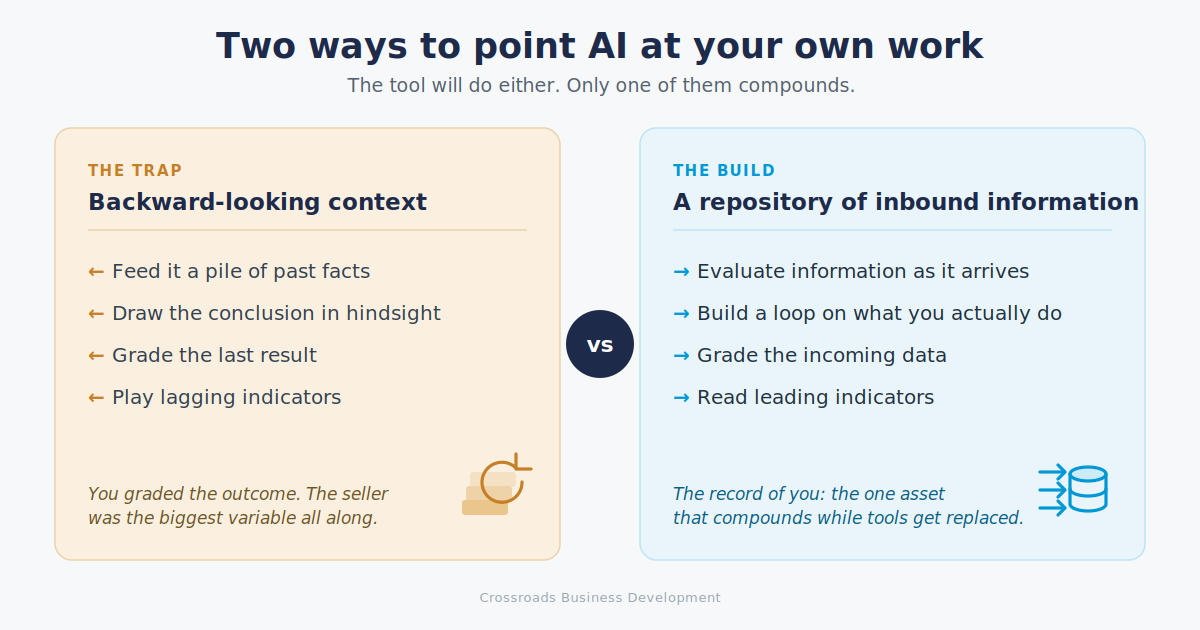
The next trap is feeding AI a pile of facts, drawing a clean conclusion, and asking how we could have seen it earlier. We would all love to run a deal from first touch to close and point at the exact moment it broke. But your sellers are a bigger part of your sales process than your sales process is. Grade the last result instead of the incoming data and you are playing lagging indicators again, to your own detriment.
It matters most when the subject is a relationship. A sale is two people. Selling a commodity you can be explicit in the process, because there is usually no seller in it and you are only navigating how a buyer decides. Put a seller in the room and the human becomes the biggest variable, and a backward read of a human is the least reliable read there is.
We had a team certain they were about to lose a customer. Everything the salesperson reported was negative, so they called a meeting and got the customer on the phone to save the account. Afterward the owner’s partner said, that did not sound like someone who was upset at all. One reading is a snapshot. Two are a trend, and a trend is the only thing you can coach. Drama is not data, but AI will build you a case out of the drama if that is what you feed it.
 Run the pre-mortem
Any time you want something real out of AI, run a pre-mortem. Optimists assume that if they act it works, and if it fails they will adjust on the fly. Pessimists run pre-mortems by instinct. Both miss the long-term piece of something going quiet: the worst case is not loud, it is a six-month window where the thing failed quietly and you no longer remember why.
We already ask this in a sales call. "How will you know, six months from now, that you made the right choice?" Turn it on your own build. If you are proud of what you made and not asking how you keep it current against the changes coming, you are letting AI convince you that you are an expert. None of us are. A fear with a date on it is a plan. A fear without one is a mood, and moods do not survive the six months it takes a quiet failure to matter.
Build the repository of you
There is no best. There is what you commit to and what you use, which is why personal development drives growth more than any system does. The question is not how I get the best process. It is how I help people use their own agency to grow. With AI, that means reminding them the tool is not replacing them. It is augmenting them, and moving them from just-in-case learning to just-in-time learning.
You do not need another video or another book to grow, and both are still worth your time. What in-time learning gives you that consumption does not is empowerment. The seller who feels empowered is looking at what they could do better instead of replaying how they failed. And the time commitment is minutes, there is a limited delay.
Books will help you understand others, they will build empathy, and it's fun to get into the corners of YouTube where you see people showcasing what they are most proud of. But, in a world of busyness, opt into something you will use.
One exercise I give someone with low confidence is to spend two weeks writing down how they talk to themselves. By the end of the first week most have stopped, because they are sick of looking at the language they use to sabotage themselves. That is a repository of you, and it changed the person just by existing. So instead of spending the next two months building a sharper skill to bolt onto your business, ask what information is coming into your organization and how you build a record to evaluate it and evaluate yourself. Better still if that record is about who you are, how you engage, and what you are trying to do. Keep it a working document you check along the way, not a finished thing you admire once, because the version you finish today is already behind.
The person you are becoming
They say we become a new person every seven years. We each run on scripts our parents and bosses and coaches wrote for us, our own small language model trained on everything we have absorbed. There has never been an easier time to read those scripts and rewrite the ones that no longer serve you. That is the challenge I will leave you with.
If you read this far, I appreciate it. Reach out on LinkedIn, and follow our podcast. The tools in front of you will be obsolete, and something better will replace them. What you build to help yourself grow is the most personal and highest-return effort you can make to get anything real out of AI right now.