I Checked In With an App 1,171 Times. Two Words Covered a Third of My Year.
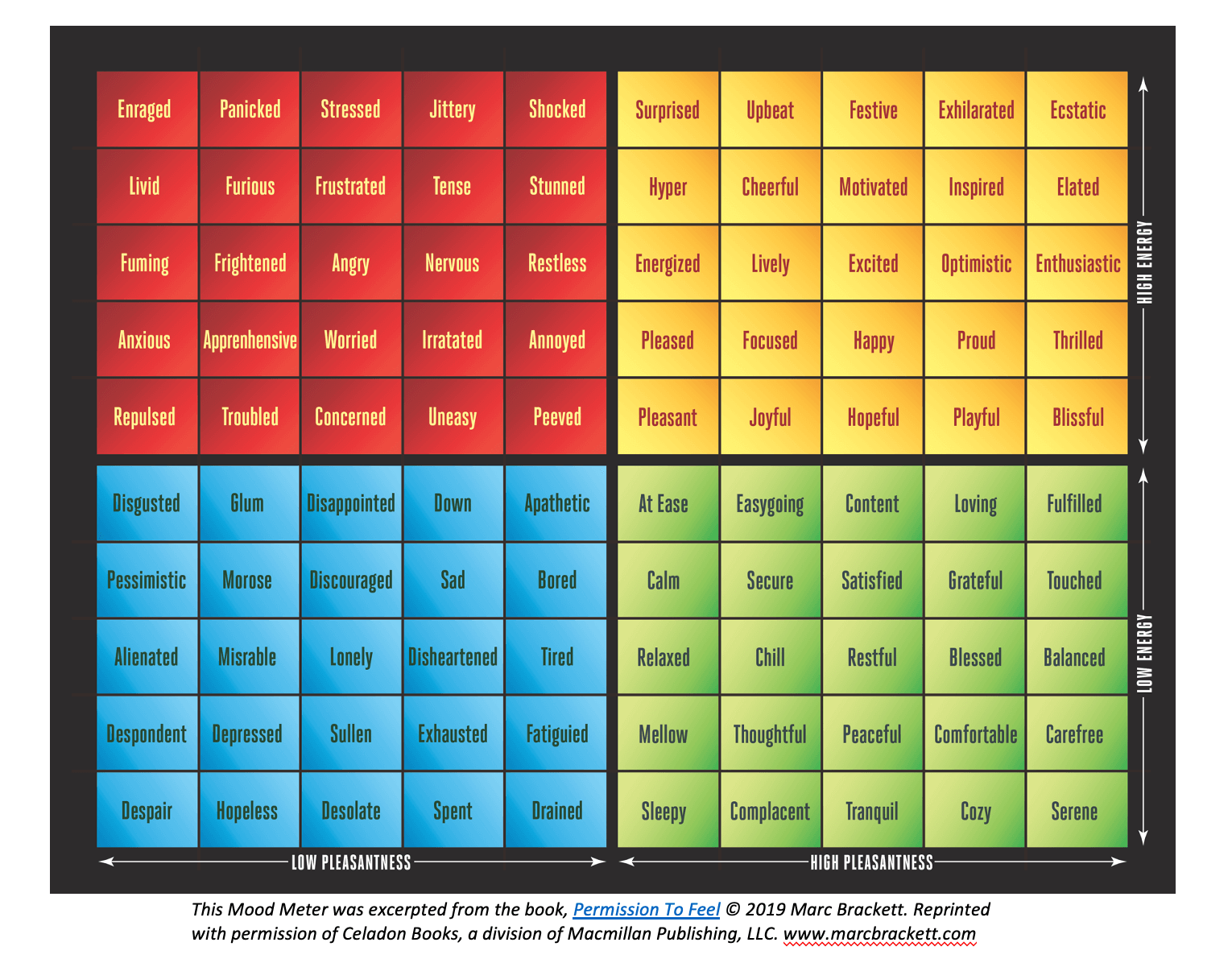
Fifteen months ago I started using How We Feel, a free app built by Marc Brackett's team at the Yale Center for Emotional Intelligence and Ben Silbermann of Pinterest. The app opens onto a grid called the Mood Meter, a square split into four colored quadrants by two axes: energy running up and down, pleasantness running left and right. Yellow is high energy and pleasant. Green is low energy and pleasant. Blue is low energy and unpleasant. Red is high energy and unpleasant. Somewhere in that grid sit 144 words, and the app asks you to pick the one that fits.
Brackett describes the underlying idea in Permission to Feel. Emotions are information. Learn to name them precisely and you can begin to work with them.
I checked in two or three times a day. I picked a word, tagged who I was with and where I was, and put the phone back down on the counter. Four hundred fifty-nine days out of four hundred sixty-one have an entry. I missed two.
Then it started to feel like a chore.
That was the thought that sent me to the export button. Not despair about the app, just a low suspicion that I had stopped learning anything from it, and underneath that suspicion a guess I was fairly confident about: I bet I'm mostly logging good. I pulled the file to confirm it. The file confirmed it. And then the file kept going, and showed me why good was the wrong thing to be confident about. This is the trap we play as sellers. We sell ourselves a good narrative, and if we don't validate it, we keep running the same behaviors and getting no results.
Two words, a third of the year
The word I chose most often was Good. One hundred fifty-five times. Second was Tired, one hundred forty-seven.
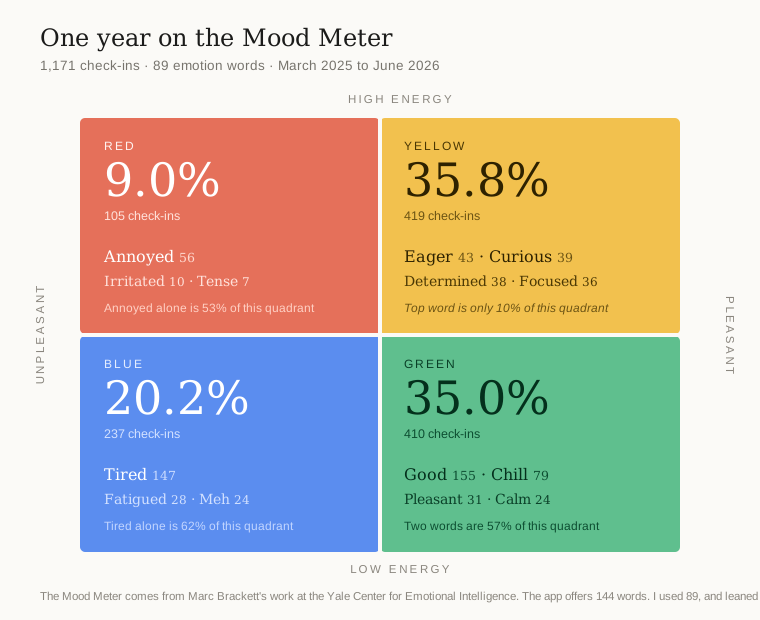
Call Chill a variety of Good, which is honest, since I reach for both when nothing in particular is happening. Now those two ideas cover 32.5% of every check-in I made in fifteen months.
The app defines Good as feeling positive, like things are just fine. Good means fine. Fine, spoken by any adult halfway out a door, means nothing. So a third of my emotional record says nothing, in two flavors.
Here is the part I got wrong about myself, and it took the data to correct it. I assumed I had gone on autopilot in a mechanical way, thumbing the same square out of laziness. That is not what happened. What happened is that I would open the grid, land in green, and stop differentiating. I was not choosing among the words in that quadrant. I was scanning for recognition, and recognition was Good.
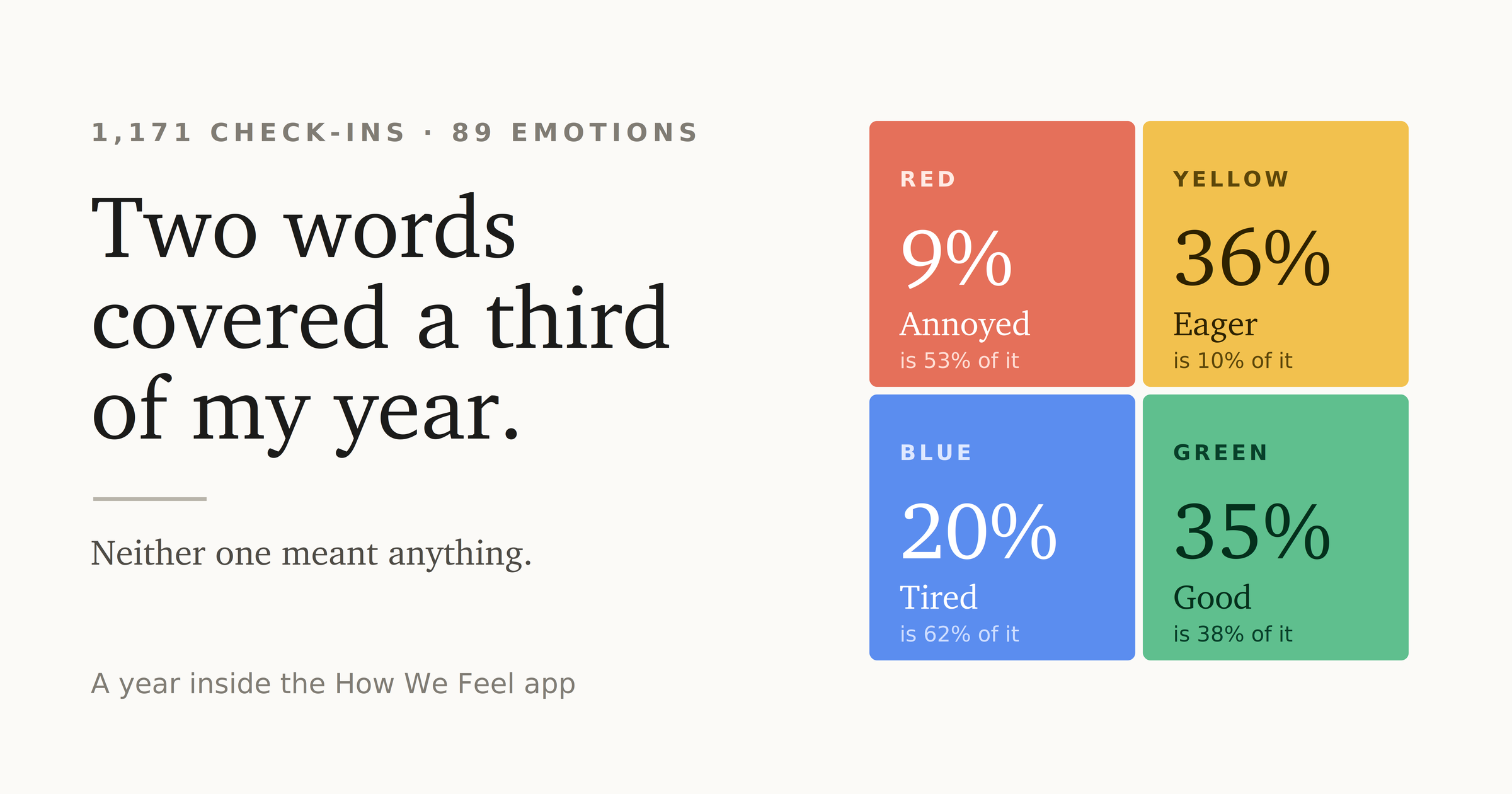
The numbers show it. In yellow, my most-used word accounts for 10% of the quadrant, spread across Eager, Curious, Determined, Focused. In green, two words swallow 57%. In blue, Tired alone is 62%. In red, Annoyed is 53%.
Yellow is the only quadrant where I was still doing the work.
The discipline held. The vocabulary went generic.
In my first three months I used 53 different emotions, and Good accounted for 4.9% of my check-ins. In my last three months I used 38, and Good accounted for 34.4%.
Nothing broke. I never skipped a week, never got bored, never quit, and I would have told you right up until the export that the habit was healthy, that it was doing what habits do. That was the problem, because the discipline was the only part of it still working. Every month I gave the app the same number of taps and a little less signal.
Across all 1,171 entries I named 89 emotions. Twenty-nine of them I used exactly once.
Once for Angry. Once for Ashamed. Once for Lonely. Once for Burned Out. Once for Proud.
Two readings are available and I think both are true. The first is underuse, which is the polite word. I was proud more than once last year and reached for Good, because Good was already on the screen and Proud asked me to admit something.
The second reading is worse. The emotions had started closing in around the act of tracking them. I was not recording a feeling. I was performing a check-in, and the check-in had a shape, and the shape had a vocabulary of about four words.
Which is Burns's point, arriving from a direction I didn't expect
David Burns has been saying one thing since Feeling Good came out in 1980, and it is the thing I have quoted at other people since I learned it. Events do not cause feelings. Thoughts do. Between what happens and what you feel, there is always an interpretation, and the interpretation is where the leverage lives.
Brackett's model says the same thing from the other side. An emotion arises from an appraisal of a stimulus, which is a tidier way of saying that the story you tell yourself about the meeting is the meeting, as far as your body is concerned.
So look at the record again. My thoughts had gone on autopilot, and the feelings that came out the other end were the feelings an autopiloted thought produces. I'm fine. I'm good. I'm tired. That is a thought with the reflection sanded off, arriving on schedule.
And the schedule turns out to be real.
The clock knew before I did
I had a theory about this. My guess was that the app's random prompt times had already decided my answer, so that six in the evening meant Tired and one in the afternoon meant Good, and I told myself the pattern was that simple.
The clock does predict the word. I had the hours wrong.
At 6:00 a.m., Tired accounts for 52.6% of my check-ins. Not 12.6%, my average, but better than half. At 1:00 p.m., Good is the most common word, as I guessed. But at 6:00 p.m., Tired shows up 6.2% of the time, less than half my baseline, and the most common word is Good. At 5:00 p.m., across forty-seven check-ins, I logged Tired zero times.
Tired bookends the day. It owns the first three hours and the last two. It does not live at six in the evening at all.
I expected the data to confirm my pattern: tired as my day wound down. My day didn't wind down at six. I wasn't usually tired at six. I was fine, and I stayed fine for two more hours, until Tired arrived at eight and climbed from there. Even my account of being autopiloted was an autopiloted account. I had not reflected on the instincts that led to the judgment. Before this audit, I would answer that my days ended with me tired, but maybe it's tired of being good?
When the guess arrives the same way the emotions did, plausible and unexamined, it still feels like knowing. But it's a default. Emotional energy is contagious whether you harness it or not. What you bring to a room shapes the room.
What the axis actually gave me
I want to defend the grid, because it taught me something a list of words could not.
Living inside two axes for a year made me fluent in one dimension I had never tracked at all. I now notice energy as a separate thing from mood. I can tell that I am running low without deciding that anything is wrong, and I can tell that I am wired without calling it happiness. I will keep using the app.
The return on it was modest. I learned to read my battery. I did not learn to read myself.
And on one axis I got worse. For a long stretch I stopped registering the difference in energy between blue and red, which sounds academic until you watch what it does to a room. My anger looks like my tired. My frustration looks like my tired. Flat voice, low volume, nothing on my face, and a word in my head that costs me nothing to say, because Tired is a feeling you can have at nobody.
Annoyed is a feeling you have at someone. It shows up 56 times in my record, my most common unpleasant word after Tired, and it clusters at home, in the evening, with the people I love most.
Blue asks nothing of anybody. Red asks a question: at whom, and about what.
When I file red under blue, I am not just misreading myself. I am handing everyone around me a bad map. They think I am depleted and they leave me alone, when what I needed was to say the thing out loud.
My data cannot prove I mislabeled those moments, and I want to be careful there, because the emotion I did not log is by definition not in the file. What the file shows is that blue outnumbers red better than two to one, and that 62% of blue is one word. Make of that what you will. I know what I make of it.
What changed
The documentation never made me lie to myself. It gave me something to argue with.
Now, when I go to tap Tired, the record is standing there with its 147 tally marks, and I have to ask the question: Am I tired? Usually, sure. But is Tired the predominant emotion, or is it the easiest thing to click? I click it because it's the easiest. So I'll challenge the assumption, and I'll look at this record again in a few months. Not in fifteen.
I write a sentence now, using the app's journal function. The emotion, then one line about why, maybe the situation. That is the whole change, and it does something I did not anticipate: I keep changing my answer partway through writing it. The word I picked by default turns out to be more complicated once I have to explain it, and by the time the sentence is finished the emotion has usually moved. Naming it precisely ends the state and starts a better one.
What the default was protecting me from is about five seconds of courage. Five seconds to look at the thing and file it accurately. Skip those five seconds and you have not saved any time, you have only agreed not to know where you are, and there is no navigating from a position you have declined to locate. And that made the app feel like a chore, which led me to consider deleting it. Instead I exported the data.
Burns gives me a tool for the rest: the Daily Mood Log. Describe the upsetting event. Rate the feelings. Catch the automatic thought. Name the distortion driving it. Write a reframe that has to be true, not merely positive. He is explicit that you must name the emotion specifically, embarrassed rather than bad, which is my whole argument arriving from a book published four decades before the app.
I have one complaint, and it is the subject of the next post. The Daily Mood Log wants an upsetting event. It is built for the extremities, for the 9% of my year that landed in red, and it has nothing much to say about the 32.5% that landed on Good. A mood log pointed at the middle has helped more than I expected. More on that next time.
The lesson is not about emotions
I collected for fifteen months and learned nothing, because collection is not analysis. The habit was real and the discipline was real and the return sat at zero until I asked the file a specific question.
This is where AI earns its keep, and not by writing your emails. It takes the pile of evidence you have been faithfully stacking about your own life and tells you what is inside it. My determination built the dataset. I knew I wanted to manage my emotions better. Ninety seconds of analysis found a pattern I had been sitting on top of for a year. I only went looking because I wondered whether the whole thing was a waste of my time.
If you track without a roadmap you have not built a mirror. You have built a well-crafted club to beat yourself with.
Data without a destination becomes evidence for the prosecution. Every honest number turns into proof of a shortcoming. I can read my own export as you wasted a year, you weren't paying attention, you don't even know when you're proud. That reading is available, it is useless, and it is a distortion, because the same file shows I logged 459 of 461 days, that 71% of my year was pleasant, and that real distress accounts for 9% of it.
The number doesn't judge. The frame does. So build the frame first.
Two ways to build it
Build a daily scorecard toward success. Define the line you measure against, in advance. What is a successful day, specifically? What weekly number will you hold yourself to, and what floor will you accept without flinching when the week goes sideways? A scorecard needs a real number, not a feeling about a number.
Or define the techniques and track the reps. Forget the outcome. Name the behaviors that produce it and count the touches. Saying the courageous thing in the meeting. Catching yourself sabotaging the energy in a room, and calling it out before somebody else has to. Choosing the second word instead of the first. Each rep gets a mark, and every mark gets credit.
I have spent a year proving I will do the reps, and that reps without a question attached produce a beautiful, useless archive. So I am running both: a number I am honest about, and a tick mark every time I spend the five seconds.
The export finally left me with this. Red was nine percent of my year. Blue and green were fifty-five. Red announces itself, everyone in the room knows when you are in it, and somebody usually asks, which is precisely why red was never the thing doing the damage. The quadrants that ate my year arrived with no alarm attached. Tired asks nothing. Good asks less.
A morning in red will affect the afternoon. An afternoon in red will affect the next morning. We are diligent about that. We are not diligent about the consequences of blue and green. Role and identity are not separate accounts.
So export something. Anything you have been faithfully stacking and quietly not reading: steps, revenue, calls, moods. Open the file, ask it the one specific question you are slightly afraid to ask, and then go tell somebody what it said.
Mine had been waiting fifteen months.