In sales, leadership, and business development, the words you use shape your results.
One of the most disempowering words in the English language, especially for sales professionals, is the word “try.”
It sounds harmless, but in reality, it often signals hesitation, lack of commitment, and an easy exit when things get uncomfortable.
If you want stronger performance, better accountability, and more consistent results, it may be time to remove this word from your vocabulary.
What Does “Try” Really Mean in Sales?
The dictionary definition of try is simple:
To make an attempt at something.
On the surface, that sounds positive.
But in practice, “trying” often means doing something halfway, without full commitment, or without a clear plan to succeed.
In high-performing sales environments, intention matters.
Top performers focus on behavior, attitude, and technique, not vague attempts.
That is why in the Sandler methodology, language matters.
Sales professionals are encouraged to be precise, accountable, and intentional in what they say and do.
Before you say “I’ll try,” ask yourself:
What specific action will I take?
When will I take it?
Am I fully committed to doing it?
If the answer is unclear, you are not committing, you are leaving yourself an escape route.
Why the Word “Try” Reduces Trust and Confidence
Imagine this conversation:
“Can you help me this afternoon?”
“I’ll try.”
Does that inspire confidence?
Probably not.
Most people hear “I’ll try” as:
Maybe
If I have time
If nothing else comes up
If I feel like it
In sales, that lack of clarity can damage trust, both internally and with prospects.
Strong sales cultures are built on clear commitments, not vague intentions.
How “Trying” Shows Up in Business Development
Salespeople often believe they are working hard, but when you look closely, they are only trying.
Examples include:
Going to a networking event but only talking to people you already know
Making one cold call, getting voicemail, and stopping
Planning prospecting time but answering emails instead
Saying you will follow up, but not scheduling it
Each of these feels like effort.
But effort without commitment rarely produces results.
Trying is comfortable.
Doing requires discipline.
The Sandler Mindset: Do or Do Not
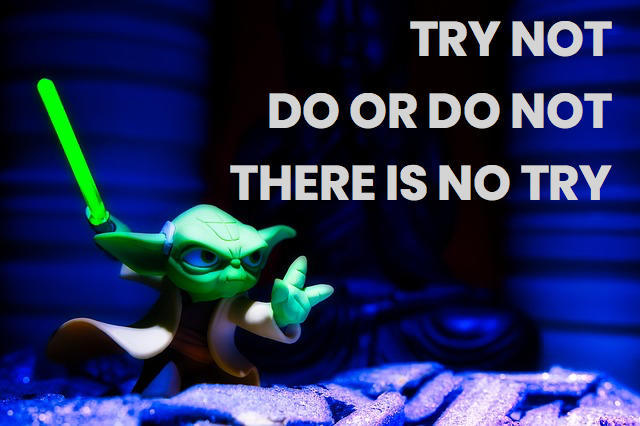
There is a famous line from Star Wars:
“Do. Or do not. There is no try.” – Yoda
It is simple, but it perfectly describes the mindset required for consistent sales success.
High performers do not rely on motivation.
They rely on commitment to specific behaviors.
They decide in advance:
How many calls they will make
How many meetings they will schedule
How often they will prospect
What actions they will take every day
They do not try to do these things.
They do them.
How to Eliminate the Word “Try” From Your Vocabulary
This is a simple exercise that can change your results quickly.
For one week, pay attention every time you say:
I’ll try
I’ll give it a shot
I should try
I’ll see what I can do
Replace it with one of these:
I will do it
I will not do it
I will do it by this date
I need to reschedule, but I will commit to a time
You will notice two things immediately:
You become more intentional
Other people trust you more
Clarity creates confidence.
Why This Matters for Sales Leaders and Teams
When sales teams rely on “trying,” pipelines become unpredictable.
Forecasts become unreliable.
Goals become harder to hit.
Organizations that build a culture of commitment instead of attempt see:
Stronger accountability
Better prospecting discipline
More consistent closing ratios
Higher confidence from leadership
This shift does not require new technology.
It requires new habits.
Ready to Build a Culture of Commitment Instead of “Trying”?
If you want your sales team to be more disciplined, more accountable, and more consistent, the Sandler methodology provides a proven framework for building those behaviors.
Sandler by Breakthrough Selling works with sales professionals, leaders, and organizations to install the mindset, skills, and structure needed for predictable growth.
Through training, coaching, and reinforcement, your team learns how to replace hesitation with commitment and activity with results.
Contact Sandler by Breakthrough Selling to learn how to strengthen your sales culture and improve performance.