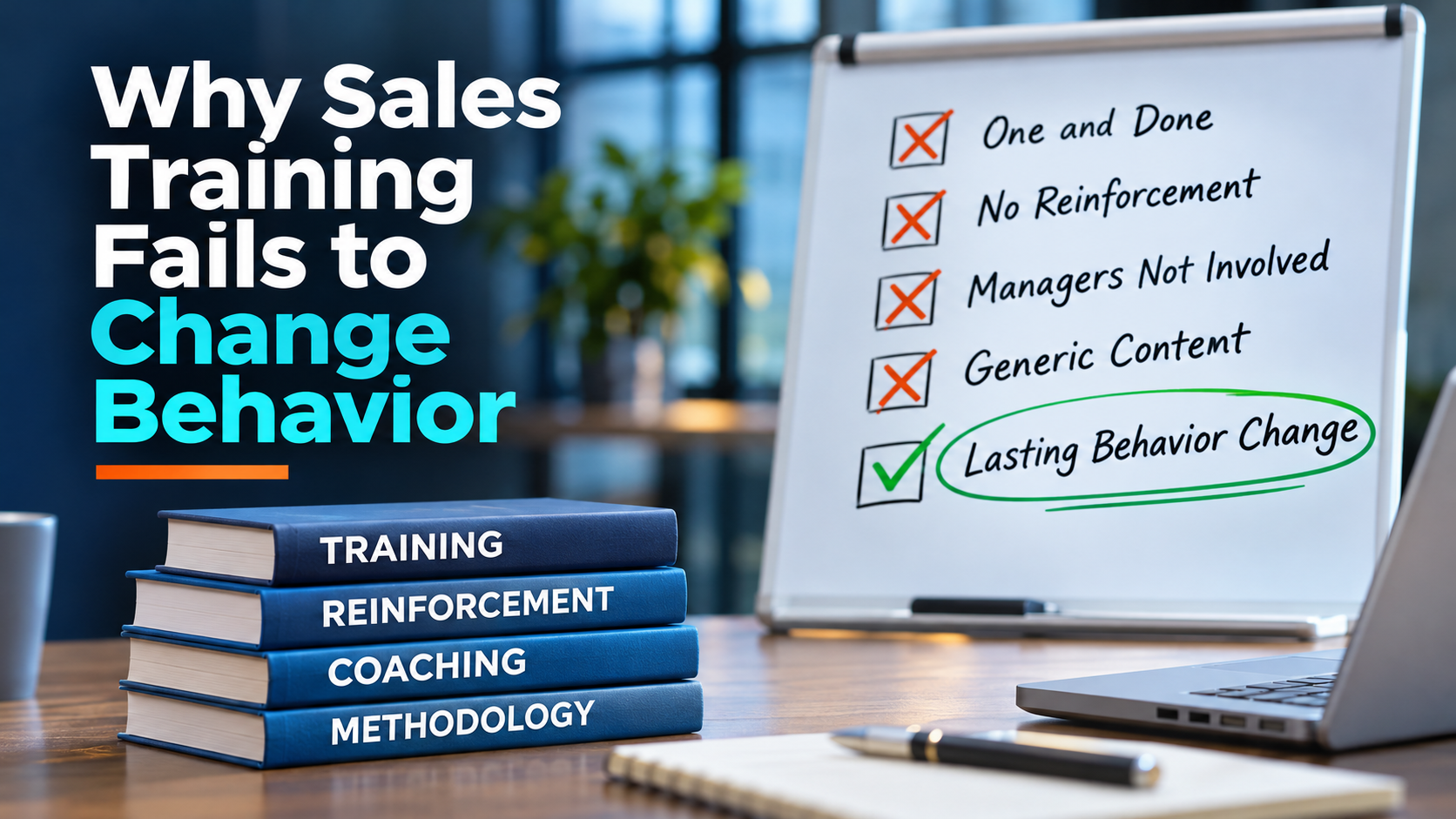
Your sales team just wrapped up a training program. Reps seemed engaged, took notes, and aced the post-session quiz. Three months later, nothing has changed. The same pipeline problems persist, close rates remain flat, and the investment feels wasted. This pattern frustrates sales leaders across every B2B industry.
The problem is rarely the content itself. It is what happens (or fails to happen) after the workshop ends. Sales Careers Canada helps organizations build sales training programs that create lasting behavior change through reinforcement, coaching, and a repeatable methodology. This article breaks down the specific reasons training fails to stick and what you can do about each one.
Key Takeaways: Why Sales Training Fails to Change Behavior
- Knowledge transfer alone does not produce lasting behavior change without structured reinforcement over weeks and months.
- Sales managers who do not actively coach after training events undermine the entire investment in new skills.
- Generic one-size-fits-all programs ignore individual skill gaps and consistently fail to engage experienced sales professionals.
- Sales Careers Canada builds reinforcement into every training engagement to drive measurable, long-term performance improvement.
- Treating training as a single event rather than a continuous development system guarantees that new skills will fade.
Reasons Your Sales Training Programs Are Not Changing Behavior
1. Training Is Treated as a One-Time Event
A two-day workshop can introduce fresh concepts, but it cannot rewire selling habits that took years to form. When there is no follow-up plan in place, reps default to old patterns by the following Monday.
Behavior change requires repeated exposure spread over weeks and months. Build reinforcement sessions, micro-learning modules, and weekly coaching conversations into your post-training plan. Space these activities across at least 90 days to anchor new habits into daily selling routines. The organizations that see lasting results are the ones that treat training as a starting point, not a finish line.
2. No Reinforcement System Exists After the Workshop
Research on the forgetting curve shows that people lose a significant portion of new information within days if nothing reinforces the learning. In sales, this means reps may pass a quiz on day one and forget the technique entirely by day thirty.
Spaced retrieval practice helps counter this decay. Short quizzes, role-play reruns, and manager check-ins scheduled at regular intervals keep new skills active. Sales Careers Canada structures all learning into a continuous improvement journey that includes practice, application, and ongoing coaching.
3. Sales Managers Are Not Involved in the Process
Trainers deliver the content, but managers are the ones reps answer to every day. When managers do not participate in training design or follow-up, adoption suffers because no one reinforces the new behaviors on the front line.
Involve your sales leaders from the very beginning. Have them co-design learning objectives, attend key sessions, and commit to weekly coaching conversations that reference what was taught. Their visible support signals to the team that this investment matters and that the new approach is the standard going forward.
4. Training Content Does Not Match Real Selling Situations
Generic programs built for a broad audience miss the mark with experienced sellers. If the scenarios are irrelevant or the concepts are too basic, reps mentally check out before the first break.
Customize training to reflect your actual sales process, deal complexity, and buyer profiles. Use real customer objections, common deal-stalling situations, and role plays modeled on your pipeline. Relevance drives engagement, and engagement is the prerequisite for behavior change. Tailor content by role, experience level, and market segment to make every session directly applicable.
5. There Is No Clear Connection Between Training and Performance Metrics
When organizations do not tie training outcomes to measurable performance indicators, it becomes impossible to know whether the program worked. Without data, accountability vanishes and reps quietly abandon the new approach.
Define specific metrics before the program launches: pipeline velocity, forecast accuracy, close rates, and average deal size. Track these benchmarks at 30, 60, and 90 days post-training. Measurement creates visibility, and visibility makes it far harder to ignore the gap between knowing something and consistently doing it in live selling conversations.
6. The Program Focuses Only on Skills and Ignores Mindset
Teaching a new closing technique is useless if the rep holds a belief that asking direct questions about budget is rude or pushy. Limiting beliefs about selling quietly sabotage even the most sophisticated skill-building programs.
Address attitudes and beliefs alongside techniques. The Sandler Selling System identifies three elements required for lasting success: behavior, attitude, and technique. All three must be developed together. Reps who only learn the "what" without examining the "why" will revert to old habits when facing a live buyer conversation.
7. Training Tries to Cover Too Much in Too Little Time
Cramming a full curriculum into a single multi-day event overwhelms learners. Reps retain only a fraction of what was presented and leave feeling unsure about where to start applying the material.
Break training into smaller, focused modules spread over a longer timeframe. Each module should target one or two specific skills that reps can practice immediately. This modular approach prevents overload and gives learners time to absorb, apply, and get feedback before moving to the next concept. Sales Careers Canada delivers flexible training programs designed around this principle.
8. No Sales Process or Methodology Supports the New Skills
Skills taught in isolation dissolve quickly if there is no underlying process to anchor them. Without a shared methodology, each rep defaults to a personal approach, and the training becomes a disconnected set of tips rather than an integrated system.
Pair skill-building with a structured sales performance ecosystem that gives every rep a common language, a repeatable process, and clear criteria for qualifying and advancing deals. When the methodology is embedded in daily workflows, new skills have a framework to live inside.
9. Coaching Happens Rarely or Not at All After Training
Training introduces new concepts. Coaching is what makes those concepts usable in live selling situations. Without regular, skill-specific coaching conversations, reps lack the personalized feedback needed to correct mistakes and build confidence.
Schedule recurring one-on-one coaching sessions that focus on behaviors taught during training. Use pre-call and post-call discussions to reinforce key principles in the context of real deals. Technology solutions like AI-driven roleplay tools also give reps a way to practice between formal coaching sessions and build the muscle memory that turns concepts into consistent selling behaviors.
10. Leadership Does Not Model the Behaviors Being Taught
When senior leaders and executives visibly ignore the methodology their teams are being trained on, it sends a clear message: this is optional. Reps pay attention to what leadership does, not just what leadership says.
Executives and front-line managers need to use the same language and frameworks being taught in training. Reference the methodology in pipeline reviews, forecast meetings, and leadership development sessions. When the entire organization operates from a shared system, training stops being a standalone event and becomes part of how you sell.
How to Build Training That Produces Lasting Behavior Change
The pattern is consistent: sales training fails when it operates as an isolated event disconnected from reinforcement, coaching, and daily workflows. Every item on this list points to the same root cause. Organizations invest in knowledge transfer but neglect the system required to turn that knowledge into repeatable selling behavior.
Sales Careers Canada addresses this gap through the Sandler Methodology, which combines structured training with ongoing reinforcement and manager coaching. According to a Sales Management Association analysis (2026), the distinction between awareness and proficiency explains why most programs stop short. Awareness is what a workshop creates. Proficiency requires deliberate practice, measurement, and sustained support.
If your current training program is not producing the behavior change you expected, start by diagnosing where the breakdown is happening. Then build a system around the training, not just a schedule of events.
FAQs About Why Sales Training Fails to Change Behavior
Why does sales training fail to produce lasting results?
Sales training fails to last because organizations treat it as a single event rather than an ongoing development system. Without reinforcement, coaching, and measurement built into the weeks and months after training, reps forget new skills and revert to familiar habits.
How long does it take for sales training to change behavior?
Meaningful behavior change typically requires 90 days or more of consistent reinforcement. Short workshops create awareness, but converting that awareness into repeatable selling skills demands ongoing practice, manager coaching, and opportunities to apply new techniques in live situations.
What role do sales managers play in training effectiveness?
Sales managers are the primary drivers of training transfer. They reinforce new behaviors through coaching conversations, pre-call planning, and post-call debriefs. When managers actively participate in and support the training process, adoption rates increase significantly.
How can organizations measure whether sales training is working?
Track specific performance metrics at 30, 60, and 90 days after training. Pipeline velocity, close rates, forecast accuracy, and average deal size give you objective data points. Comparing pre-training baselines against post-training results reveals whether the program is changing behaviors.
What makes the Sandler Methodology different from other training approaches?
Sales Careers Canada delivers the Sandler Methodology, which addresses behavior, attitude, and technique together rather than focusing on skills alone. The approach includes continuous reinforcement, manager coaching development, and a repeatable sales process that becomes part of how teams sell every day.
Can AI tools help with sales training reinforcement?
AI-powered tools provide reps with on-demand practice opportunities between coaching sessions. They offer scenario-based roleplay, real-time feedback, and call analysis that help sellers refine skills outside of formal training. These tools supplement manager coaching rather than replace it.