Why Your Sales Team Is Underperforming (And It’s Probably Not a Skills Problem)
Revenue Is Flat. The Pipeline Looks Full. Forecasts Keep Missing.
You have a sales team.
You have a CRM.
You have dashboards.
You may have invested in sales training.
Your managers tell you the team is “working hard.”
And yet revenue growth feels inconsistent, fragile, or slower than it should be.
Forecasts are optimistic at the beginning of the quarter.
By the end of the quarter, explanations replace results.
If this sounds familiar, you are not alone.
But here’s the critical insight most executive teams miss:
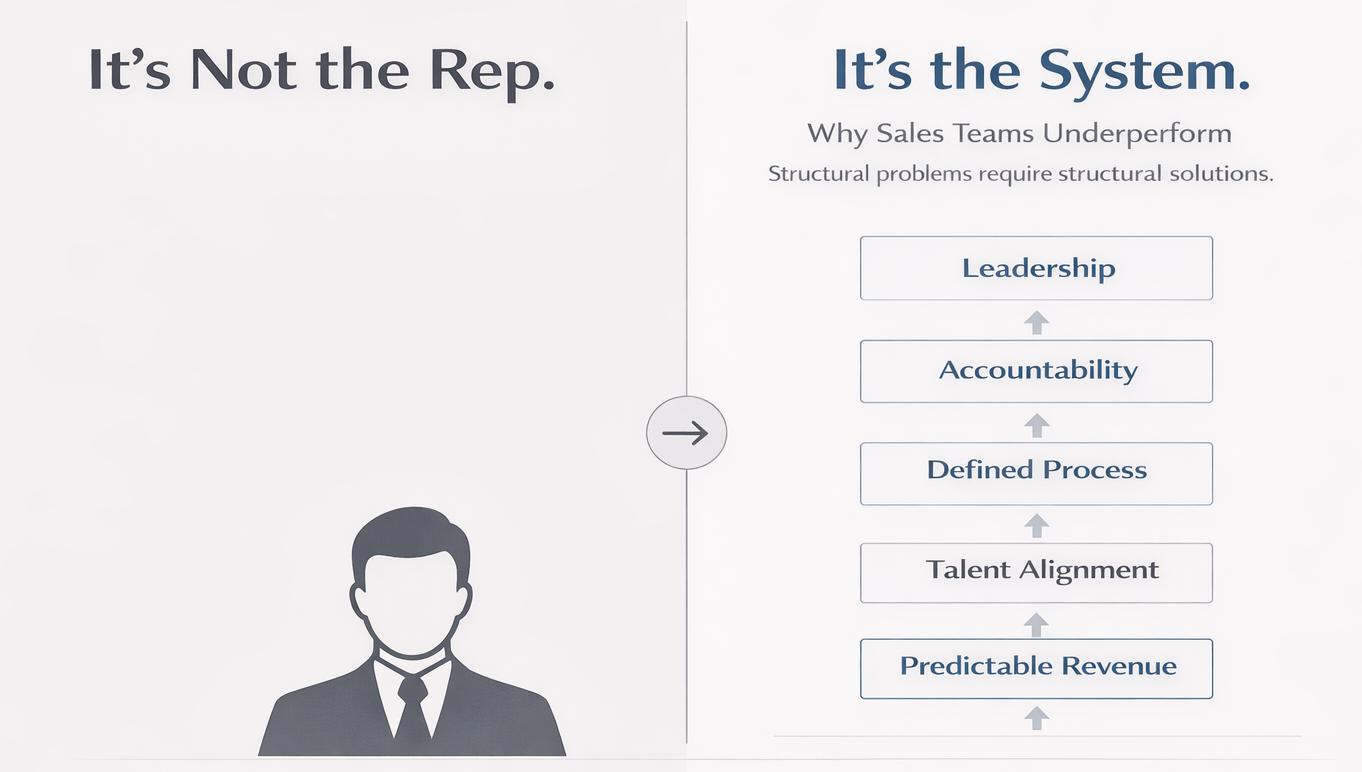
Sales underperformance is rarely a talent problem. It is almost always a structural problem.
And structural problems cannot be solved with more activity, more motivation, or another closing workshop.
They require system redesign.
What Sales Underperformance Really Means
Before we diagnose it properly, we need to define it clearly.
What Is Sales Underperformance?
Sales underperformance occurs when revenue output consistently falls below the realistic potential of:
- Your market opportunity
- Your team capacity
- Your operational infrastructure
- Your pricing and margin structure
It is not about effort.
It is about inefficiency within the revenue system.
It typically appears as:
- Chronic quota misses
- Inaccurate forecasting
- Heavy reliance on one or two “hero” reps
- Margin erosion through discounting
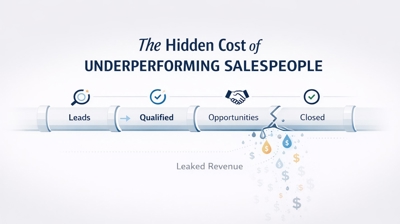
- Pipeline bloat with low conversion
- Increased sales cycle length
- Frustration between leadership and sales
Underperformance is rarely loud at first.
It creeps.
It normalizes.
It becomes “just how it is.”
Until growth stalls completely.
The Executive Misdiagnosis
When revenue plateaus, leaders often assume:
- “We need stronger closers.”
- “We need better training.”
- “Marketing needs to generate more leads.”
- “We need more aggressive comp plans.”
- “The market is tougher this year.”
Those explanations are easy.
They are also frequently wrong.
Here is the better question:
If you doubled your sales team tomorrow, would revenue double?
If the honest answer is no, then the constraint is structural — not individual.
You don’t have a production problem.
You have a system problem.
The 9 Structural Causes of Sales Underperformance
Let’s go deeper than surface-level advice.
1. You Don’t Have a Revenue Engine — You Have Independent Operators
Many organizations believe they have a “sales process.”
But if you ask five reps to describe it, you’ll get five variations.
That means the process lives in people’s heads — not in the organization.
When sales is personality-driven instead of system-driven:
- Forecasting becomes subjective
- Coaching becomes inconsistent
- Performance becomes volatile
- Scaling becomes impossible
A revenue engine requires:
- Clearly defined pipeline stages
- Written exit criteria for each stage
- Qualification standards
- Required prospecting behaviors
- Conversion benchmarks
- Weekly inspection
Without these, revenue becomes hope-based.
Hope is not a growth strategy.
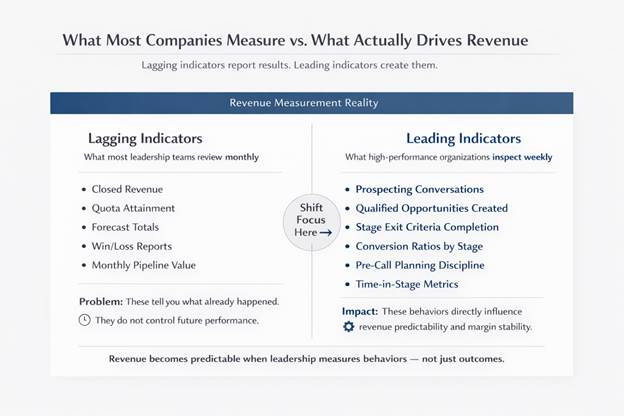
2. You Measure Revenue — Not Behavior
Revenue is a lagging indicator.
By the time you see it decline, the damage is already done.
High-performing organizations measure leading indicators:
- Prospecting conversations
- New opportunities created
- Qualification completion
- Pre-call planning discipline
- Stage conversion ratios
- Time-in-stage metrics
If these are not inspected weekly, performance drifts.
Behavior discipline drives revenue consistency.
Without it, you are reacting instead of leading.
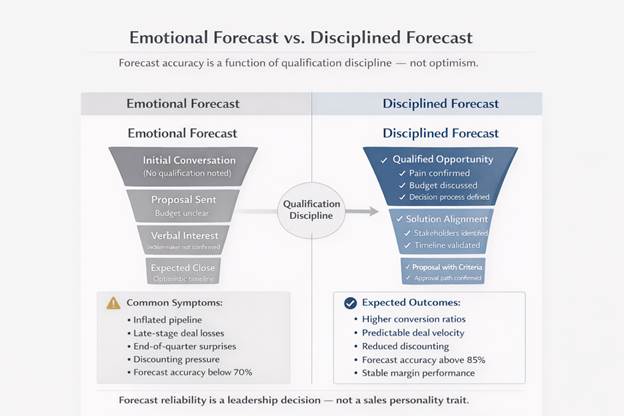
3. Forecasting Is Emotional, Not Mathematical
Many forecasts are based on rep confidence.
Confidence is not qualification.
When forecasting lacks discipline:
- Deals advance without criteria
- Budget is assumed, not confirmed
- Decision-makers are “believed to be involved”
- Urgency is unclear
- Competitor presence is unknown
Forecast accuracy below 85% is a red flag.
It signals structural weakness.
Reliable forecasting requires:
- Stage exit criteria
- Standardized qualification questions
- Manager deal reviews
- Evidence-based advancement
Without this, pipeline becomes fiction.
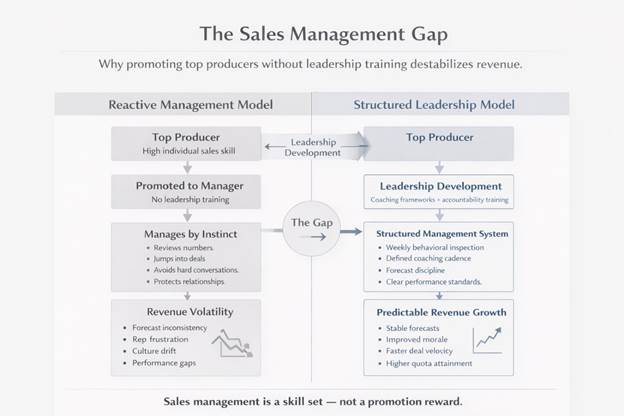
4. Sales Managers Were Promoted — But Never Trained
This is one of the most common hidden causes of underperformance.
Top producers are often promoted into management.
But production and leadership are different skill sets.
Untrained sales managers often:
- Avoid difficult conversations
- Rescue deals instead of coaching process
- Focus on numbers instead of behavior
- Accept excuses to preserve relationships
- Struggle to enforce standards
Revenue underperformance frequently traces back to management capability gaps.
Strong sales leadership requires:
- Coaching frameworks
- Behavioral accountability systems
- Structured one-on-ones
- Performance management discipline
- Talent development planning
Without manager development, revenue stalls quietly.
5. Qualification Is Weak (And Everyone Knows It)
Weak qualification creates false optimism.
Reps move deals forward prematurely because:
- They want pipeline volume
- They avoid hard budget conversations
- They fear losing the opportunity
- They want management approval
When qualification is weak:
- Close rates drop
- Sales cycles lengthen
- Discounting increases
- Forecasts miss
Strong qualification improves:
- Confidence
- Efficiency
- Margin protection
- Time management
The fastest way to improve revenue predictability is tightening qualification standards.
6. Discounting Is Masking Structural Weakness
When margins shrink, many leaders blame market pricing pressure.
But discounting often masks:
- Weak value articulation
- Poor upfront qualification
- Late-stage desperation
- Lack of decision authority
- Emotional attachment to deals
Discounting is rarely about price sensitivity.
It’s about confidence and process breakdown.
If reps rely on price to close, your system is leaking value.
7. Hiring Is Gut-Driven, Not Data-Driven
Revenue problems often originate in hiring.
Common mistakes:
- Hiring based on charisma
- Overvaluing industry experience
- Ignoring behavioral fit
- Skipping objective assessment tools
- Inconsistent onboarding
Without predictive hiring systems:
- Ramp-up takes longer
- Turnover increases
- Coaching burden rises
- Performance variability expands
Strong revenue engines begin with disciplined selection.
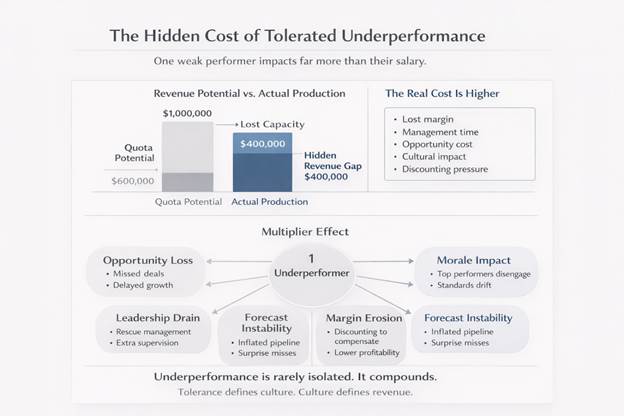
8. Underperformance Is Tolerated Too Long
Tolerance defines culture.
When weak performance continues without consequence:
- Standards erode
- High performers disengage
- Managers lose credibility
- Accountability becomes optional
The cost of tolerating one weak performer is not just salary.
It includes:
- Opportunity cost
- Morale decline
- Cultural drift
- Leadership distraction
High-performance cultures address gaps early.
Low-performance cultures rationalize them.
9. Leadership Avoids Structural Redesign
Sometimes leaders see the issues.
But redesigning a revenue system requires:
- Hard conversations
- Culture shifts
- Manager retraining
- Clear standards
- Consequence management
That feels uncomfortable.
So organizations try incremental fixes instead:
- More training
- More incentives
- More activity
Without structural alignment, incremental fixes fail.
The Cultural Impact of Revenue Instability
Revenue instability creates emotional instability.
When performance fluctuates:
- Leadership becomes reactive
- Sales becomes defensive
- Finance becomes cautious
- Hiring slows
- Strategy shifts frequently
A disciplined revenue system stabilizes culture.
Predictability builds confidence.
Confidence accelerates growth.
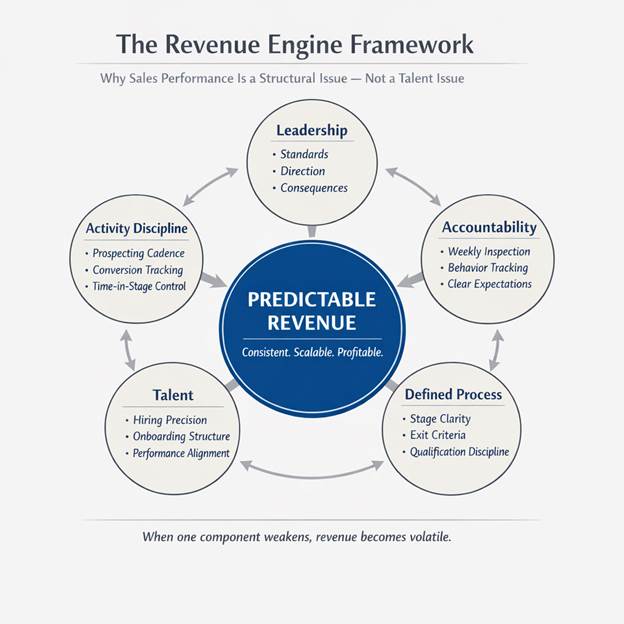
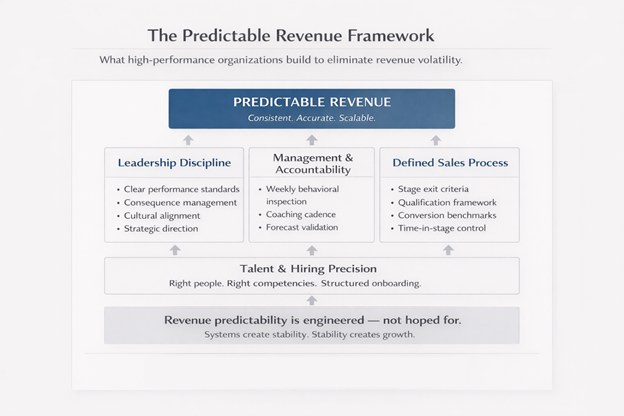
What Predictable Revenue Organizations Do Differently
Companies with consistent revenue growth share patterns:
- Weekly behavior inspection
- Documented qualification frameworks
- Defined stage exit criteria
- Structured coaching rhythm
- Clear performance consequences
- Data-driven hiring
- Leadership alignment
Notice what’s not on that list?
Motivation.
Motivation without structure fades.
Structure sustains performance.
Executive Diagnostic Questions
If you want clarity quickly, ask yourself:
- Are behaviors inspected weekly — or just revenue reported monthly?
- Is our forecast accuracy above 85%?
- Do managers coach proactively or rescue reactively?
- Do we have documented stage exit criteria?
- How long do we tolerate underperformance?
- Do we use objective hiring assessments?
- Are margins stable — or dependent on discounting?
Your answers will reveal your structural constraints.
The Financial Impact of Structural Weakness
Let’s quantify this.
Assume:
- 8 sales reps
- $1M annual quota each
- 60% quota attainment average
That is a $3.2M revenue gap.
Most leaders assume that gap is “market conditions.”
Often it’s structural inefficiency.
Even a 10% performance lift through structural improvements produces significant revenue expansion — without increasing headcount.
Structural clarity is a growth multiplier.
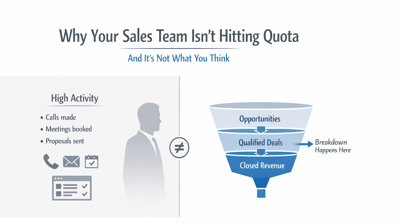
Why Activity Alone Makes It Worse
When revenue dips, organizations often push for:
- More calls
- More emails
- More meetings
- More pipeline
But if qualification and process are weak, increased activity amplifies inefficiency.
More unqualified deals.
More forecast volatility.
More discounting.
More burnout.
Better structure reduces noise.
Then activity becomes effective.
Frequently Asked Questions
Why doesn’t sales training alone fix revenue problems?
Because skills degrade without reinforcement.
Behavior change requires inspection, coaching, and structural accountability.
How do you know if your sales process is broken?
If:
- Forecast accuracy is low
- Stage definitions are inconsistent
- Close rates fluctuate widely
- Managers disagree on pipeline health
Your process is likely informal — not operationalized.
What is the fastest structural improvement you can make?
Implement weekly behavioral inspection with clear leading indicators and stage exit criteria.
Clarity produces rapid pipeline improvement.
How long does structural redesign take?
Initial improvements often appear within 90 days.
Cultural shifts typically stabilize within 6–12 months.
Final Perspective for CEOs and Sales Leaders
Revenue rarely collapses overnight.
It erodes gradually.
You see:
- Slight misses
- Margin pressure
- Pipeline optimism
- Management frustration
The instinct is to “push harder.”
The smarter move is to redesign the system.
Revenue growth should feel disciplined.
Not fragile.
If it feels fragile, your structure needs strengthening.
Executive Next Step
If revenue growth feels inconsistent — and you’re unsure whether the constraint is skills, management, process, or hiring — the first step is structured diagnosis.
At Sandler Prairie Edge, we work with executive teams to:
- Identify revenue bottlenecks
- Install accountability frameworks
- Strengthen sales management capability
- Improve hiring precision
- Build predictable revenue engines
We don’t just train salespeople.
We build performance systems.
👉 Book an Executive Revenue Diagnostic
Because revenue should feel stable, scalable, and strategic.
Not stressful.