The Cost You Don’t See on the P&L
Most leaders know when a salesperson is underperforming.
They see missed quotas.
They hear excuses.
They feel the pressure of inconsistent revenue.
What they don’t see is the true cost.
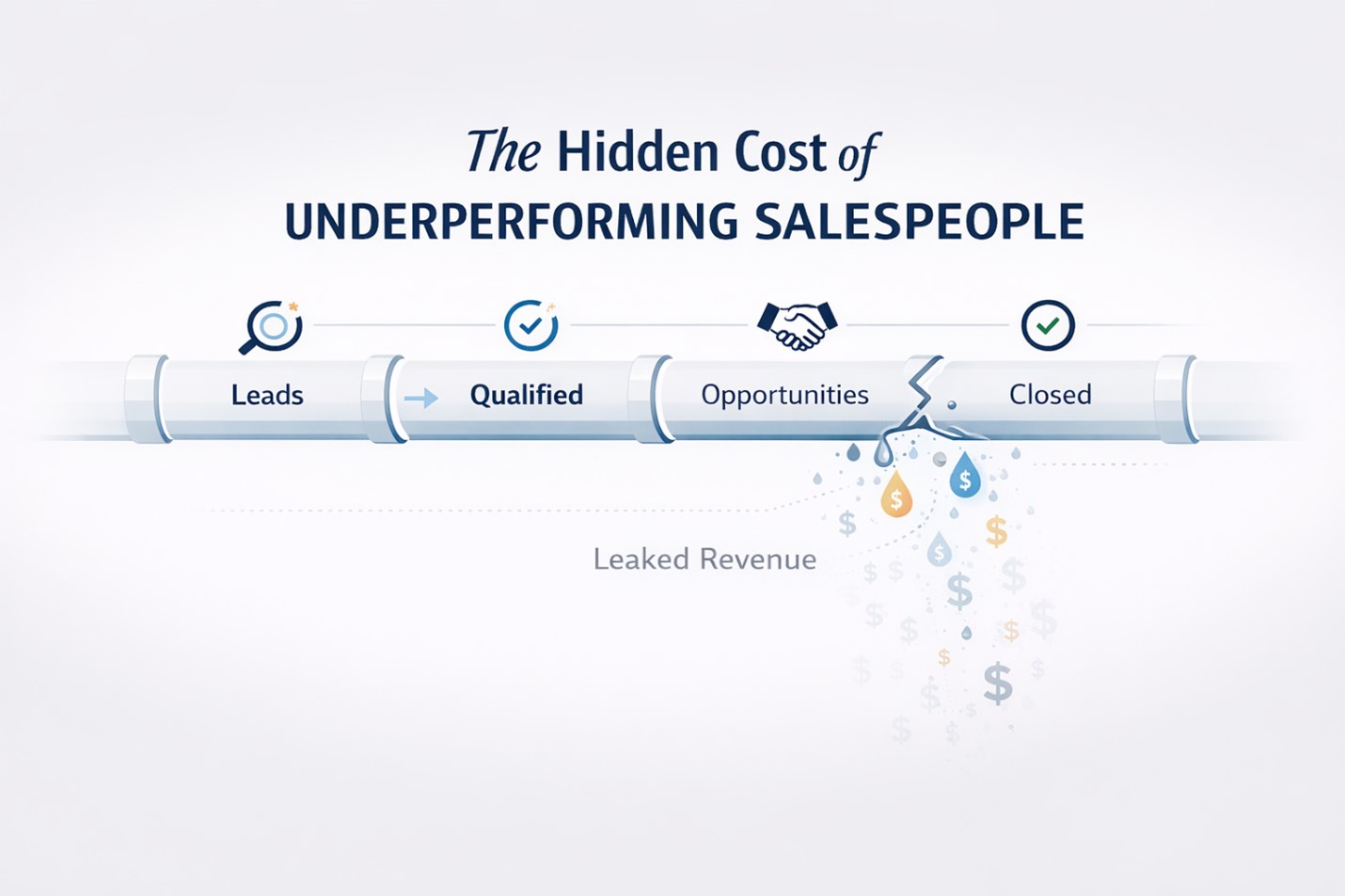
Because underperforming salespeople don’t just miss targets — they quietly drain your organization in ways that rarely show up on a report.
And by the time the problem becomes obvious, the damage is already done.
What Are Underperforming Salespeople (Really)?
Underperforming salespeople aren’t just “low producers.”
They are team members who consistently:
- Miss quota or operate below expectations
- Struggle to maintain a healthy pipeline
- Avoid difficult sales conversations
- Fail to follow a structured sales process
- Require constant oversight or intervention
But here’s the critical insight:
Underperformance is rarely just a skill issue.
It’s usually a symptom of deeper problems in:
- Sales management
- Accountability systems
- Hiring decisions
- Coaching consistency
And when leaders misdiagnose it, they unintentionally make the problem worse.
The Hidden Costs Most Leaders Underestimate
1. Revenue Leakage (That Compounds Over Time)
The most obvious cost is lost revenue.
But it’s not just about missed quota.
Underperforming salespeople:
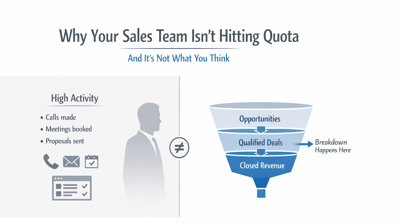
- Fail to convert qualified opportunities
- Let deals stall or die unnecessarily
- Discount too early or too often
- Miss upsell and cross-sell opportunities
This creates invisible revenue leakage.
Across a team, this compounds into:
- Unpredictable forecasts
- Slower growth
- Increased pressure on top performers
And leadership often responds by:
- Increasing targets
- Adding more leads
- Hiring more reps
Without fixing the underlying issue.
2. The Hidden Cost of Leadership Time
Underperformers don’t just cost revenue — they consume leadership capacity.
Sales leaders and executives end up:
- Stepping into deals to “save” them
- Repeating the same coaching conversations
- Managing behaviors instead of developing capability
- Firefighting instead of leading strategically
This creates a dangerous shift:
Leaders become reactive instead of proactive.
And over time, this limits:
- Strategic planning
- Team development
- Organizational growth
In many organizations, the biggest cost isn’t the salesperson.
It’s what leadership stops doing because of them.
3. Cultural Erosion Inside the Sales Team
Top performers notice everything.
They see:
- Who consistently misses targets
- Who gets away with weak performance
- Who leadership protects or avoids addressing
When underperformance is tolerated:
- Standards drop
- Accountability weakens
- Motivation declines
High performers begin to think:
“Why am I pushing this hard if others don’t have to?”
This leads to:
- Reduced effort
- Quiet disengagement
- Turnover of your best people
And now the cost multiplies.
4. Pipeline Distortion and False Forecasts
Underperforming salespeople don’t just miss deals — they distort your data.
They often:
- Overestimate deal probability
- Keep dead opportunities in the pipeline
- Avoid disqualifying weak prospects
- Report activity instead of outcomes
This creates a false sense of security.
Leadership believes:
- “Pipeline looks healthy”
- “We’re on track”
- “Next quarter will be better”
Until it isn’t.
And when forecasts consistently miss, it impacts:
- Hiring decisions
- Investment planning
- Cash flow management
At the executive level, this is more than a sales problem.
It’s a business risk.
5. The Cost of Delayed Decisions
One of the most expensive mistakes companies make:
Keeping underperformers too long.
Why does this happen?
- Hope that performance will improve
- Discomfort with difficult conversations
- Lack of clear performance metrics
- Fear of making the wrong call
But every month of delay adds cost:
- Lost revenue
- Lost time
- Lost opportunities
And perhaps most importantly:
Lost momentum.
Why Most Companies Misdiagnose the Problem
Many leaders respond to underperformance by investing in:
- More sales training
- More tools
- More leads
But these rarely fix the issue.
Why?
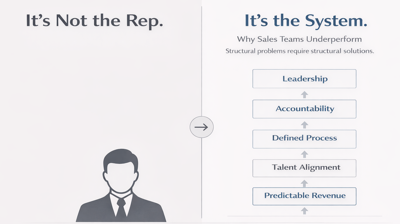
Because the real problems are often:
1. Weak Sales Management
Managers:
- Don’t coach consistently
- Avoid accountability conversations
- Focus on activity instead of behavior change
2. Lack of a Defined Sales Process
Without a structured process:
- Reps improvise
- Deals become inconsistent
- Performance becomes unpredictable
3. Hiring the Wrong People
Many organizations rely on:
- Gut instinct
- Interviews
- Likeability
Instead of predictive assessment and role fit.
What This Means for Leaders
If you’re dealing with underperforming salespeople, the question isn’t:
“How do we fix them?”
The better question is:
“What system allowed this to happen?”
Because high-performing sales organizations don’t rely on luck.
They build:
- Clear expectations
- Structured processes
- Consistent coaching
- Strong accountability
- Predictive hiring systems
And when those are in place, underperformance becomes:
- Easier to identify
- Easier to correct
- Easier to remove when necessary
How to Start Fixing the Problem
You don’t need to overhaul everything at once.
Start with these three steps:
1. Diagnose Before You Act
Before investing in training or hiring:
- Identify where the breakdown actually is
- Separate skill issues from management issues
- Evaluate your sales process clarity
2. Strengthen Sales Management
Your sales manager is the multiplier.
Focus on:
- Coaching consistency
- Accountability conversations
- Performance tracking tied to behavior
3. Reevaluate Hiring and Retention Standards
Ask yourself:
- Are we hiring for fit or familiarity?
- Do we have objective assessment tools?
- Are we keeping people too long?
Strong organizations don’t just develop talent.
They select it properly from the start.
Key Takeaways
- Underperforming salespeople cost far more than lost revenue
- The biggest impacts are hidden: leadership time, culture, and forecasting accuracy
- Most companies misdiagnose the problem and apply the wrong solutions
- The root cause is usually systemic — not individual
- Fixing the system improves performance across the entire team
FAQ: Underperforming Salespeople
Why do salespeople underperform?
Most underperformance is caused by weak management, unclear processes, or poor hiring — not just lack of skill.
Should you fire underperforming salespeople quickly?
Not immediately — but delaying decisions without a clear improvement plan significantly increases cost.
Does sales training fix underperformance?
Only if the root cause is skill-related. In many cases, training alone has little impact.
How do you identify if it’s a system problem?
Look for patterns across the team. If multiple reps struggle, the issue is likely structural.
Final Thought
Underperforming salespeople are rarely the core problem.
They’re the symptom of a system that isn’t working.
And until that system is addressed, replacing individuals won’t change the outcome.