
How Sales Leaders Can Fix It
Most sales managers have watched this play out. A new rep finishes onboarding, knows the product, and walks into a first meeting with a promising prospect. Forty-five minutes later, the rep has delivered a polished presentation, the prospect has shared very little about their business, and no next step is on the calendar.
The rep prepared hard, just in the wrong place. For someone new, product knowledge feels like the obvious route to credibility. Buyers judge a salesperson's competence by the questions they ask long before they care about features. For sales leaders responsible for ramping new hires, closing that gap is one of the fastest ways to shorten time to productivity.
What makes a discovery question weak?
A weak discovery question is one the buyer could answer for any vendor on any day. Questions like "What are your goals for the year?" or "What's getting in the way of hitting your numbers?" seem reasonable. Executives hear them from nearly every salesperson who calls, so the answers come out rehearsed and shallow.
Generic questions also send an unintended signal that the rep skipped their preparation. Company news, leadership changes, hiring activity, and industry pressures are easy to find before a meeting, and AI research tools make that work faster than ever. A buyer who has to explain the basics of their business to a salesperson has little reason to open up about the harder issues underneath.
How much should a salesperson talk during discovery?
Sandler's 70/30 Rule sets a clear benchmark: the prospect talks about 70 percent of the time, and the salesperson about 30 percent. New reps often find this uncomfortable. Silence can feel like a failure to add value.
The ratio works because of how people make decisions. When a prospect describes a problem in their own words, estimates what it costs, and considers what happens if it continues, they persuade themselves that action is needed.
When a salesperson makes those same points in a presentation, the usual response is a polite nod and a request to "send something over." Conclusions a buyer reaches on their own carry far more weight than conclusions a vendor delivers.
Sales leaders can measure this directly. Most call-recording platforms report talk-time ratios, and reviewing a new hire's first ten calls against the 70/30 benchmark quickly shows where coaching is needed most.
What should discovery questions accomplish?
Every question in a discovery meeting should move the buyer toward a clearer picture of their own situation. Filling in CRM fields is a byproduct. Well-built questions help a prospect:
- Put words to priorities they have been carrying around without naming.
- Calculate what the problem costs in revenue, time, or employee turnover.
- Recognize the personal frustration attached to a business issue.
- Identify who else in the company is affected and who will weigh in on a decision.
- Decide whether solving the problem is worth doing now.
A buyer who leaves the meeting understanding the problem better than when they arrived sees the salesperson as a resource. That perception is the foundation of consultative selling, and it makes every later stage of the sale easier.
How does the Sandler Pain Funnel structure discovery?
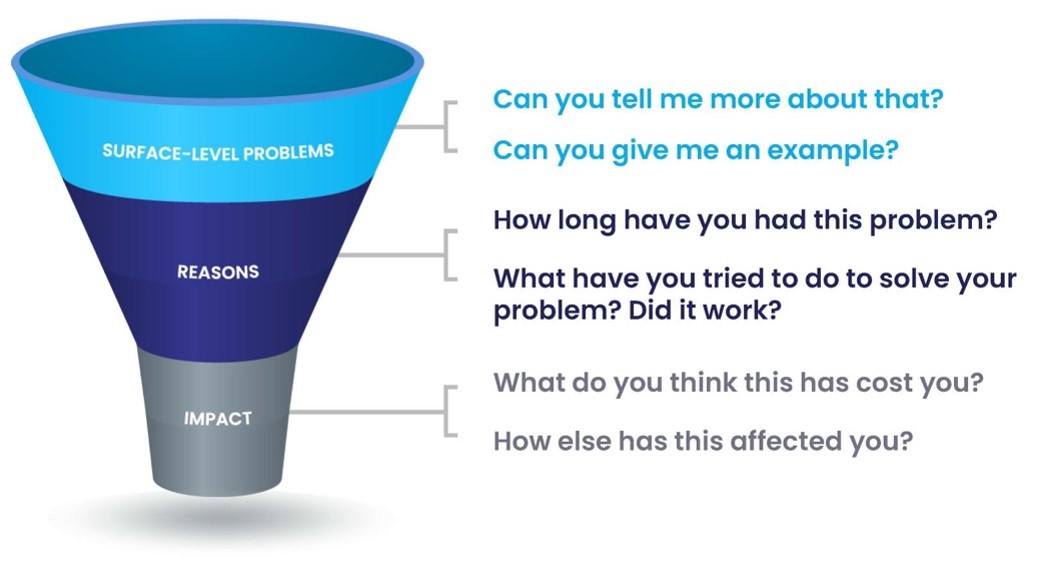 Strong discovery sounds conversational, which leads many new reps to assume it should be improvised. Experienced salespeople sound relaxed because they are following a structure they know well.
The Sandler Pain Funnel provides that structure. It moves from broad, surface-level questions toward the specific impact of a problem and the buyer's commitment to solving it. A rep working through the funnel with a prospect who mentioned staffing problems might ask:
- "You mentioned turnover on the service team. Can you say more about that?"
- "What's a recent example?"
- "When did this start?"
- "What have you tried so far?"
- "How did that work out?"
- "What do you estimate it has cost the company?"
- "How do you feel about that personally?"
- "Have you given up on trying to fix it?"
Each question depends on the answer before it. By the bottom of the funnel, the prospect has described the problem, its history, its cost, and its personal toll in their own words.
How does pre-call research improve discovery questions?
Research turns a generic question into a relevant one. Before a first meeting, a prepared rep has looked at the prospect's industry conditions, recent company announcements, open job postings, and the likely priorities of the person across the table. Two openers for the same meeting show the difference:
Without research: "How's business going?"
With research: "I saw you've posted six sales openings since spring. How is your team handling ramp time with that many new hires at once?"
The second question tells the buyer the rep did the work, and it starts the conversation at a level where real problems surface.
For sales leaders, a short pre-call planning template builds this habit faster than general reminders to do homework. A simple version asks the rep to list a few facts about the account, a hypothesis about the buyer's likely pain, and the first question they plan to ask.
Why should follow-up questions come from the buyer's last answer?
New salespeople often bring a list of questions and work through it in order. The meeting starts to feel like a survey, and buyers disengage quickly.
Better discovery is layered. The rep listens closely and builds the next question from what the prospect just said. An exchange might sound like this:
Prospect: "Our forecast misses have been getting worse."
Rep: "How far off were you last quarter?"
Prospect: "About 20 percent."
Rep: "What did that miss mean for the decisions leadership had to make?"
Prospect: "We put a hiring freeze in place."
Rep: "Who on your team felt that most?"
Every question in that exchange came from the prospect's own words. That kind of listening is what makes a buyer feel understood, and it uncovers information a scripted list would miss.
Can a salesperson ask too many questions?
Yes. Question volume is a poor measure of discovery quality. A rep who fires off twenty questions in thirty minutes leaves the buyer feeling interrogated, even when each question is solid on its own.
Good discovery feels like a working session between two people trying to understand a problem. Reps should pause, summarize what they've heard, and confirm they have it right before moving on. Those moments of reflection often prompt the buyer to add the detail that matters most.
How can sales leaders help new hires ask better questions?
A few consistent practices shorten the learning curve:
- Run weekly discovery role-plays, with managers playing realistic, guarded prospects.
- Review recorded calls for talk-time ratio and the depth of follow-up questions.
- Require a brief written pre-call plan for every first meeting during a new hire's first 90 days.
- Teach the Pain Funnel as a shared framework so coaching conversations use common language.
- Debrief after key meetings with a focus on what the rep learned about the buyer's situation.
New salespeople who learn to ask sharp, well-researched questions early build a pipeline that holds up through the later stages of the sale.
💡Better questions lead to better pipelines. Sandler by ForgePoint Group trains sales teams and sales leaders across the Greater New York area to master discovery from the first meeting. Learn more about our sales training programs and schedule a conversation with our team.