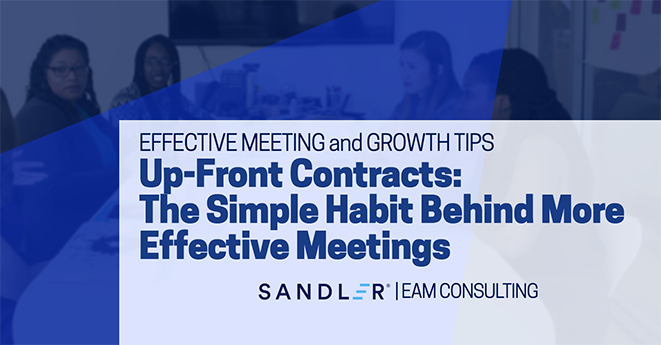
An up-front contract is a simple but powerful Sandler concept: before any meeting, all parties agree on exactly what will happen. It ensures everyone’s on the same page about expectations and behavior—no surprises, no confusion.
Too often, meetings start without clear direction. You think it’s about one thing; the other person thinks it’s about something else. That’s a recipe for wasted time and discomfort.
Creating comfort is key. It’s not just what you say but how you say it—tone, body language, and how you match the other person’s communication style. People with their defenses up won’t buy or engage openly. A good up-front contract prevents that by setting clarity and ease from the start.
The Five Elements of an Up-Front Contract
Purpose: Why you’re meeting.
Their agenda: What they want or expect.
Your agenda: What you want and what you’ll ask.
Time and logistics: When, where, and how long.
Outcome: The clear next step—even if it’s “no.”
When both sides know what to expect, meetings become more productive and less stressful.
The ANOT Framework
Use Sandler’s ANOT acronym to remember the flow:
Appreciate you taking the time.
Naturally, you’ll have questions.
Obviously, I’ll have some for you.
Typically, here’s how the process works.
For example:
“I appreciate your time today. Naturally, you’ll have some questions, and obviously, I’ll have some for you. Typically, this conversation helps us both see if we’re a good fit—no pressure, and ‘no’ is always okay.”
Up-front contracts can be used before, during, or even within a meeting when shifting topics. They build trust, save time, and help both sides feel comfortable saying “yes” or “no.” Practice often—it’s one of the simplest ways to make your meetings more effective and your sales process smoother.
Contact Sandler, Michigan, EAM Consulting if you need more help or have questioms.