Most salespeople believe speed wins deals. Get to the demo fast. Get the proposal out the door. Follow up until the prospect signs.
Yet the deals that move fastest are often the ones where the salesperson took the most time up front. When you slow down early to understand why a prospect wants to change, the rest of the sales process moves quickly. When you rush, you end up chasing, discounting, and hearing "let me think it over."
That's the idea behind one of the best-known tools in the Sandler Selling System: the Pain Funnel.
Why rushing to the pitch slows you down
When a prospect mentions a problem, the instinct is to jump in with a solution. It feels helpful. It feels efficient. But it creates three problems that lengthen your sales cycle:
- You solve the wrong problem. The first issue a prospect mentions is rarely the real one. It's the surface symptom.
- You lose leverage. Once you've presented, the prospect has what they need to shop you against competitors.
- You never learn the cost of doing nothing. Without that, there's no urgency, and the deal drifts.
In Sandler terms, the prospect has an intellectual interest, not an emotional reason to buy. People make buying decisions emotionally and justify them intellectually. If you haven't found the emotional reason, you don't have a qualified opportunity yet.
What is the Sandler Pain Funnel?
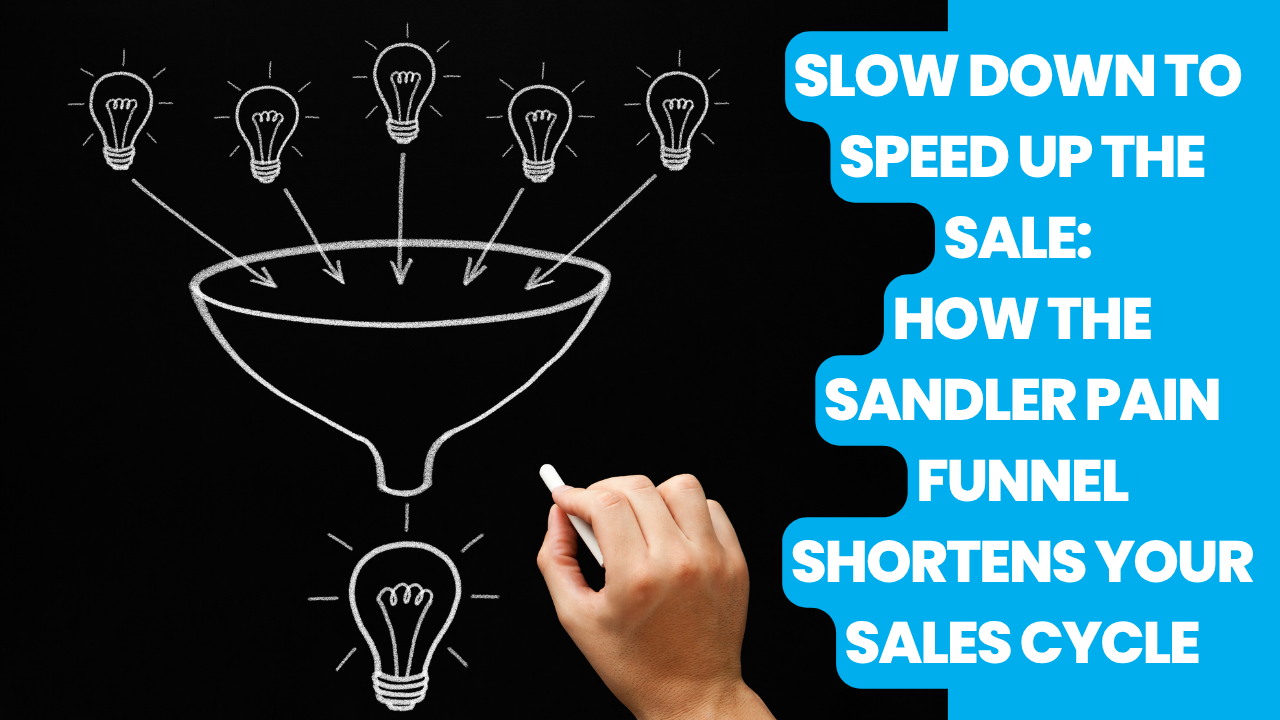
The Pain Funnel is a sequence of questions that moves a prospect from a broad, surface-level statement to the specific, personal impact of a problem. Picture a funnel: it starts wide and narrows. Each question takes the conversation one level deeper.
A typical progression looks like this:
- Open the topic: "Tell me more about that."
- Get specific: "Can you be more specific? Give me an example."
- Find the history: "How long has that been a problem?"
- Learn what's been tried: "What have you tried to do about it?" and "How did that work?"
- Quantify the cost: "How much do you think that has cost you?"
- Uncover the personal impact: "How do you feel about that?"
- Confirm commitment: "Have you given up trying to deal with the problem?"
The goal isn't to run a script. It's to help the prospect discover, in their own words, why this problem matters and why it matters now.
How the Pain Funnel speeds up the sale
The Pain Funnel feels slower in the moment. Here's why it shortens the overall sales cycle.
It qualifies, or disqualifies, early. If a prospect can't tell you what the problem costs or how it affects them, they may not be a real buyer. Finding that out in the first meeting saves you weeks of follow-up on a deal that was never going to close.
It builds urgency the prospect owns. When the prospect says, "We're losing about two deals a month because of this," that number belongs to them. You don't have to manufacture urgency. They've already convinced themselves.
It makes your presentation shorter and sharper. When you know the exact pain, you present only what solves it. No feature tours. No generic slide decks.
It reduces objections. Most objections are the result of unanswered questions. When pain is fully understood, the prospect has already worked through many of their doubts.
A Pain Funnel example
Imagine a sales director who says, "Our team isn't hitting quota."
A rushed salesperson responds: "We can help with that. Our training program improves quota attainment."
A Sandler-trained salesperson responds: "Tell me more about that."
The director explains that new hires take nine months to ramp. Pressed for specifics, they share that two of the last five hires left before reaching quota. Asked what that has cost, they estimate roughly $400,000 in lost revenue and recruiting costs. Asked how they feel about it, they admit their own job is on the line if the next quarter looks the same.
Now the salesperson isn't selling "training." They're solving a ramp-time problem that threatens the director's role. That's a very different conversation, and a much faster close.
Common Pain Funnel mistakes
- Interrogating instead of conversing. Use softening statements like "That's a good question" or "I'm curious about something." Nurture the prospect as you go deeper.
- Stopping too soon. Most salespeople stop at step two. The real reason to buy usually surfaces at steps five through seven.
- Leading the witness. Your job is to help the prospect find their pain, not to tell them what it is.
- Jumping to a solution mid-funnel. Resist the urge. Every time you present early, you give back control.
Slow down to speed up
The Pain Funnel asks you to do something counterintuitive: hold back your solution and keep asking questions. It takes discipline. But salespeople who master it spend less time chasing unqualified prospects and more time closing deals that were real from the start.
Questions are the engine of the Pain Funnel. In our next post, we'll look at the sales questioning techniques that make conversations like this feel natural. [Link to Post 2]
Ready to sharpen your discovery process? Contact your local Sandler trainer to learn how the Pain Funnel can help your team qualify faster and close more.
.png)