The Arc of Success
Most sales leaders talk about momentum as if it is something you can install, but momentum is earned. It only shows up after your team pushes through their initial resistance.
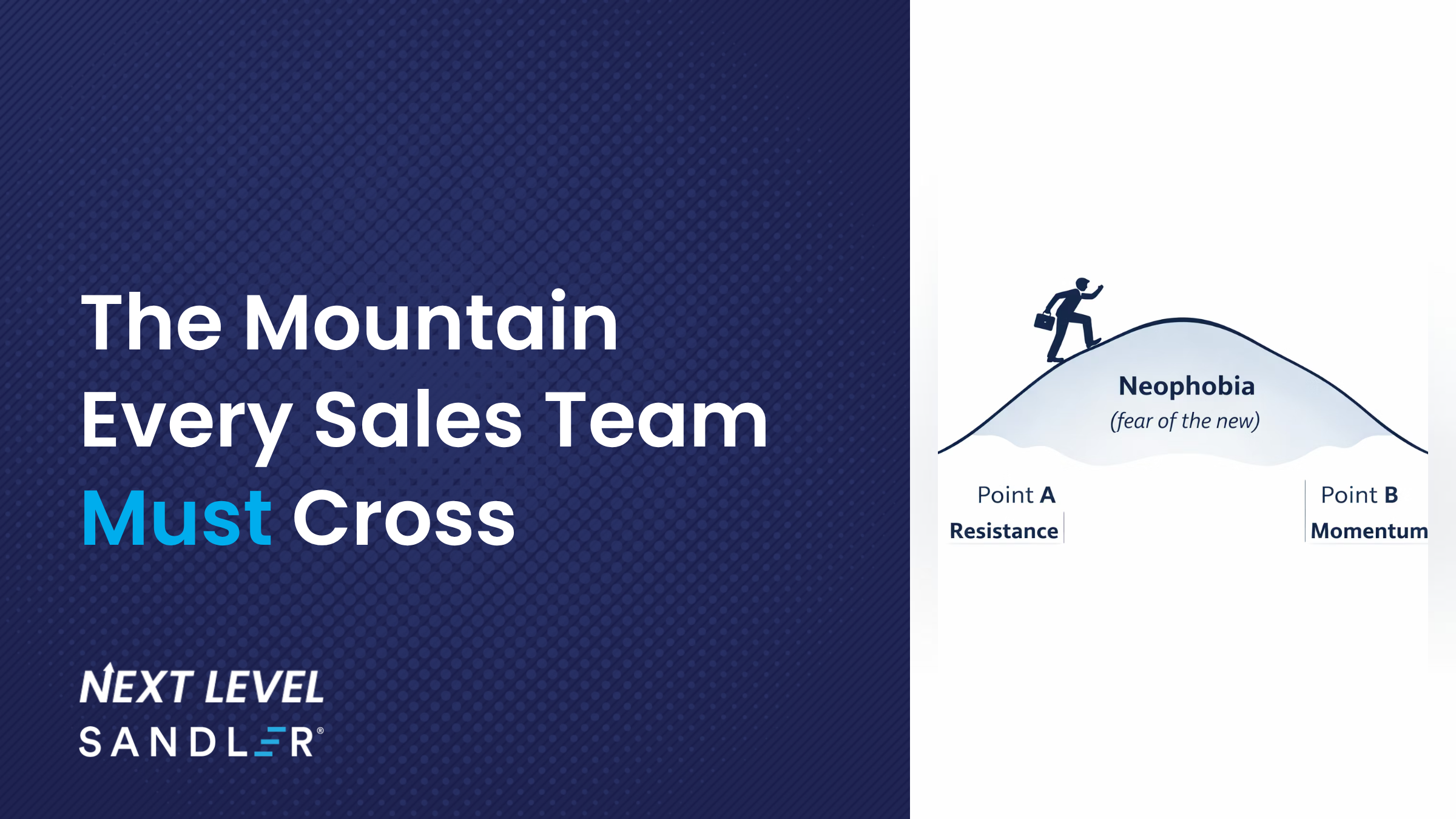
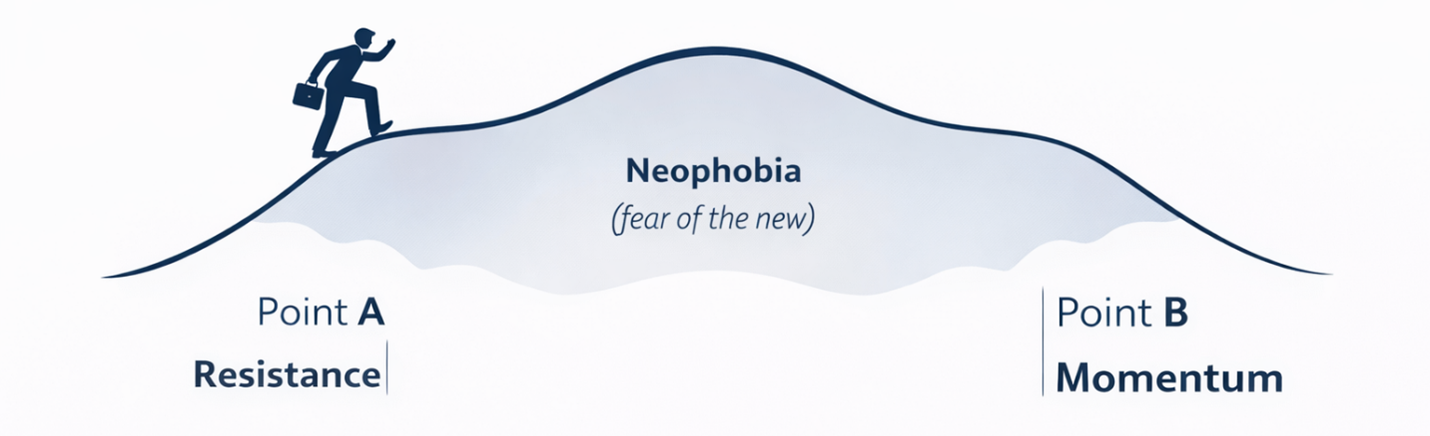
Every meaningful sales transformation follows the same shape. It is not a straight line from Point A to Point B. It is an arc.
We call it the Arc of Success.
At the beginning of the journey, your team is standing at the base of a mountain.
On the other side of the ridge sits momentum. Consistency. Control. Better conversations. Stronger pipelines.
But to get there, your team must climb past the point of resistance and overcome Neophobia, the fear of something new.
The Uphill Side of the Arc
The first half of the journey is uphill. This is where resistance lives, the hesitation to change, and the inertia of your existing culture.
When you introduce a new sales process, a new way of running meetings, or a new expectation around client conversations, you are asking people to change behavior. You are asking them to think differently, act differently, and, in many cases, feel uncomfortable.
Behavioral science calls that discomfort neophobia, the natural hesitation people feel toward anything new. It shows up in subtle ways.
- People go quiet in meetings.
- They default back to old habits.
- They say they understand, but their behavior does not change.
This is the climb, and this is where most organizations stall and start to revert to their old ways.
Not because the strategy is flawed. Not because the team lacks capability. They stall because the uphill portion of the arc requires new skills, energy, discipline, and belief before results show up.
Without structure, people stop climbing.
The Inflection Point
Every mountain has a peak, and every change initiative has a midpoint. This is where things start to shift.
If your team can push through the resistance far enough, behaviors start to feel more natural. Conversations become more fluid. Confidence begins to build. The work is still required, but it no longer feels as heavy.
This is the inflection point. It is also where most leaders make critical mistakes. They assume the team is now “good.” They stop reinforcing. They stop coaching with intensity. They shift focus back to short-term results.
That is like stopping halfway up the mountain and expecting gravity to take over. Momentum does not begin until the team crosses the peak.
The Downhill Side of the Arc
Once your team gets over the top, the dynamic changes. This is where momentum lives. Behaviors become habits. Language becomes natural. The process becomes part of how the team operates.
Deals move more efficiently. Forecasts become more reliable. The team starts to build confidence from real results, not just intention. What once required effort now starts to create energy.
But to get here, success must be engineered, coached, and led, like a good sherpa leading you up the mountain. Great leaders and managers know how to coach their team to success.
The Structure Behind the Arc
At Next Level, we never recommend relying solely on motivation to get teams up the mountain. We rely on structure.
The structure is the Coaching Triangle: Attitude, Behavior, and Technique.
Most organizations focus on technique. They teach what to say, how to ask questions, and how to run a meeting. And then, they expect everyone to overcome resistance on their own.
Technique matters, but it is not enough to get someone up the hill.
Behavior is what drives progress. The willingness to make the call, ask the tough question, and hold the line in a conversation. And…
Attitude determines whether those behaviors occur consistently, especially when they feel uncomfortable.
If attitude is weak, behavior becomes inconsistent.
If behavior is inconsistent, technique never gets applied.
The change initiative dies on the resistance side of the mountain.
When all three are aligned, something changes. The triangle becomes the support system that allows your team to continue climbing.
Why Reinforcement Matters
Crossing the Arc of Success requires coaching.
We focus on continuous reinforcement, coaching, and accountability because they keep teams moving upward when the climb gets difficult.
Leaders play the central role here.
Your team will not push through resistance because they were told to. They push through because expectations are clear, coaching is consistent, and the structure supports them. As a leader, you must push through the resistance first.
What This Means for Sales Leaders
If your team is not experiencing momentum, the answer is not more activity. It is not another tool. It is not a better script.
The answer is understanding where they are on the arc.
- Are they at the base of the mountain, preparing to climb?
- Are they in the middle, feeling the weight of resistance?
- Or are they close to the top, where momentum is about to take hold?
Each stage requires a different level of leadership. The mistake is treating all stages the same. The leaders who get this right do something simple. They commit to helping their team climb.
- They reinforce attitude.
- They coach behavior.
- They teach technique.
And they do it long enough for the team to cross the peak.
One question to consider:
Where is your team on the Arc of Success right now, and what are you doing to help them get over the top?